Tribeca Synagogue
49 White Street | also 47 White Street | Tribeca | built 1967
Open on the map9 entries

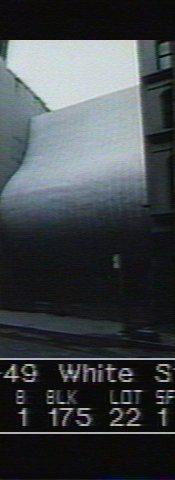
The city photographed every building for its tax records around 1940 and again in the 1980s. NYC Municipal Archives.
Written with AI from the source each entry cites, then fact-checked.
- 1938
Jacob Rosenblum, an aide to District Attorney Dewey, founds the Civic Center Synagogue for downtown workers
Jacob J. Rosenblum, a special assistant to Manhattan District Attorney Thomas E. Dewey, saw that Jewish lawyers, civil servants and textile workers downtown had no nearby place to pray on weekdays. In 1938 the Civic Center Synagogue began in a loft above a storefront and held services Monday through Friday. It is the congregation that later built 49 White Street.
Source: tribecasynagogue.org
- 1964
The congregation hastily leaves its Duane Street home after pile driving for 26 Federal Plaza damages it
The Civic Center Synagogue had built itself a proper home on Duane Street in 1957. Seven years later it had to be vacated in a hurry, after that building and nine others were found to be settling dangerously from pile driving for the new 26 Federal Plaza. The congregation then found a parcel on White Street and hired architect William N. Breger.
Source: Internet Archive
- 1965
A stone-faced textile loft building stands on the lot before the synagogue replaces it
The Landmarks Commission reports that the Civic Center Synagogue at 47-49 White Street replaced a stone-faced store and loft building used by textile firms. The synagogue was built in 1965-67.
- 1967
William Breger's marble-faced, curving synagogue opens on White Street
Architect William N. Breger designed the two-story synagogue, about fifty feet wide and a hundred deep, which was finished in 1967. The Landmarks Commission calls its style neo-Expressionist, citing the undulating surface faced in marble tile, set on a small base of brick piers and a metal-and-glass entrance. Beyond the sanctuary, the building holds offices, meeting rooms, a kitchen and a social hall.
“The neo-Expressionist style of the structure is clearly exhibited in its undulating surface and bold, geometric form. Faced in marble tile…”
- 1967
A Pratt architecture chairman who mostly designed nursing homes shapes the sanctuary as an eternal flame
The congregation hired William N. Breger, a Bronx-born, Harvard-educated chairman of the architectural design department at Pratt Institute whose specialty was nursing homes. He chose an abstract eternal flame as his motif. The New York Times later observed that the synagogue was effectively the one memorable building on his roster, and that it has drawn attention for three generations.
Source: Internet Archive
- 1967
The curved sanctuary lets an Orthodox congregation be heard without electrical amplification on the Sabbath
Orthodox practice bars electrical amplification on the Sabbath, and the sanctuary's curve solves that: in 2015 a New York Times writer standing in the rear gallery heard the synagogue's president at the front as clearly as if closer by fifty feet. The writer compared the effect to the whispering gallery at Grand Central Terminal. The wood-paneled concave interior also shelters the ark.
Source: Internet Archive
- 1989
A new rabbi turns a shrinking congregation into the Synagogue for the Arts
Rabbi Jonathan W. Glass was called to the synagogue in 1989, a time of crisis, with membership falling quickly and talk of demolishing the building. Noticing local artists and a fine performance space, the congregation rebranded itself as the Synagogue for the Arts. Artists made up roughly half of its members, and the sanctuary hosted events such as poetry readings.
Source: Internet Archive
- 2013
The congregation takes the name Tribeca Synagogue
In 2013 the congregation formally adopted the name Tribeca Synagogue, replacing Synagogue for the Arts, which had replaced Civic Center Synagogue. The congregation says the new name reaffirmed its connection to the neighborhood. By then it offered daily and holiday services, community events and a Hebrew School.
Source: tribecasynagogue.org
- 2015
Architect William Breger dies at 92 and leaves the synagogue a significant bequest
William N. Breger died on February 23, 2015, at 92. He had long objected to changes to his building, including a mechitza he disliked and the paving over of M. Paul Friedberg's landscaped plaza, yet he left the synagogue what its president called a significant bequest. His obituary suggested memorial gifts to the congregation, and the plaza is named in his honor.
Source: Internet Archive
Further reading
- TriBeCa SynagogueWikipedia
Nearby
- 51 White Street1 entry
- E. R. Mudge, Sawyer & Co. Building45 White Street | 5 entries
- 78 Franklin Street1 entry
- 80 Franklin Street1 entry
- 76 Franklin Street2 entries
- 82 Franklin Street1 entry