496 Avenue of the Americas
Greenwich Village | built 1900
Open on the map4 entries

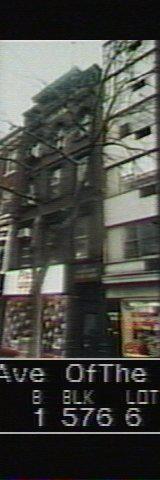
The city photographed every building for its tax records around 1940 and again in the 1980s. NYC Municipal Archives.
Written with AI from the source each entry cites, then fact-checked.
- 1842
Future police commissioner Thomas C. Acton lives here while working as a school janitor
In 1842 the Acton family boarded in the house then numbered 180 Sixth Avenue. Thomas worked as a janitor at Grammar School No. 35 on West 13th Street, but the Greenwich Village native soon rose to deputy clerk and Deputy Register. In 1860 he became a police commissioner of the Metropolitan Police, and The Times later called him the city's most prominent public official.
Source: Daytonian in Manhattan
- 1867
A blacksmith named Boch at 180 Sixth Avenue wounds himself by pushing a pistol into his forge
Leonhard Boch leased the building in 1863 and ran a blacksmith shop in the rear. A December 1867 newspaper item reported that Michael Boch of 180 Sixth Avenue had been hurt after thrusting a pistol into his forge without checking whether it was loaded. The paper called him "another blacksmith" to be wounded this way.
Source: Daytonian in Manhattan
- 1889
Rosanna Smith buys the old boarding house and has it remade in neo-Grec and Queen Anne style
Smith, who lived across the street, paid $28,100 for 180 Sixth Avenue. Architects A. B. Ogden & Son raised the attic to a full story, added fluted cast-iron pilasters to the storefront, bracketed brownstone cornices over the second-floor windows and arched top-floor windows. A stone plaque below the cornice announced the date 1889.
Source: Daytonian in Manhattan
- 1892
A gospel mission and a photography studio move in during the 1890s
By 1892 the Sixth Avenue Gospel Mission worked from an upper floor, above a restaurant run by Caroline C. Nicholas. By 1898 it was joined by the photography studio of Otto C. Wurst, who advertised the studio for sale in 1906, citing ill health after eighteen years. An earlier photographer, E. J. Lecocq, had worked here in the late 1870s.
Source: Daytonian in Manhattan
Further reading
- An 1889 Make-Over -- 496 Sixth AvenueDaytonian in Manhattan
Nearby
- 52 West 13th Street2 entries
- Jacob Day Residence50 West 13th Street | 10 entries
- 80 West 12th Street4 entries
- 59 West 12th Street3 entries
- 472 Avenue of the Americas1 entry
- E. H. Purdy & Co. Building42 West 13th Street | 5 entries