Jacob Day Residence
50 West 13th Street | Greenwich Village | built 1901
Open on the map10 entries

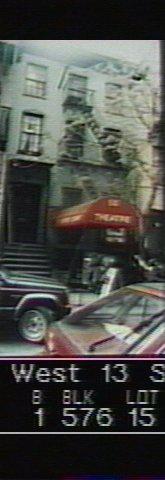
The city photographed every building for its tax records around 1940 and again in the 1980s. NYC Municipal Archives.
Written with AI from the source each entry cites, then fact-checked.
- 1846
A Greek Revival row house goes up for William B. Fash
The house at 50 West 13th Street was built between 1845 and 1846 for William B. Fash, and the house and lot were assessed at $2,500. The report describes it as a Greek Revival row house, a style that flourished in America from the 1830s through the 1850s and spread through carpenters' guides and pattern books. Day bought it about a decade later.
“50 West 13th Street was built, as a freestanding row house, between 1845 and 1846, for William B. Fash…”
- 1857
Jacob Day, a Black caterer, buys the house and runs his business from the basement
Jacob Day bought 50 West 13th Street in August 1857, when the lot stood beside an open coal yard. His catering firm grew into one of the city's most successful Black-owned businesses of its kind, at a time when catering was among the few business paths open to Black New Yorkers. Day belonged to the Caterer's Club alongside Joseph Ten Eyck and John Van Dyke, and advertised in the Jewish Messenger and the Brooklyn Daily Eagle.
- 1863
Jacob Day, a documented abolitionist, registers for Union Army service
In 1863 Jacob Day registered to serve in the Union Army but was never called up. Records show he belonged to the National Anti-Slavery Society, and he was an important figure at Abyssinian Baptist Church; he had served as a delegate to Colored Conventions in 1840 and 1843. After the war he joined the Freedman's Bank, and an 1866 Anti-Slavery Standard article names him as a representative of a convention committee planning a mass meeting in the city.
“Day registered to serve in the Union Army in 1863, however, he was not called into service.”
- 1863
Educator Sarah J. Tompkins Garnet, one of the first Black women to lead a city school, lodges in the house
Sarah J. Smith Tompkins Garnet, later known as an abolitionist and suffragist, lived at 50 West 13th Street through the 1860s and into the early 1870s, according to Board of Education records. In 1863 she was appointed one of the first Black female principals in the city's public school system, at Colored School No. 4. The educators Sarah Douglas and Emma Smith also lived in the house during those years.
- 1884
Jacob Day dies worth about $200,000, and his sons keep the catering firm going
When Day died in 1884 he was worth an estimated $200,000, about $6 million in 2024 money, and owned property in Manhattan, Brooklyn and Long Island. His sons carried on the catering business at the house until 1896.
- 1890
Thousands file past the bier of James Mason, who died in the house
James Mason, an elevated-railroad porter who rented the house from the Day family, died there of pneumonia on December 13, 1890, aged 49. Known for his work with benevolent societies, he had joined Bethel A.M.E. Church that November at his wife's urging. The New York Times reported that probably no Black man in the city had ever been buried with such ceremony: his body lay in state at Bethel Church while thousands of people passed by, and the Masonic lodges and other societies attended in full regalia.
Source: Daytonian in Manhattan
- 1960
The 13th Street Theatre opens in the basement, with Barry Manilow as musical director for some shows
A 1959 renovation redesigned the basement and the rear building as a theater and turned the first floor into a theater school. From 1960 to 1970 the Off-Off-Broadway 13th Street Theatre, started by Bro Herrod, staged shows there. Several productions, among them The Drunkard, had Barry Manilow as musical director.
- 1968
The Afro-American Folklore Troupe plays weekly shows in the basement theater
In 1968 the Afro-American Folklore Troupe, a company created by four artists (Stella Beck, Charles C. Thomas, Norman Jacobs and Marc Primus) that performed from 1963 until the mid-1970s, had a short stay here with weekly programs of poetry, prose and folklore. The troupe toured nationally and became known for staging works by African American writers, among them Langston Hughes, Countee Cullen, Leroi Jones and James Weldon Johnson, along with blues, spirituals, work songs and gospel.
“…the Afro-American Folklore Troupe had a temporary engagement at 50 West 13th Street.”
- 1972
Edith O'Hara's 13th Street Repertory Company begins a 48-year run, including a record-length play
From 1972 to 2020 the house was home to the 13th Street Repertory Company, one of the city's oldest Off-Off-Broadway theaters, founded by veteran producer Edith O'Hara. She lived in the upper part of the house until her death in 2020 at 103. Bette Midler, Barry Manilow, Chazz Palminteri, Amy Stiller and Richard Dreyfuss are among those linked to its stage, and Israel Horovitz's play Line ran close to 45 years, the longest Off-Off-Broadway run on record.
- 2024
The Landmarks Commission hears 11 speakers in favor of landmarking the Jacob Day Residence
The commission calendared the house on June 18, 2024 and held a public hearing on September 10. Eleven people spoke in favor, among them representatives of the Landmarks Conservancy, the Historic Districts Council, the Victorian Society and Village Preservation, and no one spoke in opposition. Council Member Carlina Rivera submitted written support, along with a petition of 105 campaign letters.
Further reading
- The Jacob Day House - 50 West 13th StreetDaytonian in Manhattan
Nearby
- 52 West 13th Street2 entries
- E. H. Purdy & Co. Building42 West 13th Street | 5 entries
- 59 West 12th Street3 entries
- Quad Cinema34 West 13th Street | 3 entries
- Arnhold Hall55 West 13th Street | 5 entries
- 496 Avenue of the Americas4 entries