Wood's Mercantile Buildings
50 White Street | Tribeca | built 1867
Open on the map4 entries

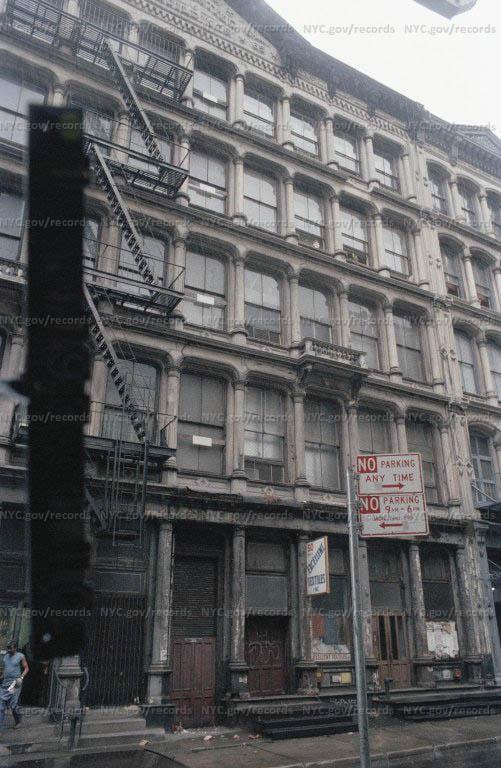
The city photographed every building for its tax records around 1940 and again in the 1980s. NYC Municipal Archives.
Written with AI from the source each entry cites, then fact-checked.
- 1865
Brooklyn merchants Samuel and Abraham Wood build three five-story stores and unite them as one
Dry-goods merchants Samuel and Abraham Wood, who lived in Brooklyn, put up three five-story buildings at 46 and 48-50 White Street in 1865-67 and joined them into one seventy-five-foot-wide structure. The base is a cast-iron storefront made by the J.B. and W.W. Cornell foundry, topped by marble-faced upper floors in the Second Empire style. The brothers also commissioned the neighboring No. 58 around the same time.
- 1865
The Woods' warehouse is a simple marble palazzo with a cast-iron base that later builders copied
The Landmarks Commission describes the Woods Mercantile Buildings as marble, five stories high and ten windows wide, with a cast-iron ground floor of Tuscan columns and a pediment bearing the name and the date 1865. Its plain, repeated window bays became a model: the commission points to No. 60 White Street (1869) and 385 Broadway (1875) as later buildings that imitated it. The aim of such facades was to look like stone while going up quickly and cheaply.
- 1900
The Wood family keeps the White Street building for nearly a century
Read more
The Woods' importing business became Wood's Dry Goods Commission Agency, headquartered on Broadway by the early twentieth century. The White Street property stayed in the family for almost a hundred years, housing importers and jobbers of dry goods and clothing, among them J.R. Leeson and Company, billed as the country's largest linen-thread importing house. A firm that stored, mixed and sold dry dyes came later.
- 1978
The upper floors of the Wood's Mercantile Buildings are converted to apartments
Between 1978 and 1984 the upper stories of 46 and 48-50 White Street, long used by dry-goods and dye firms, were converted to residential use under an alteration filed in 1978 by architect Vincent Trocchia. The ground floor stayed commercial, with a textile firm as the occupant when the Landmarks Commission surveyed the district.
Nearby
- 52 White Street5 entries
- Wood's Mercantile Buildings46 White Street | 3 entries
- 44 White Street5 entries
- 54 White Street2 entries
- 42 White Street2 entries
- 58 White Street5 entries