52 White Street
Tribeca | built 1868
Open on the map5 entries

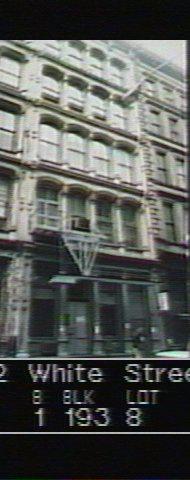
The city photographed every building for its tax records around 1940 and again in the 1980s. NYC Municipal Archives.
Written with AI from the source each entry cites, then fact-checked.
- 1866
A woman leaves her three young children at the Woolf & Sternback store at 52 White Street
In August 1866 a thief was caught at Woolf & Sternback's store, 52 White Street, and jailed after the management pressed charges. About two weeks later the New York Dispatch reported that a woman named Heyman had left her three small children, the youngest nine months old, at the store, saying the firm was to blame for her husband's imprisonment. The altered house the firm used was already slated for demolition, so this was an earlier building on the site.
Source: Daytonian in Manhattan
- 1868
Henry Fernbach designs a marble Second Empire loft for the Sternberger brothers
The 30-foot-wide building was designed by Henry Fernbach for brothers Mayer and Simon Sternberger, who owned a shirt company and turned to banking some years afterward. On the lot stood a frame building in front and an industrial building behind, and both gave way to it. Its marble front rises above a cast-iron storefront, and a pediment on the cornice carries the date 1866.
“Designed by Henry Fernbach and erected in 1866-68, it was commissioned by brothers Mayer and Simon Sternberger…”
- 1897
Textile importer Arion M. Warner dies; his firm stays at 52 White Street until 1913
Arion Marcellus Warner, born in Connecticut in 1843, headed A. M. Warner & Co., which imported household textiles such as piano covers and Irish linens. He left the office early in 1897 with stomach pains and died on March 30 after a long illness. The firm carried on here, importing and making tablecloths with two men and 26 women by 1901, until it moved to 569-575 Broadway on February 1, 1913.
Source: Daytonian in Manhattan
- 1973
Binghamton film students found the Collective for Living Cinema, an avant-garde venue at 52 White Street
The Collective for Living Cinema began in 1973 as an artist-run cooperative, started by film students from Binghamton University. Among the founders were Ken Ross, Philip Weisman, Lushe Sacker, Mark Graff and Andrea Graff. It showed filmmakers working outside the commercial mainstream, among them Ken Jacobs, Nick Zedd and Yvonne Rainer, and also published film journals.
Source: Wikipedia
- 1974
Artists' lofts fill the upper floors while the Collective for Living Cinema screens films below
In 1974 the upper floors were converted into joint living and working quarters for artists, one per floor, and the former store space became home to the Collective for Living Cinema. It ran filmmaking workshops and showed films weekly; in February 1976 it screened the 1934 musical Wonder Bar with Al Jolson. In 1985 The New York Times described its programs as avant-garde, foreign and generally neglected films.
Source: Daytonian in Manhattan
Further reading
- Henry Fernbach's 1868 52 White StreetDaytonian in Manhattan
Nearby
- Wood's Mercantile Buildings50 White Street | 4 entries
- 54 White Street2 entries
- Wood's Mercantile Buildings46 White Street | 3 entries
- 58 White Street5 entries
- 60 White Street3 entries
- 44 White Street5 entries