Grant's Tomb
501 Riverside Drive | Morningside Heights | built 1897
Open on the map21 entries

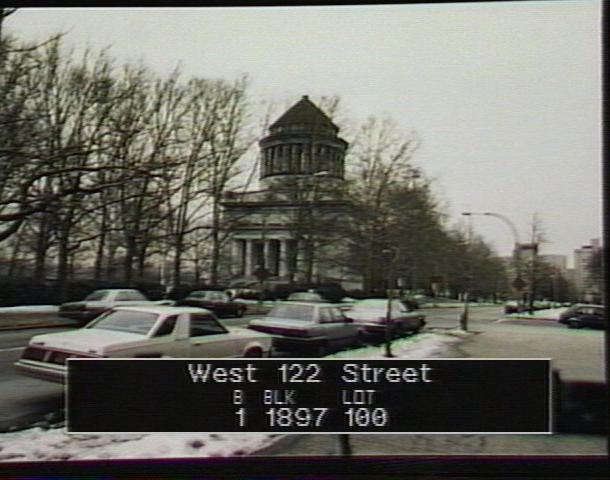
The city photographed every building for its tax records around 1940 and again in the 1980s. NYC Municipal Archives.
Written with AI from the source each entry cites, then fact-checked.
- 1885
Ulysses S. Grant is interred in a temporary tomb at Riverside Park
Ulysses S. Grant died on July 23, 1885, and his family chose a bluff in Riverside Park for his permanent memorial. He was interred on August 8, 1885, in a temporary tomb designed by Jacob Wrey Mould, following a funeral procession that drew as many as 1.5 million spectators.
Source: Wikipedia
- 1890
John H. Duncan wins the Grant tomb competition with a design echoing the Mausoleum at Halicarnassus
In 1890 the Grant Monument Association chose architect John H. Duncan, designer of Brooklyn's Soldiers' and Sailors' Memorial Arch, over four other invited firms, including Carrere & Hastings, for a tomb costing about $500,000. His stepped roof borrowed from reconstructions of the Mausoleum at Halicarnassus. The Landmarks Preservation Commission says his plan reportedly won because construction could stop at either of two points if money ran out: after the crypt or after the main body.
“…reportedly chosen because work could be halted at either of two points if funds ran out: after the construction of the crypt…”
- 1891
Construction begins on Grant's permanent mausoleum
Workers broke ground for architect John H. Duncan's design on April 27, 1891, Grant's would-be 69th birthday, after a national fundraising campaign and design competition. President Benjamin Harrison laid the permanent cornerstone exactly a year later, and the granite-and-marble mausoleum, modeled on the ancient Mausoleum at Halicarnassus, took six more years to complete.
Source: Wikipedia
- 1892
President Benjamin Harrison attends the cornerstone ceremony, and the afternoon becomes a state holiday
On what would have been Grant's 70th birthday, President Benjamin Harrison attended the laying of the cornerstone in 1892, and the city took the afternoon off as a state holiday. Sealed in the stone are copies of the nation's founding documents, a Bible, Grant's memoirs, a pamphlet from the 1886 Memorial Day observance, the mayor's proclamation, medals and newspapers. The commission notes that Columbia University and other institutions were by then acquiring land around the lonely site.
“On April 27, 1892, President Benjamin Harrison attended a ceremony marking the laying of the cornerstone. The afternoon of that day was declared a state holiday.”
- 1892
A two-month drive raises $350,000, helping the fund reach $600,000 from 90,000 donors
After years of stalled giving, Horace Porter, who took over the Grant Monument Association in 1892, enlisted businessman Edward F. Cragin to raise $350,000 in four weeks. The campaign used newspaper ads, public donation boxes and 185 committees, and the total passed $500,000 by the end of May, mostly from New Yorkers. Fundraising continued into 1893, when the fund reached $600,000 from over 90,000 individual donors, described as the world's largest fundraiser of its time.
“Fundraising continued through early 1893, at which point $600,000 had been raised from over 90,000 individual donors…”
Source: Wikipedia
- 1897
About a million people turn out for the dedication of Grant's Tomb
The mausoleum of Ulysses S. Grant was dedicated on what would have been his 75th birthday, five years to the day after President Benjamin Harrison laid its cornerstone. More than 90,000 donors had given about $600,000 to build it. An estimated one million spectators came despite poor weather, and over 50,000 marchers paraded from Madison Square Park. Architect John Hemenway Duncan modeled it on the Mausoleum at Halicarnassus.
Source: Wikipedia
- 1897
Chinese diplomat Yang Yu plants a ginkgo tree for Li Hongzhang, who had met Grant on his world tour
Ten days after the tomb's dedication, former Chinese minister Yang Yu put a ginkgo tree in the ground on the site of Grant's temporary tomb. He acted for Li Hung Chang, the Chinese viceroy who had met Grant during the former president's world tour. The tree was soon followed by a Chinese cork tree and a plaque inscribed in Chinese and English.
Source: grantstomb.org
- 1902
Julia Dent Grant is placed in the second sarcophagus beside her husband
On December 20, 1902, twenty-five aging Civil War veterans kept guard while electric lights shone on the two red granite sarcophagi for the first time. A derrick hoisted the five-ton lid of one just far enough to slip in the coffin of Julia Dent Grant. More than a thousand New Yorkers waited in the cold rain outside during private services the next day. The Daily News credits her insistence that her husband's wishes be honored with bringing the tomb to New York at all.
Source: nydailynews.com
- 1906
Grant's Tomb draws a record 607,484 visitors in 1906, more than the Statue of Liberty drew in its early years
In its early days Grant's Tomb ranked among the country's most visited buildings. Annual attendance often topped 500,000 and peaked at 607,484 in 1906, according to the Grant Monument Association's history of the site. The association says the tomb out-drew the Statue of Liberty through World War I.
Source: grantstomb.org
- 1938
WPA workers carry out a simplified version of John Russell Pope's plans and move the eagles
The Grant Monument Association hired John Russell Pope in 1929 to complete the facade with a pediment and candelabra, but the Depression kept his plans from being built. In 1938 the Works Progress Administration finally carried out restorations under Aymar Embury II, who followed Pope's plans closely but simplified them to save money. The two eagles, which had stood on large blocks at the ends of the parapet, were moved to the wing-walls beside the entrance steps.
“In 1938 they were moved to their present position when the W.P.A. carried out some restorations and alterations.”
- 1942
Tarpaulins cover the sarcophagi at night during World War II air-raid precautions
After the United States entered World War II, the Grant Monument Association considered closing the monument but kept it open. From 1942 to 1945 tarpaulin sheets covered the sarcophagi at night as a precaution against air raid damage. A silk sheet donated by Japanese citizens was taken away in 1944, and vandals damaged the cork tree beside the tomb in 1942.
“…the sarcophagi were covered by tarpaulin sheets at night between 1942 and 1945 to protect them from air raid damage…”
Source: Wikipedia
- 1959
The National Park Service takes over Grant's Tomb
After New York's governor signed a bill transferring the tomb's land to the federal government in 1956 and President Eisenhower approved the operational transfer in 1958, the National Park Service formally assumed management of Grant's Tomb on May 1, 1959. The site had already recorded more than 18.6 million visitors under its previous private caretakers.
Source: Wikipedia
- 1966
Allyn Cox's mosaic murals are dedicated as the last major addition to the monument
The Grant Monument Association, formed in 1885 to build the tomb, handed the site to the National Park Service in 1959 and dissolved in 1965. Before dissolving, it secured the installation of mosaic murals by Allyn Cox in the three lunettes inside the memorial, which were dedicated in 1966. The Grant's Tomb site's history calls them the last major addition to the monument.
Source: grantstomb.org
- 1970
The Park Service destroys the bronze trophy cases and paints over Dean Fausett's murals
Under a plan adopted around 1969, the National Park Service destroyed the bronze trophy cases that the tomb's architect had designed for the two reliquary rooms. In 1970 Dean Fausett's murals, painted in the 1930s and still in good condition, were covered in raspberry and blue paint, and captioned photo exhibits went up in their place. The Grant Monument Association says drawings from the original design competition and records of early donors were also discarded or lost.
Source: grantstomb.org
- 1972
Artist Pedro Silva and thousands of volunteers build mosaic benches around the tomb
The National Park Service commissioned a 400-foot run of mosaic tile benches around the memorial to mark the 100th anniversary of Grant's designation of Yellowstone as the first national park. Chilean-born artist Pedro Silva led the work with other artists and thousands of volunteers, including local families, Columbia students and graffiti crews, from 1972 to 1974. CITYarts has restored the benches every year since 1994.
Source: cityarts.org
- 1975
The Landmarks Preservation Commission designates the General Grant National Memorial
On November 25, 1975, after a September hearing at which a National Park Service representative spoke in favor and no one opposed, the Landmarks Preservation Commission designated the memorial and its Riverside Drive lot a New York City landmark. The designation excluded the interior. The report ranks the tomb among the city's most impressive monuments, with a striking site above the Hudson River and Riverside Park.
“The representative of the National Park Service spoke in favor of designation. There were no speakers in opposition to designation.”
- 1979
Attendance bottoms out near 35,000 as graffiti and vandalism overwhelm the tomb
The memorial was regularly vandalized and covered in graffiti by the 1970s, and homeless people, drug users and muggers made it a haunt. By 1979 yearly visits had fallen to a little over 35,000. The Park Service could not keep up with the damage: the stone eagles were broken so often that staff stocked several spare beaks as replacements.
“…annual patronage bottomed out at just over 35,000 in 1979…”
Source: Wikipedia
- 1993
Columbia student Frank Scaturro goes public with a report on the tomb's neglect
Frank Scaturro, a Columbia University student who volunteered at Grant's Tomb in the early 1990s, spent two and a half years reporting problems to his National Park Service supervisors without success. In the fall of 1993 he sent a report to the president and Congress documenting its deplorable condition and proposing restoration, which drew national media attention. With backing from the Grant family and the last surviving member of the old association, he founded a new Grant Monument Association.
Source: grantstomb.org
- 1994
A lawsuit and an Illinois resolution threaten to move the Grants out of New York
In 1994 the new Grant Monument Association and a Grant family representative filed suit against the Interior secretary and park officials to compel a restoration, aided by attorney Edward S. Hochman. The association also disclosed that Grant's descendants intended to re-inter his remains unless the government restored the tomb. The Illinois legislature added pressure with a resolution demanding that the Grants be moved to Illinois if the tomb was not restored.
Source: grantstomb.org
- 1997
The restored tomb is rededicated on its centennial after a $1.8 million restoration
Under pressure, the government added nighttime security, tripled the tomb's operating budget and appropriated about $1.8 million for a restoration before the 1997 centennial. The work included cleaning off graffiti, repairing the roof and water damage in the rotunda, and replacing the deteriorating granite plaza. The Park Service also restored the Fausett murals and installed new bronze trophy cases. On April 27, 1997, the tomb was rededicated.
Source: grantstomb.org
- 2011
The restored overlook pavilion reopens across Riverside Drive with a gift shop and visitor space
The neoclassical overlook pavilion across the street from the tomb, once the site's public restrooms, stayed in disrepair for 14 years after the centennial restoration. It reopened on April 27, 2011, during Grant's birthday commemoration, after a 10 a.m. ceremony and ribbon-cutting. The restoration added a gift shop, a room for presentations, two one-person restrooms and extra office space for the National Park Service.
Source: grantstomb.org
Further reading
- Grant's TombWikipedia
Nearby
- International House500 Riverside Drive | 11 entries
- Riverside Church490 Riverside Drive | 13 entries
- Manhattan School of Music130 Claremont Avenue | 8 entries
- Union Theological Seminary80 Claremont Avenue | 8 entries
- Interchurch Center475 Riverside Drive | 4 entries
- Church of Corpus Christi535 West 121st Street | 9 entries