Union Theological Seminary
80 Claremont Avenue | also 601 West 120th Street, 90 Claremont Avenue, 600 West 122nd Street | Morningside Heights | built 1926
Open on the map8 entries

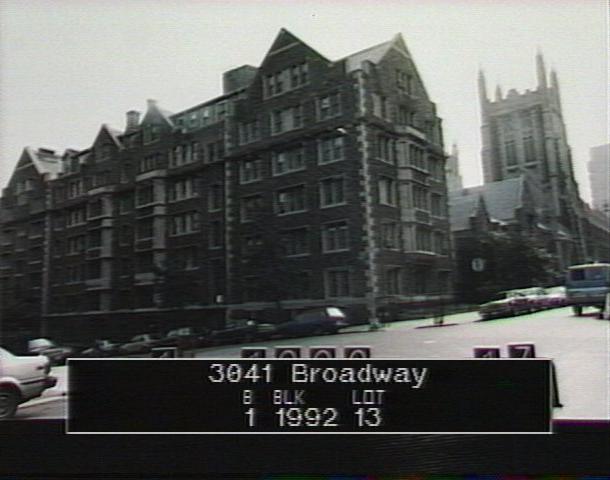
The city photographed every building for its tax records around 1940 and again in the 1980s. NYC Municipal Archives.
Written with AI from the source each entry cites, then fact-checked.
- 1908
Allen & Collens, winners of a design competition, begin the seminary's Gothic quadrangle on Claremont Avenue
The Landmarks Preservation Commission dates the seminary's Morningside Heights buildings from 1908, when work began, to 1910, and says the architects Allen & Collens won the commission in a competition. The complex encloses two city blocks around a landscaped quadrangle and is built of trap rock in random ashlar with limestone trim. The seminary had moved in 1884 to its second home on Lenox Hill, at what is now 700 Park Avenue, before building here.
“The buildings were designed by the architects Allen & Collins who won the commission in competition.”
- 1910
Union Theological Seminary completes its Gothic campus on Morningside Heights
Founded in 1836 and fully independent of the Presbyterian Church since 1893, the seminary moved to Morningside Heights and completed its brick and limestone English Gothic Revival buildings, by Allen & Collens, in 1910. Reinhold Niebuhr joined the faculty in 1929, and Paul Tillich arrived in December 1933 after fleeing Nazi Germany. The city designated the campus a landmark in 1967.
Source: Wikipedia
- 1928
Reinhold Niebuhr joins the Union faculty
Theologian Reinhold Niebuhr joined Union Theological Seminary's faculty in 1928 as professor of practical theology, leaving a Detroit pastorate for a role that made him one of the seminary's most influential thinkers. He remained on the Claremont Avenue campus for more than three decades, retiring in 1960.
Source: Wikipedia
- 1930
Dietrich Bonhoeffer comes to Union for a year of study
The young German theologian arrived in 1930 hoping for a Sloane Fellowship and found the seminary's theology disappointing. A Black classmate, Frank Fisher, brought him to Abyssinian Baptist Church in Harlem, where he taught Sunday school and heard Adam Clayton Powell Sr. preach, and he kept a lifelong love of the African-American church. He came back to Union in June 1939 but left after two weeks to stand with Germany's Christians, and was executed by the Nazis on April 9, 1945.
Source: Wikipedia
- 1933
Paul Tillich, driven out of Frankfurt by the Nazis, joins Union's faculty
Reinhold Niebuhr recruited the theologian Paul Tillich to Union after Nazi officials dismissed him from the University of Frankfurt and put him on a list of undesirables. Tillich slipped away from a Gestapo arrest in October 1933 and joined the seminary that December. With Niebuhr he helped make Union the center of both liberal and neo-orthodox Protestantism between the wars.
Source: Wikipedia
- 1939
Auburn Theological Seminary relocates onto the Union campus
Auburn Theological Seminary, based in upstate New York, moved onto Union's Morningside Heights campus in 1939, sharing its Gothic buildings while remaining a separate institution. The arrangement lasted seventy-five years before Auburn moved its operations off campus in 2014.
Source: Wikipedia
- 1967
The city designates Brown Memorial Tower, James Tower and James Memorial Chapel as landmarks
On November 15, 1967, the Landmarks Preservation Commission designated the seminary's Brown Memorial Tower at Broadway and West 120th Street and the James Tower and James Memorial Chapel on Claremont Avenue. After hearings in December 1966 and January 1967, with the seminary in favor, the commission called the towers among the finest English Perpendicular Gothic buildings in New York, praising the restraint of their design and the skill of the stone carvers.
- 1970
James Cone begins teaching at Union, where he shapes Black theology for nearly five decades
James Hal Cone, a founder of liberation theology and an influential Black theologian, started teaching at Union in 1970. From 1977 until he died in 2018 he held the Charles A. Briggs chair in systematic theology. The seminary is described as a birthplace of Black theology and womanist theology.
Source: Wikipedia
Further reading
- Union Theological SeminaryWikipedia
Nearby
- Riverside Church490 Riverside Drive | 13 entries
- Manhattan School of Music130 Claremont Avenue | 8 entries
- Church of Corpus Christi535 West 121st Street | 9 entries
- Interchurch Center475 Riverside Drive | 4 entries
- Pupin Hall538 West 120th Street | 8 entries
- Milstein Center, Barnard College3011 Broadway | 5 entries