74th Street Generating Station
503 East 74th Street | also 506 East 75th Street | Lenox Hill
Open on the map6 entries

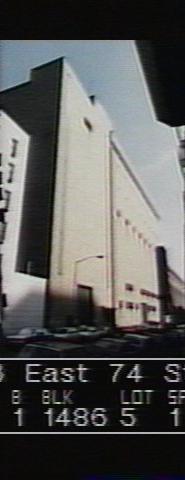
The city photographed every building for its tax records around 1940 and again in the 1980s. NYC Municipal Archives.
Written with AI from the source each entry cites, then fact-checked.
- 1899
The Manhattan Elevated Railway Company breaks ground on a huge power house by the East River
Work began in 1899, for the Manhattan Elevated Railway Company, on a power house on the East River between 74th and 75th streets, a building 200 by 500 feet. The engineer George H. Pegram designed it. Museum of the City of New York photographs include a view of the trench in May 1900, and the main towers were the first section completed, in October 1900.
Source: blog.mcny.org
- 1902
The first electric train on the Second Avenue Elevated runs on power from the new station
On January 9, 1902, the Manhattan Railway Company ran its first electric train along the Second Avenue Elevated, powered by the new East River plant. After the inaugural trip, many of the invited guests went to inspect the power house itself. The company had announced its plan to electrify the elevated system in February 1899 and revealed the riverfront site four months later.
“…the Manhattan Railway Company's first electric train was run along the Second Avenue Elevated on January 9, 1902.”
Source: Wikipedia
- 1902
Eight huge Allis-Corliss engines drive what were then the largest alternators ever built
By 1902 the power house was fully operating with eight Allis-Corliss reciprocating steam engines, each rated at up to 10,000 horsepower. Every engine turned a Westinghouse three-phase alternator producing 11,000 volts at 25 cycles and rated at 7,500 kilowatts. The Museum of the City of New York notes that these eight alternators were the largest built up to that time, and that the engine room had been nearly finished by mid-1901.
Source: blog.mcny.org
- 1915
Steam turbines begin to replace the plant's original giant engines
As turbine technology advanced, the original reciprocating engines gave way to smaller and more efficient machines. Five of the eight were removed between 1914 and 1918, and three 30,000-kilowatt low-pressure turbines began running from 1915. By 1919 a 60,000-kilowatt Westinghouse turbine could deliver 70,000 kilowatts at peak, almost the whole plant's output at opening, in a quarter of the floor space the eight engines had needed.
“Five of the original engines were removed between 1914 and 1918. Three new 30,000-kilowatt low pressure steam turbine units were placed into operation beginning in 1915.”
Source: Wikipedia
- 1978
Con Edison burns synthetic liquefied coal here in a federal fuel experiment
In September 1978 the plant served as a test site for synthetic liquefied coal. More than 4,000 barrels of SRC-II fuel from the U.S. Department of Energy were burned to make electricity, under a contract with the Electric Power Research Institute. The aim was to learn whether liquefied coal could substitute for other fuel and cut the country's reliance on foreign oil.
Source: Wikipedia
- 1996
A five-alarm fire at the Con Edison steam plant is fought for hours in an asbestos containment area
At 3:36 a.m. on June 28, 1996, a box alarm was transmitted for a fire at the Con Edison steam plant on East 75th Street, where residents had been woken by an explosion. Because the blaze was in an asbestos containment area, a hazardous-materials team responded and everyone within a square block was evacuated. The fire went to five alarms and was declared under control at 9 a.m.; air and debris samples later showed no asbestos had escaped.
Source: fdnewyork.com
Further reading
- 74th Street Generating StationWikipedia
Nearby
- Lycée Français de New York502 East 76th Street | 4 entries
- The Belaire524 East 72nd Street | 6 entries
- Sotheby's1334 York Avenue | 6 entries
- Cherokee Apartments516 East 78th Street | 8 entries
- Eleanor Roosevelt High School411 East 76th Street | 5 entries
- Hospital for Special Surgery535 East 70th Street | 5 entries