Cherokee Apartments
516 East 78th Street | also 508 East 78th Street | Lenox Hill | built 1911
Open on the map8 entries

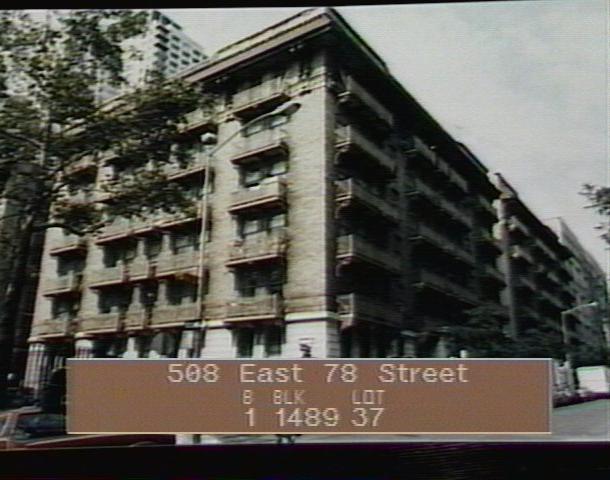
The city photographed every building for its tax records around 1940 and again in the 1980s. NYC Municipal Archives.
Written with AI from the source each entry cites, then fact-checked.
- 1909
Anne Harriman Vanderbilt pledges $1 million for model tenements for tuberculosis patients
In February 1909 Anne Harriman Vanderbilt announced a $1 million gift to build four model tenements for people with tuberculosis and their families. The idea came from Dr. Henry Shively of the tuberculosis clinic at New York Presbyterian Hospital, who held that architecture could help fight the disease. She added $81,000 for a site on East 77th and 78th Streets, and her husband William Kissam Vanderbilt then hired Henry Atterbury Smith as architect.
“In February 1909, Anne Harriman Vanderbilt announced that she would donate $1 million to build a set of four model tenements for people living with tuberculosis…”
Source: Wikipedia
- 1909
Mrs. Vanderbilt offers to pay for ending East 77th Street at Cherokee Place so John Jay Park can be rejoined
When the site for the East River Homes was picked, John Jay Park was cut in two by East 77th Street, which ran on to the river. After buying the lots, Mrs. Vanderbilt offered to cover the cost of stopping the street at Cherokee Place so that the two halves of the park could be united. The Landmarks Preservation Commission's 1985 report cites a New York Times story from April 1909 for the offer.
“Mrs. Vanderbilt offered to pay the expenses of having 77th Street stop at Cherokee Place and the two parts of the park united.”
- 1911
Henry Atterbury Smith founds a company to build his open-stair tenements
In 1911 architect Henry Atterbury Smith formed the Open Stair Tenement Company to put up buildings to his design. Besides the East River Homes it built the John Jay Homes across East 77th Street, since demolished. Smith's open stairways had not fitted New York's building code, and he had been unable to use them until the law was changed; his link with Dr. Shively gave him the chance to build the plan here.
“In 1911 Smith formed the Open Stair Tenement Company to construct buildings of his design. In addition to the East River Homes, his company built the John Jay Homes…”
- 1912
The East River Homes open with over 100 of 383 apartments already rented
More than 100 of the 383 apartments were already taken when the East River Homes opened in January 1912, rented to people with a touch of tuberculosis and to delicate residents prone to catching it. Many others were eager to move in. The four buildings, each wrapped around its own courtyard with open corner stairs, were meant to give sick tenants fresh air and sunlight.
“When the East River Homes opened in January 1912, more than 100 of the 383 apartments were already rented to "persons who have a touch of tuberculosis…”
- 1912
A charity leases part of the complex as a 'Home Hospital' for tuberculosis patients
In March 1912 a charity, the New York Association for Improving the Conditions of the Poor, leased one section as a Home Hospital for the treatment of tuberculosis. Families with a member suffering a severe case could be treated under a doctor's care without being split up or sent to a sanatorium. Twenty-four apartments, all those opening on one stairway, were taken in 1912, and a second stairway group of twenty-four was added in November 1913.
“In March of the same year, ... the New York Association for Improving the Conditions of the Poor leased one section of these buildings for use as a "Home Hospital…”
- 1924
The trust that ran the tenements gives way as the buildings are sold to City and Suburban Homes
The trust that operated the East River Homes was dissolved in 1923, and under its terms the buildings passed to Presbyterian Hospital. The hospital first handled the buildings through a rental agent, then sold them in October 1924 to the City and Suburban Homes Company. Since then the buildings have been used as regular rental apartments.
“In 1923 the trust which ran the tenements was dissolved ... in October 1924, the buildings were sold to the City and Suburban Homes Company…”
- 1985
The Landmarks Commission designates the Shively Sanitary Tenements after hearings in 1981 and 1984
The Landmarks Preservation Commission designated the Shively Sanitary Tenements, now the Cherokee Apartments, a city landmark on July 9, 1985. The buildings had been the subject of a first public hearing on February 10, 1981 and a second on September 11, 1984. At each hearing two speakers favored designation, and the owner's representative said he was neither for nor against it.
- 1994
The complex becomes part of a National Register historic district with the York Avenue Estate
In 1994 a National Register of Historic Places district was established that takes in the Cherokee Apartments together with the neighboring York Avenue Estate built by the City and Suburban Homes Company. The four former East River Homes buildings are contributing properties in the district, which carries the Shively Sanitary Tenements in its name.
Source: Wikipedia
Further reading
- Cherokee ApartmentsWikipedia
Nearby
- Lycée Français de New York502 East 76th Street | 4 entries
- 74th Street Generating Station503 East 74th Street | 6 entries
- Eleanor Roosevelt High School411 East 76th Street | 5 entries
- Three Facebooks Moms1471 1st Avenue | 1 entry
- St. Stephen of Hungary Church414 East 82nd Street | 5 entries
- Brearley School610 East 83rd Street | 4 entries