Electric Lady Studios
52 West 8th Street | also 52A West 8th Street | Greenwich Village | built 1927
Open on the map12 entries

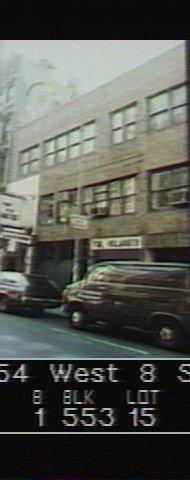
The city photographed every building for its tax records around 1940 and again in the 1980s. NYC Municipal Archives.
Written with AI from the source each entry cites, then fact-checked.
- 1929
The Film Guild Cinema opens in 1929 as a modernist movie house designed by Frederick Kiesler
The Film Guild Cinema opened on this site in 1929, counted among the earliest modernist or constructivist buildings in New York. Its designer, the architectural theorist and De Stijl member Frederick Kiesler, called it the first 100% cinema and aimed to draw viewers fully into the film. Decades later the building would hold a country nightclub in its basement and then Jimi Hendrix's recording studio.
Source: 6sqft
- 1930
The cowboy-themed Village Barn nightclub opens in the basement
Meyer Horowitz opens the Village Barn in the basement of the building at 52 West 8th Street, decorated like a rustic barn rather than a typical Prohibition-era speakeasy. The club books country acts such as the Riders of the Purple Sage and western singer Tex Fletcher, plus a novelty turtle race advertised in 1936. It keeps drawing crowds for decades before closing in the late 1960s.
Source: Ephemeral New York
- 1931
Rudy Vallee discovers Judy Canova at the Village Barn
In 1931 Rudy Vallee, who ran his own nearby club, Villa Vallee, discovered the performer Judy Canova at the Village Barn, the country-themed nightclub in the basement that Meyer Horowitz had opened the previous November. Don Cornell and the Hartmans are also listed among the entertainers who got their start at the club.
“In 1931, Rudy Vallée, who had a nearby club, Villa Vallée, discovered Judy Canova at the Barn.”
Source: Wikipedia
- 1938
Hans Hofmann begins lecturing on art in the building
Abstract expressionist Hans Hofmann starts teaching art lectures in the building at 52 West 8th Street in 1938, two decades before he devotes himself to painting full time. The building's basement still holds the Village Barn nightclub at the time, years before Hendrix later turns the same address into a recording studio.
Source: Wikipedia
- 1948
The Village Barn becomes the home of the first country music program on network television
On May 24, 1948, NBC began broadcasting a live weekly variety show from the Village Barn, the first country music show ever carried on a national American network. The 40-minute premiere on WNBT featured Texas Ruby and Curly Fox with the Dixie Boys. The show ran until September 1949 and came back from January 16 to May 29, 1950, with square dancing and audience races for kiddie cars, hobby horses and potato sacks.
Source: Wikipedia
- 1968
Jimi Hendrix buys the defunct Generation nightclub on the site
Jimi Hendrix and manager Michael Jeffery purchase the Generation, a recently closed Greenwich Village nightclub where Hendrix had often joined jam sessions with B.B. King, Chuck Berry, Sly and the Family Stone, and other musicians. Hendrix first intends to reopen it as a club, but advisors Eddie Kramer and Jim Marron convince him to build a professional recording studio instead.
Source: Wikipedia
- 1970
Jimi Hendrix opens Electric Lady Studios
Hendrix turned the former Generation Club into a recording studio of his own. The opening party was held on August 26, 1970, and he died less than a month later. Patti Smith recorded Horses here in 1975.
Source: Wikipedia
- 1975
John Lennon and David Bowie improvise the session that produces Fame
In 1975 John Lennon and David Bowie held a loose, improvised session at Electric Lady that gave Bowie his hit single Fame, from the album Young Americans. Hendrix had been dead for five years by then, and the studio he built had become a regular stop for major rock and soul artists, including Stevie Wonder and Led Zeppelin.
“In 1975, John Lennon and David Bowie held an improvisatory session at the studio that produced Bowie's hit single "Fame" for his Young Americans album.”
Source: Wikipedia
- 1991
The 8th Street Playhouse, known for midnight Rocky Horror screenings, closes
The Film Guild Cinema at 52 West 8th Street was renamed the 8th Street Playhouse in 1930. It built a following for quirky film festivals and nightly midnight movies, above all The Rocky Horror Picture Show, which came with a live Floorshow of its own. After the owner, Steve Hirsch, died in 1986, the theater passed to BS Moss, then United Artists and finally City Cinemas, and it closed in 1991.
Source: Wikipedia
- 1997
The Soulquarians begin jamming and recording at Electric Lady
From 1997 into the early 2000s, the Soulquarians, an experimental collective of Black musicians, jammed and recorded at the studio. D'Angelo and Questlove began preparing Voodoo there in 1997, and adjacent sessions produced the Roots' Things Fall Apart, Erykah Badu's Mama's Gun, Common's Like Water for Chocolate and Bilal's debut. The era faded as labels balked at releasing the experimental music.
Source: Wikipedia
- 2005
Electric Lady sits unbooked for ten months as home recording takes over
Electric Lady was busy until the early 2000s, but cheaper recording technology let artists work from home, and the studio sat unbooked for ten months in 2005. It was resold to the investor Keith Stoltz several years later. Lee Foster, then 27 and a former intern, returned and found a pizza box patching a broken ceiling tile and cheap Hendrix calendar cutouts on the walls.
Source: nyunews.com
- 2007
Ryan Adams and Patti Smith bring Electric Lady back to life
The studio's revival began when Ryan Adams phoned manager Lee Foster at 5 a.m. from outside the door and recorded the song Two on the spot. He then spent nine months making his album Easy Tiger there. Its success led Patti Smith to book Electric Lady for her 2007 album Twelve, and the studio has stayed busy since.
Source: nyunews.com
Further reading
- Electric Lady StudiosWikipedia
- Then & Now photos: Eighth Street Playhouse and Village BarnVillage Preservation: Greenwich Village Then & Now
- A cowboy club in the VillageEphemeral New York
Nearby
- 50 West 8th Street1 entry
- 48 West 8th Street1 entry
- West Side Savings Bank388 Avenue of the Americas | 1 entry
- 111 Waverly Place3 entries
- Robert Hogan House175 MacDougal Street | 5 entries
- 396 Avenue of the Americas2 entries