Stonewall Inn
53 Christopher Street | also 113 7th Avenue South | West Village | built 1915
Open on the map23 entries

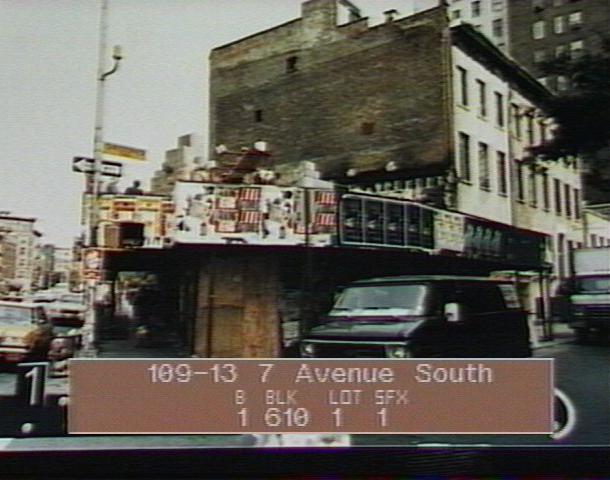
The city photographed every building for its tax records around 1940 and again in the 1980s. NYC Municipal Archives.
Written with AI from the source each entry cites, then fact-checked.
- 1930
William Bayard Willis joins No. 51 and No. 53 Christopher Street into one building
Separate stables had gone up at No. 51 in 1843 and No. 53 in 1846 for two different owners, and No. 53 later housed a wholesale bakery. In 1930, architect William Bayard Willis joined the two structures internally and reduced No. 51 to two stories, letting the bakery spread across both ground floors while a single apartment took the floor above.
Source: Daytonian in Manhattan
- 1934
Bonnie's Stonewall Inn restaurant opens, giving the site its name
After Prohibition's repeal, architect Harry Yarish remodeled the ground floor into a restaurant called Bonnie's Stonewall Inn in 1934, adding a neo-Colonial brick front with arched doorways and a shallow columned portico at No. 53. The restaurant's name outlasted it, later attaching to the gay bar that opened in the same space in 1967.
Source: Daytonian in Manhattan
- 1935
The Greenwich Village Association dines at the Stonewall Inn restaurant as Robert Moses talks parks
Soon after Bonnie’s Stonewall Inn opened on Christopher Street, it became a venue for weddings, banquets and civic events. In May 1935 the Greenwich Village Association held its dinner there. Parks Commissioner Robert Moses was the speaker, and he addressed the changes then proposed for Washington Square Park. The landmarks commission lists the evening among the social and civic events the restaurant hosted before it became a gay bar.
- 1961
Geraldine Page is guest of honor at a Summer and Smoke cast reunion at the restaurant
In 1961 the Stonewall Inn restaurant hosted a reunion for the cast of Summer and Smoke, which the Circle in the Square had staged in 1952. The actress Geraldine Page was the guest of honor. The party shows the restaurant era of 51-53 Christopher Street, a few years before the place closed in early 1966 and reopened as a gay bar in 1967 under the same name.
“In 1961 Geraldine Page was the guest of honor at a reunion of the cast members of the Circle-in-the-Square's 1952 production of Summer and Smoke.”
- 1965
The Harper estate sells the Christopher Street buildings, and the restaurant closes in early 1966
In March 1965 the executors and trustees of the Harper estate sold the parcel with 51, 53, 55, 59 and 61 Christopher Street to the real estate investor Joel Weiser, according to the landmarks commission. The Stonewall Inn restaurant shut in early 1966. The façade was altered, with the second-story stucco repaired and the restaurant signs above the storefront windows removed.
“…the executors and the trustees of the Harper Estate sold a parcel consisting of the buildings at 51, 53, 55, 59, and 61 Christopher Street to real estate investor Joel Weiser…”
- 1967
Men tied to the Genovese crime family reopen the space as a gay bar
After a fire had gutted the restaurant and it closed in the mid-1960s, four men connected to the Genovese crime family put up about $3,500 to reopen 53 Christopher Street as an unlicensed private club on March 18, 1967. It ran as a gay bar without a liquor license, reportedly paying off local police, until the raid two years later.
Source: Wikipedia
- 1969
A police raid sparks the Stonewall uprising
In the early hours of June 28, 1969, police raided the Stonewall Inn, a gay bar. Patrons and neighbors fought back, and protests continued on Christopher Street for several nights. The uprising became a turning point for the LGBTQ rights movement, and the first pride marches were held a year later to mark it.
Source: Wikipedia
- 1969
Police raid the Stonewall Inn four days before the uprising and seize its liquor
The Stonewall Inn was one of five Village gay bars that police raided in the final three weeks of June 1969, and it was hit on June 24. Under Seymour Pine’s direction, officers seized the bar’s liquor and arrested employees, yet it reopened the next day. Frustrated by the limited effect, Pine and Detective Charles Smythe planned a second raid for late the following Friday night, when the bar would be crowded.
“…five Village LBGT bars were raided in the last three weeks of June 1969, including the Stonewall Inn, on June 24. ... The Stonewall reopened the next day…”
- 1969
Police wait in Christopher Park for a signal from undercover officers that never comes
Pine recalled in 2004 that two policewomen posing as lesbians and two plainclothes men were inside the bar on the night of the raid. He and Detective Charles Smythe waited in Christopher Park across the street for a signal from the women. No signal came, so the two officers walked to the door, hoping to close the bar for serving minors. They expected patrons to line up quietly, as in earlier raids, but this crowd would not go along.
Source: Internet Archive
- 1969
A police report logs a Volkswagen stomped on outside the Stonewall Inn
Newly released police records include a complaint from the owner of a 1968 Volkswagen parked across the street from the Stonewall Inn. Her car had been stomped on at about 3 a.m. on June 28, 1969, damaging the roof, hood and rear engine cover. The documents, posted at OutHistory.org in 2009, also name Marilyn Fowler among those who shoved and kicked an officer; no woman’s arrest in the uprising had been documented before.
Source: archive.nytimes.com
- 1969
Street youths form a kickline and sing about being the Stonewall Girls
As the Tactical Patrol Force marched down Christopher Street in a V formation, the crowd simply turned a corner and regrouped behind the police. The cat-and-mouse game lasted about two hours. At several points a group of gay street youths formed a chorus line and sang a taunting song calling themselves the Stonewall Girls, facing off against the helmeted, shielded officers. Things petered out around 4:30 a.m.
“…a group of gay street youths formed a kickline and started singing "We Are the Stonewall Girls; we wear our hair in curls…”
- 1969
Boards over the windows carry graffiti blaming police and Mafia as the inn reopens
By Saturday afternoon the broken storefront windows were boarded up and painted black, and graffiti covered the boards and the brick above them. Messages included “We Are Open,” “Support Gay Power” and a slogan saying gay prohibition made cops corrupt and fed the Mafia. That night the bar reopened and served only soft drinks, given away free, while a far larger crowd gathered outside in Christopher Park.
- 1969
A Mattachine sign in the window pleads for calm after the first night of rioting
On Sunday afternoon, after Mattachine Society officials met the mayor’s office and the police, a sign went up in a window of the Stonewall Inn. It urged homosexuals to keep the streets of the Village peaceful and quiet. Hundreds of gay men and lesbians still gathered in Christopher Park, but the Tactical Patrol Force flooded the area and most people spent the evening talking and watching.
- 1969
The Stonewall Inn closes, a for-rent sign in its window
By October 1969 a for-rent sign hung in the Stonewall Inn’s window. Historian David Carter, whom the landmarks commission cites, attributes the closing to the club’s notoriety and to its lack of a liquor license, which had forced the owners to run it as a juice bar. Plans filed in autumn 1970 aimed to reopen the space as a soft-drink restaurant and bar with a larger platform for disco dancers.
“…the Stonewall Inn closed by October 1969 when a for rent sign appeared in the window, done in by the club's notoriety and the lack of a liquor license…”
- 1970
The first Christopher Street Liberation Day march honors the uprising’s anniversary
On June 28, 1970, the first anniversary of the uprising, New Yorkers held the first parade that grew into Pride. Craig Rodwell conceived it as a gay holiday and called it Christopher Street Liberation Day, a name meant to shift attention from the Mafia-run Stonewall to the broader struggle for liberation. Organizers urged other cities to hold events the same day, and four or five joined in, including Los Angeles, San Francisco and Chicago.
- 1989
The City Council renames the stretch of Christopher Street in front of the inn Stonewall Place
On the 20th anniversary of the uprising, in 1989, the City Council voted to rename the part of Christopher Street in front of the Stonewall Inn as Stonewall Place. Ten years earlier, for the tenth anniversary, the city had declared June Lesbian and Gay Pride and History Month. The landmarks commission lists both among the ways the uprising has been commemorated.
- 1994
Thomas Garguilo takes over the bar after Jimmy Pisano’s death to keep it open for the 25th anniversary
Jimmy Pisano opened a bar at 53 Christopher Street in 1990 that was first called New Jimmy’s and later became Stonewall. After he died of AIDS-related complications in early 1994, his boyfriend Thomas Garguilo took over because he wanted the bar open for the riots’ 25th anniversary. Garguilo recalled that so many people came to mark the anniversary that a line formed to take pictures of the bar, which he said had often been empty in the three years after it reopened.
“Pisano died of AIDS-related complications in early 1994, and Garguilo took over operation, as he wanted the bar to be open for the 25th anniversary…”
Source: Wikipedia
- 1999
The Stonewall Inn becomes the first LGBT site listed on the National Register of Historic Places
In 1999, thirty years after the uprising, the National Register of Historic Places added the Stonewall Inn, which the landmarks commission calls the first LGBT landmark to be so honored. A year later, in 2000, the building was named a National Historic Landmark. The commission treats both as part of the memorialization of Stonewall that grew out of the annual Pride commemorations.
- 2007
The Stonewall Inn reopens with a Judy Garland costume in the window
After closing in 2006, the bar returned in March 2007 under the businessmen Bill Morgan, Tony DeCicco and Kurt Kelly and the investor Stacy Lentz, the bar’s first lesbian investor. Lentz hung a costume in the window to honor Judy Garland, a gay icon who died a few days before the 1969 riots. The costume resembled the dress that Garland’s character Dorothy wears in The Wizard of Oz.
“Lentz hung a costume in the window to honor the actress Judy Garland, a gay icon who had died a few days before the riots…”
Source: Wikipedia
- 2015
Designated a New York City landmark
The Landmarks Preservation Commission made the Stonewall Inn an individual landmark, the first in the city designated mainly for its place in LGBTQ history.
Source: NYC Landmarks Preservation Commission, Stonewall Inn designation report (2015)
- 2016
Stonewall National Monument is established
President Barack Obama designated the Stonewall National Monument, the first U.S. national monument dedicated to LGBTQ history. It includes Christopher Park across the street.
Source: Wikipedia
- 2020
Crowdfunding keeps the Stonewall Inn open during the pandemic shutdown
The bar closed in March 2020 as COVID-19 reached New York and its owners failed to win a loan. By June it risked closing for good, so Kurt Kelly and Stacy Lentz launched two GoFundMe campaigns, which raised at least $300,000 in a month. The Gill Foundation added $250,000 in matching funds, and the Stonewall reopened in July 2020 with limited capacity.
“…launched two crowdfunding campaigns on GoFundMe; They raised at least $300,000 for the bar in one month, and the Gill Foundation provided another $250,000…”
Source: Wikipedia
- 2024
A national visitor center for LGBTQ culture opens at 51 Christopher Street
On June 28, 2024, the 55th anniversary of the uprising, a 3,700-square-foot visitor center opened at 51 Christopher Street, described as the first official national visitor center dedicated to LGBTQ culture and history. Construction had begun in 2022, complementing the Stonewall National Monument designated in 2016.
Source: Wikipedia
Further reading
- Stonewall InnWikipedia
- Then & Now photos: 53 Christopher StreetVillage Preservation: Greenwich Village Then & Now
Nearby
- 55 Bar55 Christopher Street | 7 entries
- Stonewall Inn51 Christopher Street | 6 entries
- 57 Christopher Street1 entry
- Lion's Head and Mattachine building59 Christopher Street | 4 entries
- 117 7th Avenue South4 entries
- 45 Christopher Street3 entries