Pupin Hall
538 West 120th Street | also 530 West 120th Street | Morningside Heights | built 1901
Open on the map8 entries

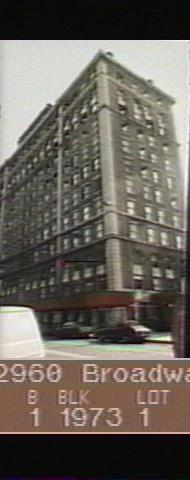
The city photographed every building for its tax records around 1940 and again in the 1980s. NYC Municipal Archives.
Written with AI from the source each entry cites, then fact-checked.
- 1931
Columbia's physics building becomes a research hub as Urey finds deuterium and Pegram studies the neutron
By 1931 the physics building that would later be named for Michael Pupin had become a leading research center. Around then the chemist Harold Urey, a Nobel laureate, discovered deuterium, while George B. Pegram studied the phenomena linked to the recently discovered neutron. The building had been put up in 1925-1927 to give the Physics Department more space than its original home in Fayerweather Hall.
“By 1931, the building which later became Pupin Hall was a leading research center. During this time Harold Urey (Nobel laureate in Chemistry) discovered deuterium…”
Source: Wikipedia
- 1935
The physics building is renamed Pupin Hall
McKim, Mead & White completed Columbia's physics building in 1927 as part of the Morningside Heights campus. Columbia's trustees renamed it Pupin Hall in 1935, the year physicist and longtime professor Mihajlo Idvorski Pupin died, honoring his career at the university.
Source: Wikipedia
- 1939
Columbia physicists split the uranium atom for the first time in the United States
Working with a cyclotron that John R. Dunning and George Pegram had built in the basement of this physics building, a team including Dunning, Herbert Anderson, Eugene Booth and Francis Slack split uranium atoms on January 25, 1939, the first such experiment in the country. Dunning wrote in his diary that they had seen a new phenomenon 'of far-reaching consequences.' Columbia scientists went on to develop gaseous diffusion for separating uranium isotopes, the method later used at the K-25 plant in Oak Ridge for the Manhattan Project.
Source: ahf.nuclearmuseum.org
- 1947
Physicists in Pupin Hall measure the Lamb shift and electron spin
In 1947, working inside Pupin Hall, Columbia physicist Willis Lamb measured the shift in hydrogen's energy levels now called the Lamb shift, while colleague Polykarp Kusch measured the electron's anomalous magnetic moment. Both measurements became foundational to the then-emerging field of quantum electrodynamics.
Source: Wikipedia
- 1965
Pupin Hall is named a National Historic Landmark
Built in 1925–27 to designs by McKim, Mead & White, the physics building was renamed in 1935 for the Serbian-American scientist Michael Pupin after his death. On December 21, 1965, it was designated a National Historic Landmark for the atom-splitting experiments carried out there in 1939. The Rutherfurd Observatory on its roof still holds public observing nights.
Source: Wikipedia
- 1987
Columbia disciplines two freshmen who carried depleted uranium out of a Pupin basement storeroom
Columbia suspends freshman Kenneth Hechtman for a year and puts classmate Jeff Bankoff on probation after the two took chemicals, including depleted uranium-238, from a basement storage area of the Pupin physics laboratory building. They found the shelves during a late-night walk through the campus tunnels in early December, and Hechtman used some of the chemicals in experiments in his dorm room. The university says the area was unlocked because of construction, and federal and local agencies end their inquiry after finding no immediate health hazard.
Source: thecrimson.com
- 2009
The American Physical Society names Pupin Hall a historic site and honors I. I. Rabi
In 2009 the American Physical Society recognized Pupin Hall, where Columbia's physics department is based, as a historic site, singling out Isidor Isaac Rabi's work on magnetic resonance. David Hirsh, Columbia's executive vice president for research, accepted a plaque at a ceremony attended by Rabi's two daughters, Nobel laureate Tsung-Dao Lee and author Richard Rhodes. The society was founded at Columbia in 1899 and began its Historical Sites Initiative only a few years earlier.
Source: columbia.edu
- 2015
Columbia's Center for Theoretical Physics opens on Pupin Hall's upper floors
Led by physicist Brian Greene, the new Center for Theoretical Physics takes over part of Pupin Hall's eighth and ninth floors. It has a spacious lounge with plenty of natural light, wall-to-wall communal blackboards to encourage collaboration, and an open glass staircase. About two-thirds of Columbia's fifteen theoretical physicists move their offices in, and the opening is a step in the university's Science Initiative, which also pays for the building's overhauled mechanical, electrical and plumbing systems and its replaced copper cornice.
Source: magazine.columbia.edu
Further reading
- Pupin HallWikipedia
Nearby
- Church of Corpus Christi535 West 121st Street | 9 entries
- Union Theological Seminary80 Claremont Avenue | 8 entries
- Milstein Center, Barnard College3011 Broadway | 5 entries
- Low Memorial Library535 West 116th Street | 12 entries
- Interchurch Center475 Riverside Drive | 4 entries
- 119th Street Croton Aqueduct Gatehouse1191 Amsterdam Avenue | 1 entry