Fraunces Tavern
54 Pearl Street | also 99 Broad Street | Financial District | built 1719
Open on the map16 entries

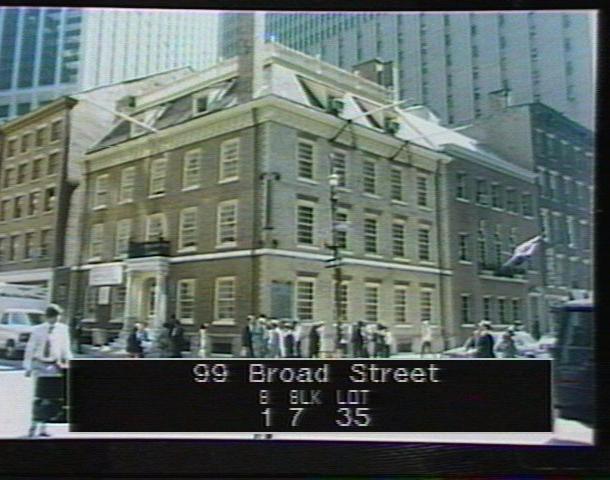
The city photographed every building for its tax records around 1940 and again in the 1980s. NYC Municipal Archives.
Written with AI from the source each entry cites, then fact-checked.
- 1762
Samuel Fraunces buys the De Lancey mansion and turns it into a tavern
The house at Pearl and Broad Streets was built in 1719 for the merchant Étienne De Lancey, reportedly with bricks imported from the Netherlands. In 1762 Samuel Fraunces bought the property and converted it into a public house, first called the Queen's Head after Queen Charlotte.
Source: Wikipedia
- 1768
The New York Chamber of Commerce is founded in the tavern's Long Room
The Chamber of Commerce of the State of New York was formed in 1768 in the Long Room of the Queen's Head Tavern, as Samuel Fraunces's establishment was then called. Its offices stayed in the building until 1770. The tavern was a hub of colonial clubs, hosting the Sons of Liberty, the New York Society Library, the Saint Andrew's Society and the Friendly Brothers of St. Patrick.
Source: frauncestavernmuseum.org
- 1775
A cannonball from the British warship Asia crashes through the tavern roof
On the night of August 23, 1775, John Lamb and his artillery company tried to take about a dozen cannons from the Battery and traded fire with HMS Asia. The warship answered by bombarding the city from midnight until three in the morning. One 18-pound ball tore through the roof of the tavern on Pearl Street.
Source: frauncestavernmuseum.org
- 1776
The Provincial Congress raises 31 toasts at a Washington banquet, and Fraunces bills for broken glasses
On June 14, 1776, the New York Provincial Congress gave a banquet in the Long Room for General George Washington, his staff and officers, as thanks for their defense of the colony. The evening ran through 31 toasts, from the Congress and the army to liberty for all mankind, with fife and drum and campaign songs. Samuel Fraunces's bill totaled 91 pounds, including 78 bottles of Madeira and sixteen shillings for broken glasses.
Source: frauncestavernmuseum.org
- 1783
George Washington says farewell to his officers in the Long Room
Nine days after the British evacuated New York, George Washington gathered the officers of the Continental Army in the tavern's Long Room to take his leave of them. He told them he parted with a heart full of love and gratitude. From 1785 to 1788, while New York was the nation's capital, the building also held offices of the Departments of Foreign Affairs and War and the Treasury Board.
Source: Wikipedia
- 1783
A joint British and American commission hears Black Loyalists' claims in the Birch Trials
As the war ended in 1783, a joint British and American commission met at the tavern to decide which Black Loyalists, many formerly enslaved, could leave New York with the departing British army. The proceedings are known as the Birch Trials, after Brigadier General Samuel Birch, who oversaw them. About 3,000 Black Loyalists evacuated between April and November 1783, and those approved were recorded in the Book of Negroes.
Source: frauncestavernmuseum.org
- 1783
Governor Clinton hosts the Evacuation Day celebration after the British leave
British troops left New York on November 25, 1783, the last American city they had occupied. Washington led the Continental Army from the Bowery's Bull's Head Tavern to Cape's Tavern at Broadway and Wall Street, and Governor George Clinton held his own Evacuation Day celebration at Fraunces Tavern. Washington was in the city that week and made use of the tavern for meals, including takeout.
Source: frauncestavernmuseum.org
- 1785
Congress leases the tavern for its Foreign Affairs, War and Treasury offices
In early 1785 Samuel Fraunces leased the building to the Confederation Congress, and two weeks later sold it to a Brooklyn butcher, George Powers, who rented further rooms to the Board of Treasury. While the offices were here, Prussia signed a commercial treaty in September 1785 and Morocco a diplomatic one in June 1786. The three departments stayed until May 1788.
Source: frauncestavernmuseum.org
- 1790
The first Supreme Court justices dine at the tavern to mark the Court's opening
On February 2, 1790, members of the new U.S. Supreme Court dined here to celebrate the Court's opening. Chief Justice John Jay of New York was joined by John Rutledge, William Cushing, James Wilson and John Blair, along with Robert Hanson Harrison, who later declined to serve. By then John Francis rented the building from George Powers and had turned it back into a tavern.
Source: frauncestavernmuseum.org
- 1798
Ballerina Anna Gardie dies in a murder and suicide at the building's boarding house
In 1798 the ballerina Anna Gardie, who lived at 54 Pearl Street with her husband, was killed. The old tavern was then a boarding house run by a widow, Mrs. Orcet, for owner Dr. Nicholas Romaine. Her husband was also found dead from stab wounds, and the coroner ruled it a murder and suicide. The museum's own history calls it an alleged murder.
Source: frauncestavernmuseum.org
- 1804
Hamilton and Burr both attend a Society of the Cincinnati meeting a week before their duel
On July 4, 1804, the Society of the Cincinnati met at the building, then managed by David Ross. Alexander Hamilton and Aaron Burr both attended, a week before their duel. By then the former tavern was mainly a boarding house with a bar on the ground floor, but proprietors kept the Fraunces Tavern name on the masonry.
Source: frauncestavernmuseum.org
- 1854
A fire guts the tavern and its rebuilding adds two floors
A major fire tears through the old DeLancey house, badly damaging the structure that had served as Fraunces Tavern for nearly a century. Owners rebuild it with two additional stories on top of the surviving lower floors, permanently changing the proportions of the 1719 building before its early-1900s restoration strips the additions away.
Source: Daytonian in Manhattan
- 1903
The city declares the tavern a park to stop its demolition
When the building was threatened with demolition in 1900, the Daughters of the American Revolution and Andrew H. Green, who founded a society for preserving scenic and historic sites, tried to buy it, but the owners refused. In 1903 the city used eminent domain and designated the property a park. The owners agreed to sell to the Sons of the Revolution in 1904, and the city dropped the park status once the group took title in July.
Source: frauncestavernmuseum.org
- 1907
The Sons of the Revolution restore the tavern and open it as a museum
The patriotic society Sons of the Revolution bought the much-altered building in 1904 and hired architect William Mersereau to return it to an 18th-century appearance. His reconstruction, finished in 1907, kept the surviving original materials and structure from 1719. The Fraunces Tavern Museum opened in the restored building the same year.
Source: Wikipedia
- 1965
The Landmarks Commission designates Fraunces Tavern after a hearing with no opposition
After a public hearing on October 19, 1965, where three representatives of the owner, the Sons of the Revolution, spoke in favor and no one spoke against, the commission designated the tavern on November 23. Its report notes the 18th-century Holland brick in the west wall and calls the building the earliest of the 18th-century buildings still standing in Manhattan. It also describes the tavern as an early restoration that saved one of the city's few notable 18th-century buildings.
- 1975
A bomb planted by Puerto Rican nationalists kills four people
Members of the FALN, a Puerto Rican paramilitary group, set off a bomb in the vestibule of the Anglers' Club building next door at 101 Broad Street, killing four people and injuring more than 50 others. It remains one of the deadliest bombings in New York City history, and as of the 2020s no one has ever been prosecuted for it.
Source: Wikipedia
Further reading
- Fraunces TavernWikipedia
- The 1719 Fraunces Tavern -- 54 Pearl StreetDaytonian in Manhattan
Nearby
- Anglers' Club of New York101 Broad Street | 4 entries
- 58 Pearl Street4 entries
- 24 Water Street4 entries
- 26 Water Street2 entries
- 105 Broad Street3 entries
- 60 Pearl Street2 entries