Hotel St. George
55 Clark Street | also 96 Henry Street, 80 Pineapple Street, 98 Henry Street | Brooklyn Heights | built 1888
Open on the map8 entries

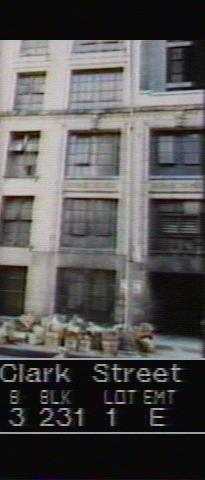
The city photographed every building for its tax records around 1940 and again in the 1980s. NYC Municipal Archives.
Written with AI from the source each entry cites, then fact-checked.
- 1783
A tavern called the St. George closes on the block that later holds the hotel
Before the hotel, the site held a tavern named the St. George, which operated from the mid-1770s until 1783. The hotel that later took over the block carried the same name.
Source: Wikipedia
- 1885
Captain William Tumbridge opens the original St. George Hotel
William Tumbridge, a South African-born Union Navy captain, established the hotel in 1884 or 1885. Augustus Hatfield designed the first part, ten stories of red brick with 130 guestrooms, bowling alleys, Turkish baths and an air-cooling system. A 360-room annex on Clark Street followed in 1886 and a 210-room annex on Pineapple Street in 1891, bringing the hotel to 800 guestrooms.
“The current hotel was established in either 1884 or 1885 by William Tumbridge, a South African–born Union Navy captain.”
Source: Wikipedia
- 1905
NAACP founder Mary White Ovington lives at the St. George
By the 1900s the hotel took both long-term residents and short-term visitors. Mary White Ovington, a founder of the NAACP, was among the long-term residents and lived there in 1905.
Source: Wikipedia
- 1906
Workers cleaning an artesian well find gold, and prospectors flock to the hotel
In 1906 a crew cleaning out an artesian well close to the middle of the hotel's site struck gold. The find drew gold miners to the area.
“…workers discovered gold while cleaning an artesian well near the center of the hotel's site in 1906, gold miners flocked to the area.”
Source: Wikipedia
- 1930
The enlarged St. George opens as New York City's largest hotel
The hotel's second expansion, which included a 31-story tower designed by Emery Roth for Bing & Bing, opened its doors on March 21, 1930. Its 2,632 rooms made it larger than Manhattan's New Yorker Hotel, which gave it the most rooms of any hotel in the city. Its restaurants could seat 9,000 diners at once and it employed more than 2,100 people.
Source: Wikipedia
- 1957
Leonard Bernstein and the New York Philharmonic record in the hotel's ballroom
Columbia Records used the Grand Ballroom for several well-known recordings by Bernstein and the Philharmonic. Tchaikovsky's Romeo and Juliet Fantasy Overture was taped there on January 28, 1957, followed by Stravinsky's The Rite of Spring in January 1958 and Gershwin's An American in Paris in December 1958. Rhapsody in Blue came in June 1959.
“Columbia Records (now Sony Classical) used the Grand Ballroom at the Hotel St. George as a venue for several famous recordings by Leonard Bernstein and the New York Philharmonic…”
Source: Wikipedia
- 1965
During the Northeast blackout, crowds head for the one large building still making its own power
The hotel generated its own electricity, so when the Northeast blackout of 1965 hit, people flocked to it as the only large structure in the area with power. That year an investment group from Hong Kong headed by T. F. Mok had bought it for $3.85 million and started turning it into a mix of apartments and short-term hotel rooms.
“During the Northeast blackout of 1965, people flocked to the St. George because it was the only large structure in the area that still generated its own power.”
Source: Wikipedia
- 1995
A 16-alarm fire guts the Clark Street side of the hotel complex
Smoke was first reported at 3 a.m., but the hotel did not call the Fire Department because its alarm showed no problem. The fire began in the Clark Building, whose standpipe did not work, and burned through the upper floors of both the Clark and Marquee buildings. More than 700 firefighters responded and no one died; investigators found a 61-year-old man ransacking the Clark Building for copper had accidentally started it.
“Investigators found that a 61-year-old man had accidentally started the fire while ransacking the Clark Building for copper to steal and resell.”
Source: Wikipedia
Further reading
- Hotel St. GeorgeWikipedia
Nearby
- First Presbyterian Church124 Henry Street | 3 entries
- Plymouth Church57 Orange Street | 6 entries
- St Francis College Faculty Residence97 Columbia Hts | 4 entries
- First Unitarian Church121 Pierrepont Street | 2 entries
- One Clinton1 Clinton Street | 4 entries
- Herman Behr Mansion82 Pierrepont Street | 6 entries