Plymouth Church
57 Orange Street | also 56 Cranberry Street | Brooklyn Heights | built 1849
Open on the map6 entries

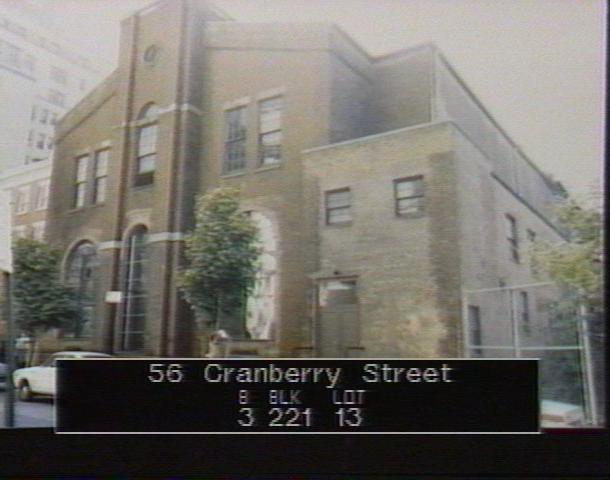
The city photographed every building for its tax records around 1940 and again in the 1980s. NYC Municipal Archives.
Written with AI from the source each entry cites, then fact-checked.
- 1849
Joseph C. Wells builds Plymouth Church as a barn-like auditorium
The church was built in 1849-50 to a design by Joseph C. Wells, who later helped found the American Institute of Architects. Influenced by Manhattan's Broadway Tabernacle, it arranges the pews in an arc before the pulpit so it resembles an auditorium or theater more than a traditional church. The site had been bought from the First Presbyterian Church, which had moved to Henry Street.
“The church was built in 1849–50 and was designed by Joseph C. Wells.”
Source: Wikipedia
- 1860
Henry Ward Beecher puts a ring on enslaved child Sally Maria Diggs, declaring her wed to freedom
Beecher held mock slave auctions in the sanctuary to raise money to buy enslaved people's freedom. On February 5, 1860, before about 3,000 people, a collection plate holding $900 and a gold ring reached the pulpit for Sally Maria Diggs, a child who had escaped slavery in Alabama. He placed the ring on her finger. She returned to the church 67 years later and gave the ring back.
“…when a plate containing $900 and a gold ring reached the pulpit, he placed the ring on Diggs's finger…”
Source: Wikipedia
- 1860
Abraham Lincoln attends services at Plymouth Church, which had invited him to speak
The church had invited Lincoln in October 1859 and offered a $200 fee. He attended services on February 26, 1860, and a plaque now marks the pew where he sat. The lecture first planned for Plymouth ended up at Cooper Union in Manhattan.
“Lincoln accepted and attended services at the church on February 26, 1860. A plaque now marks the pew where he sat.”
Source: Wikipedia
- 1866
E. and G. G. Hook replace the church's first organ with the biggest instrument in the country at the time
The church's first pipe organ gave way in 1866 to a new instrument from E. and G. G. Hook, then the largest in the country. Aeolian-Skinner expanded it in 1937. The organ later accompanied concerts by composers including Philip Glass and Charlemagne Palestine.
Source: Wikipedia
- 1913
The Arbuckle family's gift pays for a garden and classical parish house
The family of coffee merchant John Arbuckle donated money in 1913 for a large garden and a Classic Revival parish house, designed by Woodruff Leeming. The garden, facing Orange Street, holds a Beecher statue and a Lincoln bas-relief by the sculptor Gutzon Borglum, later known for Mount Rushmore.
“In 1913 the family of John Arbuckle, a coffee merchant, donated money to create a large garden and the Classic revival parish house.”
Source: Wikipedia
- 1963
Martin Luther King Jr. preaches on the American Dream at Plymouth Church
In February 1963 Martin Luther King Jr. gave a sermon on the American Dream at the church. Over its history the church has hosted speakers including William Lloyd Garrison, Charles Sumner, Charles Dickens, Ralph Waldo Emerson and Horace Greeley.
“In February 1963, Martin Luther King Jr. delivered a sermon on the American Dream at the church.”
Source: Wikipedia
Further reading
- Plymouth Church (Brooklyn)Wikipedia
Nearby
- Hotel St. George55 Clark Street | 8 entries
- St Francis College Faculty Residence97 Columbia Hts | 4 entries
- First Presbyterian Church124 Henry Street | 3 entries
- Eagle Warehouse28 Old Fulton Street | 5 entries
- Juliana's Pizza19 Old Fulton Street | 2 entries
- Theodore Roosevelt United States Courthouse225 Cadman Plaza East | 3 entries