55 Grove Street
West Village | built 1839
Open on the map7 entries

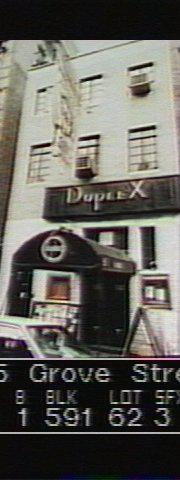
The city photographed every building for its tax records around 1940 and again in the 1980s. NYC Municipal Archives.
Written with AI from the source each entry cites, then fact-checked.
- 1839
Attorney William A. Thompson builds five rented houses on Grove Street, including No. 55
William A. Thompson, a lawyer, put up five brick-faced houses on the north side of Grove Street in 1839 as a speculative venture. He rented them out instead of selling, mostly to working-class tenants, and the first family at No. 55 auctioned its furniture within months of moving in. His daughters inherited the row after his death in 1873, and about then the attic was raised to a full floor.
Source: Daytonian in Manhattan
- 1894
A cabman rooming at No. 55 is jailed for fleecing three Swedish immigrants fresh off a ship
Michael Kelly, a 35-year-old hansom driver renting a room at No. 55, worked with the operator of the Picus Hotel to prey on new arrivals. On August 4, 1894 he met three Swedish brothers at the dock, claimed to be an agent of the Hamburg Line, and took them to the hotel for breakfast. When he demanded $1.50 each for the ride and began whipping them for refusing, a policeman arrested him, and he was sentenced that afternoon to six months on Blackwell's Island.
Source: Daytonian in Manhattan
- 1922
Bootlegger James Grasso, a roomer at No. 55, is shot at a Kenmare Street cafe that rivals had lost
James Grasso, a gangster and bootlegger, rented a room here in 1922. On February 23 he and three associates sat down at the Cafe Venezia at Kenmare and Elizabeth Streets, which two rival bootleggers had recently owned until one was found nearly decapitated and the other was shot down. Gunfire broke out during a cabaret act; Jerry Ruberto died instantly and Grasso was reported dying from an abdominal wound.
Source: Daytonian in Manhattan
- 1930
Former actor Keith Smerage, expelled from Harvard in 1920, is found dead in his rented room
Keith Smerage had been one of 32 Harvard students whom a university "court" expelled in 1920 on suspicion of being homosexual. He turned to acting, but by 1930 had gone a year and a half without a role and was bussing tables in a Village restaurant until he lost that job in July. On September 7 his roommate, a government clerk named Philip Towne, found him dead of gas asphyxiation with the door and window cracks stuffed with paper.
Source: Daytonian in Manhattan
- 1949
Lisette and Evsa Model are evicted while out of town, and friends rescue their belongings
Lisette Model, a Harper's Bazaar photographer, and her husband, the painter Evsa Model, rented the apartment here in 1949 and left for the West that June, with rent paid through September. On September 26 a passing gallery owner found their pictures and furniture dumped on the sidewalk after the landlord had them removed. Within an hour friends including Berenice Abbott had hired a van and moved everything to storage, though two of Evsa's paintings were destroyed.
Source: Daytonian in Manhattan
- 1951
A two-story cabaret opens at No. 55 and becomes the Duplex, a Village comedy and piano-bar room
Two years after the Models' eviction, a renovation turned the basement and ground floor into a cabaret called Upstairs/Downstairs, with drinks below and entertainment above. By the early 1960s it was the Duplex, which a 1978 Villager article described as a venue that put comedians like Dick Cavett and Woody Allen in front of audiences. A 2007 New York Times article listed Barbra Streisand, Joan Rivers and Richard Pryor among those who came through its doors.
Source: Daytonian in Manhattan
- 2007
Rose's Turn piano bar and cabaret closes after 56 years of nightlife at No. 55
Quynhi Pham leased the building in 1990 and renamed the club Rose's Turn, after his mother and the Gypsy song, keeping the piano bar downstairs and cabaret upstairs. It became a favorite of gay patrons, and performers such as Liza Minnelli and Olivia Newton-John reportedly stepped up to sing. In July 2007 The New York Times reported that a new owner, who paid $3.5 million, would not keep the piano bar.
Source: Daytonian in Manhattan
Further reading
- Bootleggers, Evicted Artists, and Nightclubs - 55 Grove StreetDaytonian in Manhattan
- Then & Now photos: 55 Grove StreetVillage Preservation: Greenwich Village Then & Now
Nearby
- Arthur's Tavern57 Grove Street | 4 entries
- Marie's Crisis59 Grove Street | 7 entries
- 82 Christopher Street1 entry
- 78 Christopher Street1 entry
- 84 Christopher Street1 entry
- 61 Grove Street5 entries