Marie's Crisis
59 Grove Street | West Village | built 1839
Open on the map7 entries

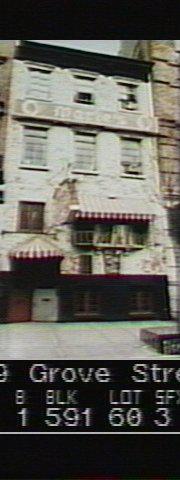
The city photographed every building for its tax records around 1940 and again in the 1980s. NYC Municipal Archives.
Written with AI from the source each entry cites, then fact-checked.
- 1809
Thomas Paine dies in a small wooden house that stood on the site of No. 59
Ill and weakened by strokes, Thomas Paine moved in May 1809 into a small house that Madame Bonneville rented for him in what was then Columbia Street. It was a little building behind a dwelling facing the street. He died there around 9:00 on the morning of June 8, 1809. The house was an earlier building on this site and was torn down in 1839.
Source: Daytonian in Manhattan
- 1839
The widening of Grove Street and William A. Thompson's five new houses replace Paine's death house
In 1836 Columbia Street was widened and renamed Grove Street, taking nearly 20 feet of this lot and leading to the demolition of the main house. The little wooden building where Thomas Paine died stood for three more years. In 1839 the attorney William A. Thompson cleared it and built five matching Federal-style brick houses for middle-class families, No. 59 among them.
Source: Daytonian in Manhattan
- 1852
Resident William Doughty testifies in the divorce case of the actor Edwin Forrest
William M. Doughty, steward of the steamboat Troy, lived at No. 59 with his wife from 1850. In 1852 he was pulled into the bitter divorce of the actor Edwin Forrest and his wife Catharine, who accused Forrest of infidelity. Doughty swore that on a night boat to Troy in 1843 he had seen Forrest and a "Miss Clinton" share the stateroom next to his, and the Tribune printed his testimony on January 15.
Source: Daytonian in Manhattan
- 1905
Nineteen-year-old Loretta Pfeiffer of No. 59 dies on a New Jersey stoop after two men posing as police scare her
Loretta Pfeiffer, whose family lived at No. 59, spent the day at Little Coney Island with her fiance on August 4, 1905. Two men pretending to be officers threatened her with jail unless he paid $5, and she vanished while he went for the money. Passersby found her unconscious on a stoop in North Bergen, New Jersey, where she managed to whisper "Grove street" before dying; a doctor concluded fright had killed her, and the Evening World ran the headline "Girl Held Up By Two Thugs Dies of Fright."
Source: Daytonian in Manhattan
- 1923
Village historians unveil a bronze plaque for Thomas Paine on the front of No. 59
The Greenwich Village Historical Society, formed in 1922, raised money for a memorial tablet on the house standing on the site of Paine's death. Members hoped it would draw attention to the neighborhood's history rather than its bohemian tea rooms. At the unveiling on June 9, 1923, a message from President Harding was read, and the poet Juanita Clivette, known as the Sappho of Greenwich Village, pulled the flag from the plaque and read her own poem.
Source: Daytonian in Manhattan
- 1929
Federal inspectors raid a speakeasy in the lower level of No. 59
By the late 1920s the lower floor of the old Paine house had become a speakeasy, an irony given that the plaque on the front was meant to turn visitors from the Village's nightlife. Federal inspectors O'Brien, McAuliffe and Quinn raided it on January 4, 1929. Police Commissioner Grover Whalen, quoted in The New York Times, branded the place a breeding ground for crime and a danger to local morals.
Source: Daytonian in Manhattan
- 1935
Marie Du Mont opens the Crisis, the Village bar that became Marie's Crisis
In 1935, after the upper floors had been converted to apartments in 1931, Marie Du Mont took over the lower level and opened a bar and cafe named the Crisis, a nod to Paine's pamphlet. It became a favorite spot of Village bohemians, and she bought the whole building in 1957. Decades later it remains known for its sing-along piano bar and the WPA mural behind the counter.
Source: Daytonian in Manhattan
Further reading
- Marie's Crisis Cafe -- No. 59 Grove StreetDaytonian in Manhattan
- Then & Now photos: 59 Grove StreetVillage Preservation: Greenwich Village Then & Now
Nearby
- Arthur's Tavern57 Grove Street | 4 entries
- 55 Grove Street7 entries
- 61 Grove Street5 entries
- 78 Christopher Street1 entry
- 74 Christopher Street1 entry
- 82 Christopher Street1 entry