555 Edgecombe Avenue
Washington Heights | built 1916
Open on the map14 entries

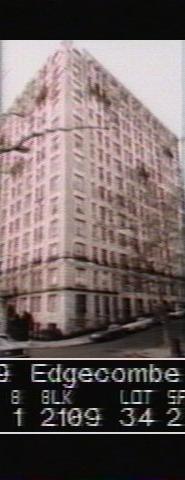
The city photographed every building for its tax records around 1940 and again in the 1980s. NYC Municipal Archives.
Written with AI from the source each entry cites, then fact-checked.
- 1914
The Board of Examiners overrules the buildings department over the height of the Roger Morris Apartments
Schwartz & Gross filed plans for a twelve-story building on May 7, 1914, but the Superintendent of Buildings rejected them, ruling it fifteen stories and over the legal height of 150 feet. The architects argued that the steep slope merely lifted the basement above ground, citing three of their own apartment houses with the same design that had been allowed. The Board of Examiners granted their appeal on May 21, and construction began soon after.
- 1916
A court rules that babies may use the main entrance
At first, infants in the Roger Morris Apartments had to go in through the service entrance on 160th Street and ride the freight elevator. That rule led to a lawsuit in 1916. The New York Supreme Court settled the dispute by ruling that babies could use the building's main entrance, on Edgecombe Avenue.
Source: Wikipedia
- 1916
The Roger Morris Apartments open on Edgecombe Avenue
Architects Schwartz & Gross's 12-story apartment house, developed by contractor Albert Schwarzler, is completed and occupied at the corner of Edgecombe Avenue and West 160th Street. It becomes one of the largest buildings along the ridge overlooking the Harlem River valley below Sugar Hill.
Source: Wikipedia
- 1940
The Roger Morris Apartments become a Black address as white tenants leave
Schwartz & Gross designed the building in 1914–16 as the Roger Morris Apartments, named for the British officer whose estate once covered the site. It housed white tenants when it opened, but between 1938 and 1940 all of them left, and 67 Black residents had moved in by 1940. Big-band leaders Count Basie and Andy Kirk and boxer Joe Louis were among later residents.
Source: Wikipedia
- 1941
Bandleader Count Basie lives at 555 Edgecombe in 1941-42
Count Basie is among the prominent residents the city's Landmarks Preservation Commission lists at 555 Edgecombe Avenue. The report gives 1941 and 1942 as his years in the building. It names him alongside Paul Robeson and his wife Eslanda, who lived there in 1940-42, and Kenneth Clark and Canada Lee, who arrived later.
- 1941
Paul Robeson moves into the building for about two years
The singer and actor takes an apartment at 555 Edgecombe Avenue in the early 1940s, living there for roughly two years as the address draws a growing roster of Black professional and cultural figures. His residency later gives the building's federal landmark designation its name, the Paul Robeson Residence.
Source: Wikipedia
- 1942
Psychologist Kenneth B. Clark moves into 555 Edgecombe Avenue
The social psychologist Kenneth B. Clark moved into 555 Edgecombe Avenue in 1942, according to the city's landmark designation report. The report counts him among the building's best-known residents, though it says most tenants were not celebrities but a cross-section of successful Black New Yorkers such as doctors, teachers and nurses.
- 1943
Actor and producer Canada Lee rents a penthouse apartment at 555 Edgecombe
In 1943 the actor and producer Canada Lee rented a penthouse apartment at 555 Edgecombe Avenue. The city's landmark designation report lists him among the building's prominent residents, together with Paul Robeson and his wife Eslanda, Count Basie and Kenneth Clark, who had all arrived within the previous three years.
- 1943
Tenants stage a rent strike after the building is sold
After the Schwarzler estate sold 555 and 545 Edgecombe Avenue in 1943, thirty-two residents began a rent strike. They said landlord Louis Demburg had cut doorman service, heat and hot water, and blamed the resident manager, Cecil Carter, who had dismissed a doorman and elevator operators. The owners finally fired Carter and brought back the earlier manager, who restored the services.
“Following the sale, 32 residents organized a rent strike…”
Source: Wikipedia
- 1947
Bishop Charles "Sweet Daddy" Grace buys the building
The flamboyant founder of the United House of Prayer for All People purchases 555 Edgecombe Avenue, adding the Sugar Hill address to his church's real-estate holdings along the East Coast. Grace's ownership continues the building's run as a magnet for prominent Black New Yorkers through the postwar years.
Source: Wikipedia
- 1960
After Daddy Grace's death, followers try to block the sale of 555 Edgecombe
Daddy Grace was still the owner when he died in January 1960. In March Alexander Gross said he had purchased 545 and 555 Edgecombe Avenue, and he took them over in May while Grace's followers tried to stop the trustees from cashing his $1.055 million check. Gross resold both buildings in December to Matthew Golson, whose family held 555 until 2022.
Source: Wikipedia
- 1976
The building is named a National Historic Landmark for Paul Robeson
Singer, actor and activist Paul Robeson lived at 555 Edgecombe in the early 1940s. On December 8, 1976, the building was designated a National Historic Landmark as the Paul Robeson Residence, and the city made it a landmark in 1993. In 2009 the corner was co-named Paul Robeson Boulevard and Count Basie Place.
Source: Wikipedia
- 1993
The Landmarks Preservation Commission designates the Roger Morris Apartments a city landmark
The Landmarks Preservation Commission designated 555 Edgecombe Avenue a landmark on June 15, 1993, after a public hearing on July 15, 1991 at which two speakers testified in favor. The report describes the Roger Morris Apartments, known simply as 555, as significant for housing many of New York's successful African Americans, and notes that by the mid-1940s it was considered part of Sugar Hill.
- 1994
Marjorie Eliot begins free Sunday jazz concerts in her apartment
After her son Philip died in 1992, pianist Marjorie Eliot marked the anniversary with an outdoor concert at the Morris-Jumel Mansion across the street. The next year she moved the memorial into her apartment, 3-F, and it became a weekly event: every Sunday at 3:30, with no tickets or charge, musicians play for up to 50 guests.
Source: openculture.com
Further reading
- 555 Edgecombe AvenueWikipedia
- Marjorie Eliots Parlor JazzPlace Matters
- The most elite apartment building in HarlemEphemeral New York
Nearby
- Morris-Jumel Mansion65 Jumel Terrace | 13 entries
- Prince Hall Masonic Temple454 West 155th Street | 3 entries
- Sugar Hill Development400 West 155th Street | 3 entries
- 409 Edgecombe Avenue4 entries
- Church of the Intercession550 West 155th Street | 11 entries
- Church of St. Catherine of Genoa504 West 153rd Street | 3 entries