Bronx General Post Office
558 Grand Conc | also 558 Grand Concourse | Concourse Village | built 1937
Open on the map11 entries

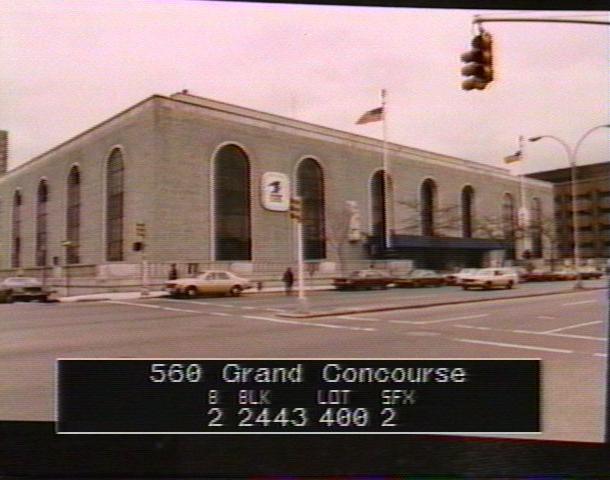
The city photographed every building for its tax records around 1940 and again in the 1980s. NYC Municipal Archives.
Written with AI from the source each entry cites, then fact-checked.
- 1913
The federal government buys 13 buildings on Mott Avenue, completing the post office block
After buying a 276-by-100-foot plot on Spencer Place from Henry L. Morris for $100,000 in January 1910, the federal government moved to take the rest of the block by eminent domain. In November 1913 it bought 13 buildings at 554-582 Mott Avenue, now the Grand Concourse, and owned the whole block. Those earlier buildings stood on the site of today's post office, and the government went on renting them to tenants.
“…the U.S. government bought 13 buildings at 554–582 Mott Avenue that November, thereby obtaining full ownership of the block…”
Source: Wikipedia
- 1936
Postmaster General James Farley lays the cornerstone and attacks New Deal critics
Albert Goldman, the city's postmaster, and Postmaster General James A. Farley officiated as the cornerstone was laid on June 13, 1936. Farley used the ceremony to go after critics of the New Deal.
“Farley made the occasion an opportunity to assail the critics of the New Deal…”
- 1937
The Bronx Central Annex opens before 3,000 people
Postmaster General Farley dedicated the building on May 15, 1937, in front of 3,000 people. It was expected to handle 500,000 pieces of mail a day and also housed the Internal Revenue Bureau, the Customs Service and the Treasury. William H. Farrell Jr., who lived in the Bronx and had been with the Post Office Department since 1891, served as its first superintendent until 1943.
Source: Wikipedia
- 1937
Thomas Harlan Ellett designs a gray-brick post office with marble arches
Consulting architect Thomas Harlan Ellett, working for the Treasury's Supervising Architect, called his design "contemporary Georgian." The building fills a whole block on a granite terrace, its gray brick walls set with round-arched Vermont marble frames. Flanking the Grand Concourse entrance are two 14-foot white marble sculptures, Henry Kreis's The Letter and Charles Rudy's Noah, chosen over nearly 400 other entries.
“Ellett regarded the building as being designed in a "contemporary Georgian" style.”
Source: Wikipedia
- 1938
A Fordham priest's protest forces a Walt Whitman quote off the lobby murals
When Ben Shahn and Bernarda Bryson hung mockups of their murals in the lobby in December 1938, Ignatius W. Cox, a priest teaching at Fordham University, objected to a Walt Whitman quotation he said endorsed religious skepticism. Work stopped for a time and another quotation was substituted. A reference to the Deering company was also dropped from a panel over worries about commercial promotion.
“Ignatius W. Cox, a priest on the faculty at Fordham University in the Bronx, objected to the inclusion of a quotation by Walt Whitman…”
Source: Wikipedia
- 1939
Ben Shahn and Bernarda Bryson finish 13 murals of American workers
Chosen in 1938 by Ellett and Henry Varnum Poor from 198 submissions, Ben Shahn and Bernarda Bryson completed the lobby's 13 egg-tempera panels in August 1939. Twelve show workers in industry and farming, drawn from photographs Shahn took for the Farm Security Administration between 1935 and 1938. The largest, on the north wall, shows Whitman speaking to American workers and their families.
“They are derived from photographs that Shahn took between 1935 and 1938, while he was employed by the Farm Security Administration.”
Source: Wikipedia
- 1955
The health department puts an X-ray machine in the post office lobby
In 1955 the New York City Department of Health put a temporary X-ray machine in the lobby to encourage customers and mail carriers to get tested for tuberculosis. The post office had already added other services for the public: an automatic Mailomat sorting machine in 1947, a stamp vending machine in 1948, and in 1951 one of the city's first curbside mailboxes for drivers.
“…the New York City Department of Health temporarily installed an X-ray machine in the building's lobby in 1955…”
Source: Wikipedia
- 1996
Union leader Moe Biller pays to restore the faded Shahn murals
By the mid-1990s the murals had deteriorated again. After reading a New York Times article about them, Moe Biller, president of the American Postal Workers Union, hired conservator Alan Farancz to restore them, and Farancz and an assistant finished the work in 1996. In 1995 the Times had called the murals possibly the greatest publicly displayed art in the Bronx.
Source: Wikipedia
- 2013
The lobby becomes an interior landmark as the Postal Service moves to sell
When the Postal Service announced plans to sell the building, nearly every Bronx elected official objected, and only the exterior was protected as a city landmark. Preservationists, Representative José Serrano and Ben Shahn's son Jonathan pushed to protect the murals too. The Landmarks Preservation Commission designated the lobby an interior landmark on December 17, 2013.
“…the agency granted the building's interior landmark status on December 17, 2013…”
Source: Wikipedia
- 2014
Youngwoo & Associates buys the post office for $19 million
Youngwoo & Associates, favored by local officials for its marketplace proposal, bought the building in September 2014 for $19 million and planned to rebrand it Bronx Post Place, keeping a small post office. The redevelopment stalled, a 2019 sale for more than $70 million fell through, and a rooftop restaurant, Zona de Cuba, opened that year and became the largest tenant.
Source: Wikipedia
- 2025
A residential developer buys the post office and CUNY leases it for Hostos
In July 2025 Youngwoo & Associates sold the building to the residential developer Maddd Equities for $44 million. That September the City University of New York signed a 35-year lease on part of it for a life-science facility for neighboring Hostos Community College, and the next year CUNY paid $201 million for the building.
“In July 2025, Youngwoo & Associates sold the building to a residential developer, Maddd Equities, for $44 million.”
Source: Wikipedia
Further reading
- Bronx General Post OfficeWikipedia
Nearby
- Hostos Center for the Arts & Culture450 Grand Conc | 1 entry
- Cardinal Hayes High School650 Grand Conc | 4 entries
- Franz Sigel Park Comfort Station671 Grand Conc | 2 entries
- Lincoln Hospital2824 Park Avenue | 2 entries
- 730 Grand Conc3 entries
- Bronx Terminal Market610 Exterior Street | 4 entries