Chamber of Commerce Building
59 Liberty Street | also 65 Liberty Street | Financial District | built 1901
Open on the map12 entries

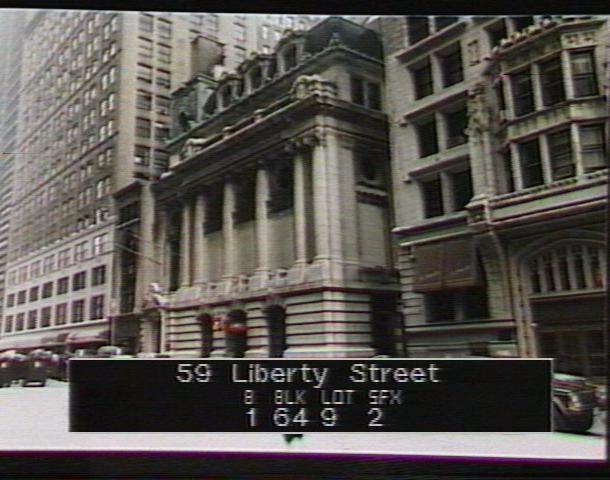
The city photographed every building for its tax records around 1940 and again in the 1980s. NYC Municipal Archives.
Written with AI from the source each entry cites, then fact-checked.
- 1901
Chamber president Morris K. Jesup buys the Real Estate Exchange Building for $700,000
In January 1901 Morris K. Jesup, the chamber's president, bought the Real Estate Exchange Building at 65 Liberty Street from the Central Realty, Bond, and Trust Company for $700,000. The iron-fronted, six-story building had been finished in 1884, and the chamber had moved into it then.
“The chamber's president Morris K. Jesup bought the Real Estate Exchange Building the next month from the Central Realty, Bond, and Trust Company, at a cost of $700,000.”
Source: Wikipedia
- 1901
Chamber members march to the site for the cornerstone laying
On November 8, 1901, more than 100 chamber members walked from the Mutual Life Insurance Building to the building site, where Morris K. Jesup spread mortar for the cornerstone with a sterling silver trowel and declared the stone laid. The stone held dozens of magazines, books and newspapers, coins, medals and lists of members.
Source: Daytonian in Manhattan
- 1902
The largest one-piece rug imported into the country arrives for the assembly room
A few days after the November 1902 dedication, a carpet for the marble floor of the assembly room arrived from Berlin, described as the largest one-piece rug imported into the country to that date. It was designed by W. & J. Sloane, weighed 2,750 pounds and spanned 59 feet 8 inches by 37 feet 8 inches. Fifty men were needed to carry it in. The New York Tribune noted that the looms in Germany had to be strengthened several times and that part of an outside wall was taken away to get the rug out.
Source: Daytonian in Manhattan
- 1902
The Chamber of Commerce dedicates its new marble headquarters
The New York Chamber of Commerce, founded in 1768, opened its purpose-built Beaux-Arts headquarters designed by James B. Baker. Former president Grover Cleveland delivered the dedication address and President Theodore Roosevelt attended, marking the culmination of a building fund the Chamber had raised since 1897.
Source: Wikipedia
- 1903
Statues of Hamilton, Clinton and Jay are unveiled on the facade
Sculptors Daniel Chester French and Philip Martiny's eight-foot marble figures of Alexander Hamilton, DeWitt Clinton and John Jay were dedicated on the building's exterior, joining Karl Bitter's carved relief of Mercury and Ceres above the entrance.
Source: Wikipedia
- 1922
Helmle & Corbett finish a remodel that adds a floor and a new banquet room
The building closed in June 1921 while Helmle & Corbett remodeled it, and the work was done by the first week of January 1922. They added an entire floor, visible from the street only as a change to the mansard roof, and made the former library the main banquet room, with a smaller dining room on the third floor. The Times described the grand staircase as inspired by the Ducal Palace in Venice and said it had travertine steps.
Source: Daytonian in Manhattan
- 1926
Weathered statues come down from the facade
After more than two decades of exposure to weather and chemical pollution, the marble figures of Hamilton, Clinton and Jay had deteriorated badly enough that they were removed from the building's exterior.
Source: Wikipedia
- 1966
The Landmarks Preservation Commission designates the building as Calendar No. 1
On January 18, 1966, the Commission designated the Chamber of Commerce Building as a landmark, listed as Calendar No. 1. No one spoke at the hearing, and the owner wrote that it did not oppose designation. One commissioner dissented, and the report called it a bold design standing out among skyscrapers.
- 1979
Moving the Great Hall's 300 portraits sparks a controversy
When the chamber moved to 200 Madison Avenue in 1979, its new offices had space for just 10 to 20 of the 300 portraits in the Great Hall. The old building could store about 200, which left about 80 to be given away. Art experts considered the portraits integral to the room's character, and by early 1983 the chamber's collections curator said it was no longer selling them.
“The new offices could only fit 10 to 20 of the Great Hall's 300 portraits, but the Chamber of Commerce Building could store about 200 of these portraits.”
Source: Wikipedia
- 1979
The Chamber leaves downtown for Midtown after more than two centuries
The Chamber of Commerce relocated its headquarters to Midtown Manhattan, leaving the Liberty Street building vacant for roughly a decade before a new tenant, the International Commercial Bank of China, purchased it in 1989.
Source: Wikipedia
- 1989
The International Commercial Bank of China buys the building after ten empty years
The building stood empty for ten years after the chamber left, because potential tenants balked at the cost of bringing it up to modern standards and potential buyers had twice failed to complete a sale. In 1989 it was bought for $5.6 million or $5.75 million by the International Commercial Bank of China, which is now Mega International Commercial Bank. Haines Lundberg Waehler later renovated it into office space.
Source: Wikipedia
- 1991
Acid rain damage forces a major marble restoration
After decades of acid rain and pollution ate away at its marble facade, the Chamber of Commerce Building was restored by architects Haines Lundberg Waehler in 1990 and 1991. The project replaced more than 25,000 tons of the building's original white marble.
Source: Daytonian in Manhattan
Further reading
- Chamber of Commerce Building (Manhattan)Wikipedia
- The 1902 Chamber of Commerce Bldg -- 65 Liberty StreetDaytonian in Manhattan
Nearby
- Liberty Tower53 Liberty Street | 12 entries
- 14 Maiden Lane4 entries
- Marine Midland Building140 Broadway | 14 entries
- 63 Nassau Street3 entries
- Cushman Building174 Broadway | 6 entries
- Equitable Building120 Broadway | 13 entries