Marine Midland Building
140 Broadway | also 70 Liberty Street | Financial District | built 1968
Open on the map14 entries

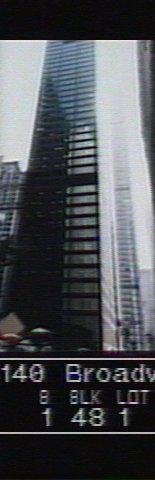
The city photographed every building for its tax records around 1940 and again in the 1980s. NYC Municipal Archives.
Written with AI from the source each entry cites, then fact-checked.
- 1896
Earlier on this block, the National Bank of Commerce starts a tower with controversial nude figures by Karl Bitter
The National Bank of Commerce began an 18-story Renaissance Revival tower at 31-33 Nassau Street, on the block where 140 Broadway now stands, in 1896. James B. Baker designed it in granite, brick and terra cotta, and the sculptor Karl Bitter carved two large figures above its main entrance. The figures proved controversial because they were nude.
Source: Wikipedia
- 1962
Developer Erwin Wolfson dies, and Harry Helmsley is asked to form a company to build 140 Broadway
Erwin S. Wolfson, who had assembled the Broadway block and was a founder of the Diesel Construction Company, died unexpectedly in June 1962, when a 36-story tower was planned for the site. Diesel's president, Carl A. Morse, then turned to Harry Helmsley to set up the 140 Broadway Development Corporation.
- 1965
Skidmore drops a pale gridded design for a smooth black skin that contrasts with One Chase Manhattan
By 1965 Skidmore, Owings & Merrill had abandoned its early scheme for a light-colored grid and given 140 Broadway a trapezoidal plan and an exceptionally smooth black aluminum and bronze-glass skin. Critic John Morris Dixon reasoned that a shiny little brother to One Chase Manhattan Plaza would have looked like a poor relation. Museum of Modern Art curator Arthur Drexler saw parallels with Ad Reinhardt's black paintings.
“…a little brother to Chase [One Chase Manhattan Plaza] in the same shiny finish surely would have looked like a poor relation.”
- 1965
Marine Midland Bank leases 20 floors and wins naming rights
In October 1965, Marine Midland Bank agrees to lease both basements and the tower's first 20 floors, becoming its largest tenant. Developer Harry Helmsley's corporation grants the bank naming rights in exchange, and its second floor houses the main banking hall. By March 1967 the tower is 90 percent rented, and the Department of Buildings certifies it complete that October.
Source: Wikipedia
- 1966
A quiet construction job builds 140 Broadway with welded steel and muffling blankets
Work at 140 Broadway employed six hundred workers from 26 trades and was planned to be one of the quietest big jobs in the city. Demolition was done in evenings and on Saturdays, and heavy wire-mesh blankets absorbed noise and debris. A butt-welded frame reduced the need for loud bolting and riveting, and the 14,000-ton frame rose about a floor every two days before a U.S. Steel crew topped it off in June 1966.
“…special steel wire mesh blankets ... weighing several hundred pounds each were used to absorb noise and contain debris…”
- 1968
A press party celebrates the finished tower, and Ada Louise Huxtable calls it among the city's handsomest
In late March 1968 a reception and press party marked the completion of the Marine Midland tower. Ada Louise Huxtable of the New York Times was probably the first to review it, calling it among the handsomest in the city and New York's ultimate skin building. She singled out the accent of Isamu Noguchi's cube. Six years later she called it one of the buildings she admired most anywhere.
- 1968
Isamu Noguchi installs the sculpture The Cube on the plaza
Architect Gordon Bunshaft suggests bringing in sculptor Isamu Noguchi, who first proposes a cluster of rough-hewn monoliths for the plaza facing Broadway. Developer Harry Helmsley judges that too costly, so Bunshaft proposes merging the rocks into one block. Noguchi's finished sculpture, a vermilion rhombohedron 28 feet tall balanced on one corner with a cylindrical hole through its center, is installed in 1968, with its aluminum frame detailed by Skidmore, Owings & Merrill.
Source: Wikipedia
- 1969
A bomb explodes on the eighth floor, injuring 20 people
At around 10:30 p.m. on August 20, 1969, a bomb equivalent to roughly 25 sticks of dynamite explodes in a hallway near the elevators, injuring 20 bank employees working the night shift in the stock bookkeeping department. Floor-to-ceiling file units weighing three tons each absorb most of the blast but are shoved about a foot, and the explosion blows out windows and opens a five-foot hole in the concrete floor. Bomber Sam Melville is convicted and later killed during the 1971 Attica Prison riot.
Source: Wikipedia
- 1972
Ronald Kaufman tries and fails to bomb 140 Broadway with a device hidden in a bank vault
In 1972 a man named Ronald Kaufman tried unsuccessfully to bomb 140 Broadway by hiding an explosive in a bank vault in the building. The attempt came three years after the 1969 bombing of the eighth floor that injured 20 people.
“In 1972, Ronald Kaufman made an unsuccessful attempt to bomb the building by hiding an explosive in a bank vault.”
Source: Wikipedia
- 1981
A 47th-floor fire injures five elevator riders and exposes missing firefighter keys citywide
On October 20, 1981, a fire broke out on the 47th floor of 140 Broadway. An elevator carrying five workers opened its doors on that floor, injuring them, and they had to seal the door by hand. An investigation found that hundreds of city buildings lacked the firefighter elevator keys that a 1973 law, with a September 1981 deadline, required, and numerous landlords were later issued summonses.
“On October 20, 1981, a fire occurred at 140 Broadway's 47th floor. When an elevator with five workers inside opened its doors on the 47th floor, the occupants were injured…”
Source: Wikipedia
- 1984
A disgruntled engineer hides air-conditioning parts in a sprinkler tank, and divers retrieve them
In 1984 a disgruntled maintenance engineer named Robert Rodriguez removed parts of the tower's air-conditioning system and hid key components, including a steam-bearing case cover and a thrust-bearing housing cover, in a tank on the 37th floor that served the sprinkler system. About 10,000 people were without air conditioning for several weeks. Rodriguez was arrested in June 1984, and scuba divers recovered the parts.
Source: Wikipedia
- 1998
Silverstein Properties buys the tower for $190 million
After developer Harry Helmsley dies in January 1997, his widow Leona Helmsley sells off more than a dozen of his properties. Though only 59 percent occupied and in need of renovation, 140 Broadway draws six serious bidders, and Larry Silverstein's Silverstein Properties buys it for $190 million in January 1998. Silverstein then spends $60 million renovating the tower and leasing out its vacant space.
Source: Wikipedia
- 1999
A renovation repaves the plaza in granite and adds a polished black monument to Harry Helmsley
In 1999, with the building half vacant, its new owners began a major renovation. The plaza was repaved in granite, and the low circular benches on Cedar Street gave way to raised tree planters. The owners also put up a large, polished black granite monument to Harry Helmsley near the corner of Broadway and Cedar Street.
- 2013
The city designates the Marine Midland Building a landmark
On June 25, 2013, the New York City Landmarks Preservation Commission designates 140 Broadway, long known as the Marine Midland Building, a city landmark. The designation recognizes Gordon Bunshaft's 1967 tower for Skidmore, Owings & Merrill, admired by critics including Ada Louise Huxtable, who called it one of the buildings she most admired anywhere.
Source: Wikipedia
Further reading
- 140 BroadwayWikipedia
Nearby
- Chamber of Commerce Building59 Liberty Street | 12 entries
- Liberty Tower53 Liberty Street | 12 entries
- Equitable Building120 Broadway | 13 entries
- 14 Maiden Lane4 entries
- American Surety Building100 Broadway | 11 entries
- One Chase Manhattan Plaza28 Liberty Street | 12 entries