Martin M. Myers House
59 Sullivan Street | SoHo | built 1820
Open on the map5 entries

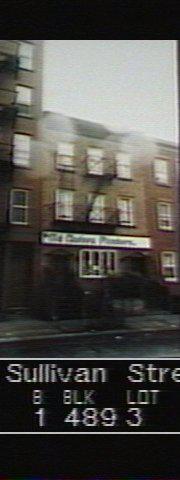
The city photographed every building for its tax records around 1940 and again in the 1980s. NYC Municipal Archives.
Written with AI from the source each entry cites, then fact-checked.
- 1846
Lamplighter Martin Myers wins an $8.88 refund after protesting his tax bill on 59 Sullivan Street
Martin Myers worked as a lamplighter, a trade that had only appeared after gas street lighting began in 1823. Annoyed by his 1845 real estate tax bill, he complained to the city. On May 5, 1846, the Committee on Annual Taxes agreed that a clerk had miscopied the assessed value of his house and lot, and approved a refund of $8.88.
Source: Daytonian in Manhattan
- 1879
A boarder's teenage son helps expose a jewel-theft ring that used him as an unwitting courier
Widow Mary Seaman lived at 59 Sullivan Street with her teenage son Charles. In February 1879 the New York Times reported that he had been the key to breaking up a gang of four teenagers who stole jewelry from the safe of a firm where one of them clerked. The gang hired Charles at $4 a week to carry the loot to pawnshops, and detectives called him an innocent party.
Source: Daytonian in Manhattan
- 1885
A boarder's Sun ad for "a very fine boy" brings a curious visitor, who is offered a three-day-old baby for $2
A Mrs. Pose, who boarded at 59 Sullivan Street, ran a trade in infants. In 1883 a woman told a court she had bought a baby for $10 at Mrs. Pose's house, and on November 25, 1885 Mrs. Pose advertised in The Sun for a fine boy. A young man who answered out of curiosity was told the three-day-old was remarkably intelligent and could be taken away for $2, if he had a good home to take it to.
Source: Daytonian in Manhattan
- 1903
The Spina family converts the ground floor of 59 Sullivan Street into a saloon with twin stoops
In 1903 the Spina family, by then the building's owners, renovated the ground floor of the former Federal rowhouse for a saloon. The change needed an industrial-grade beam, visible from the street, with a large window flanked by two doorways, one to the bar and one to the upper floors, each reached by its own stoop. Francesco Spina first held the liquor license, and the saloon ended with Prohibition.
Source: Daytonian in Manhattan
- 1905
Two organ grinders playing "Tammany" draw a protesting crowd after a policeman stops the music
Organ grinder Giorgana Lozzetto lived in the building in 1905. On the night of August 17 he and a friend were pushing a hurdy-gurdy home when passersby asked for the Tammany tune. A policeman said such music could not be played after 7 p.m. and led them toward the stationhouse, while a crowd offered $5 to keep them playing and followed along. The two were soon released and went home with a windfall from the impromptu protest.
Source: Daytonian in Manhattan
Further reading
- The Martin M. Myers House - 59 Sullivan StreetDaytonian in Manhattan
Nearby
- 61 Sullivan Street1 entry
- 57 Sullivan Street House57 Sullivan Street | 6 entries
- 63 Sullivan Street3 entries
- 65 Sullivan Street1 entry
- 55 Sullivan Street1 entry
- 67 Sullivan Street1 entry