6 Morton Street
West Village | built 1836
Open on the map5 entries

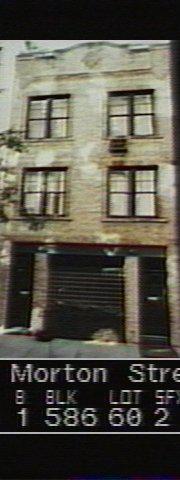
The city photographed every building for its tax records around 1940 and again in the 1980s. NYC Municipal Archives.
Written with AI from the source each entry cites, then fact-checked.
- 1836
Charles Oakley builds a store-and-house at 6 Morton Street that later gets a patterned-brick front
Charles Oakley, a New York-born agent, built No. 6 Morton Street in 1836 as a Federal-style building with a peaked roof. A new storefront went in by 1889, when a butcher shop occupied the ground floor, and the roof was raised to a full third story. Some time before 1938 the facade received a new cladding of patterned brick, and in 1943 the storefront was replaced with a residential entrance.
“No. 6 Morton Street was constructed in 1836 for New York -…”
- 1846
An exploding spirit-gas lamp sets off a fire alarm at Samuel Decou's bakery at 6 Morton Street
Samuel Decou ran the bakery at 6 Morton Street in 1846. One evening that year the fire bells rang when a young girl was handling a spirit gas lamp that burst. It threw burning fluid over her hands and arms. Firemen put out the blaze, and the Evening Post called the damage trifling, although another paper had reported the bakery destroyed.
Source: Daytonian in Manhattan
- 1849
A man listed at 6 Morton Street is arrested for extorting William B. Astor
Franklin G. Bragg, listed at 6 Morton Street in 1849, and Isaac A. Biggs wrote William Backhouse Astor letters demanding $50,000 and threatening to burn Astor buildings. Working with police, Astor filled a package with fake bills. Bragg collected it at the Astor home on the morning of May 13, followed by undercover officers, and both men were arrested.
Source: Daytonian in Manhattan
- 1899
Police tell a Morton Street family their son is dead and find him alive
After a man died by suicide in Central Park in November 1899, police found a notebook in his pocket with the name Eugene Sullivan and went to 6 Morton Street to inform the family. Eugene, an expressman and the son of owner Patrick Sullivan, was at home and very much alive. He had no idea how a notebook filled with musical terms and popular songs carrying his name had reached the dead man.
Source: Daytonian in Manhattan
- 1923
A newspaper sale story wrongly links 6 Morton Street to Aaron Burr
When Patrick Sullivan sold 6 Morton Street to James L. Van Sant in January 1923, the New York Times said the house had once belonged to former Vice President Aaron Burr. That was not quite right. Burr had owned the land as part of his Richmond Hill estate, but he never owned the building, which dates to 1836. The paper also noted the sale was the first in 33 years.
Source: Daytonian in Manhattan
Further reading
- The Much-Altered 1836 Johnson Bakery - 6 Morton StreetDaytonian in Manhattan
Nearby
- 8 Morton Street5 entries
- 268 Bleecker Street2 entries
- 270 Bleecker Street2 entries
- Rev. C. F. Frey House266 Bleecker Street | 4 entries
- 264 Bleecker Street5 entries
- 10 Morton Street2 entries