60 Morton Street
West Village | built 1848
Open on the map6 entries

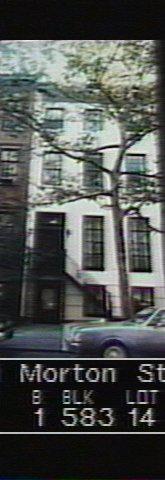
The city photographed every building for its tax records around 1940 and again in the 1980s. NYC Municipal Archives.
Written with AI from the source each entry cites, then fact-checked.
- 1848
Two speculative houses rise at 60 and 62 Morton Street, and No. 60 goes to Samuel Baker
A matching pair of speculative houses at 60 and 62 Morton Street went up in 1847-48, built by the clothier John D. Scott and the lumber dealer Helmus H. Wells. Scott sold No. 60 to Samuel W. Baker, a partner in Wells's lumber firm, Wells, Bontecou & Co. The three-story house had Corinthian pilasters beside its entrance and pediments over the parlor-floor openings.
Source: Daytonian in Manhattan
- 1875
Crates for a chaplain's friends are addressed to the house, and a newspaper smells a customs dodge
Lumber dealer Francis Bontecou lived here in the 1870s and was close to the Rev. J. P. Newman, a Methodist minister who became Senate chaplain. In December 1875 the New York Daily Observer accused Newman of sneaking duty-free goods into port. It said eight crates of Chinese curiosities from the bark Kate Kearney were addressed to Col. T. B. Thorpe for Bontecou at 60 Morton Street.
Source: Daytonian in Manhattan
- 1905
A boarder is arrested for taking his young daughter from her school
Insurance agent Andrew La Croix took rooms here in 1905 after separating from his wife. On December 19 he waited outside St. Vincent de Paul's school on West Fourth Street and took his 6-year-old daughter Margaret. Two nights later police arrested him at a Hudson Street prayer meeting, and the Brooklyn Daily Eagle reported the girl was returned to her mother.
Source: Daytonian in Manhattan
- 1919
The Knights of Columbus run a service club for soldiers and sailors in the house
After the United States entered World War I, the Knights of Columbus took the house and turned it into the Veronica Council Service Station, which offered recreation and temporary lodging to servicemen. Newspapers announced dances here in 1919 for men in uniform. Afterward the club turned to charity, and in December 1921 it announced plans to give out more than 2,000 Christmas baskets from the Morton Street clubhouse.
Source: Daytonian in Manhattan
- 1926
Actress Norma Millay and her husband are among the first tenants after the apartment conversion
A 1926 renovation split the house into apartments and removed the stoop for a basement entrance. Norma Millay, a singer and actress, and her husband Charles Ellis were among the earliest tenants, and the Evening Post called him well known in the Provincetown Playhouse group. Her sister, the poet Edna St. Vincent Millay, lived close by at 75-1/2 Bedford Street.
Source: Daytonian in Manhattan
- 1980
John Belushi and Judith Jacklin live in the basement-and-parlor duplex
By 1980 the duplex was home to John Belushi and his wife Judith Jacklin, who had married in 1976. Bob Woodward's 1984 biography Wired describes their bedroom on the basement level and next to it a music room Belushi called the vault, with soundproofed walls and a high-end stereo.
Source: Daytonian in Manhattan
Further reading
- The 1848 Samuel W. Baker House - 60 Morton StreetDaytonian in Manhattan
- Then & Now photos: 60 Morton StreetVillage Preservation: Greenwich Village Then & Now
Nearby
- James H. Noe House58 Morton Street | 6 entries
- 66 Morton Street6 entries
- Russell Trall House52 Morton Street | 4 entries
- Cornelius Oakley House59 Morton Street | 5 entries
- Thaddeus Hyatt House46 Morton Street | 5 entries
- 428 Hudson Street2 entries