Cornelius Oakley House
59 Morton Street | West Village | built 1828
Open on the map5 entries

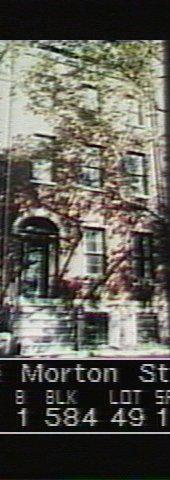
The city photographed every building for its tax records around 1940 and again in the 1980s. NYC Municipal Archives.
Written with AI from the source each entry cites, then fact-checked.
- 1828
Tobacco merchant Cornelius Oakley builds a Federal house on Trinity Church land
Cornelius Warner Oakley, a tobacco merchant with offices at 108 Front Street, put up the house in 1828 as one of the first on Morton Street. The ground belonged to Trinity Church, and he held it on a lease. The lot also took in a brick carriage house behind it on Barrow Street. With no houses yet across the way, the front of the house had a clear view south to the St. John's burying ground.
Source: Daytonian in Manhattan
- 1888
A self-supporting home for working women opens in the house
In 1888 the house was taken over by the Girls' Endeavor Society, a branch of the Association of Working Girls' Societies. The home rented its two parlors to the society and filled the other rooms with young milliners, governesses, students and typists. State labor commissioner Carroll D. Wright wrote in 1889 that the home had nearly paid its own way in its first year.
Source: Daytonian in Manhattan
- 1902
The city rents the parlor floor for a kindergarten
In July 1902 the city gave the Board of Education permission to lease the parlor floor from the Endeavor Club for kindergarten classes. The yearly rent was $500, including light, heat and janitor service. The city renewed the lease at least through 1904, and a branch of the Charity Organization Society later used the same floor.
Source: Daytonian in Manhattan
- 1928
Journalists Bruce and Beatrice Gould see their play taken by Jed Harris
Charles Bruce Gould and his wife Beatrice Blackmar Gould, both newspaper writers, were living here in 1928. On January 17 the New York Evening Post reported that producer Jed Harris had taken their play Man's Estate, which they wrote together during a two-month vacation. In 1935 the couple became co-editors of the Ladies' Home Journal.
Source: Daytonian in Manhattan
- 1930
The house is picked in the 1930s as the city's best late Federal design
The Landmarks Commission's 1969 report calls this three-and-a-half-story brick house a standout of Federal architecture, with a doorway of paired Ionic columns, leaded fanlight and stone arch, plus segmental dormers. The Federal Arts Project's Index of American Design chose it in the 1930s as the city's outstanding late Federal example. By then it had already been cut into apartments, though the staircase and parlor-floor details survived.
“…selected in the Nineteen-thirties by the Federal Arts Project of the Index of American Design as the outstanding example of late Federal style in the City…”
Further reading
- The Cornelius Oakley House - 59 Morton StreetDaytonian in Manhattan
- Then & Now photos: 59 Morton StreetVillage Preservation: Greenwich Village Then & Now
Nearby
- 48 Commerce Street5 entries
- 46 Commerce Street5 entries
- 60 Morton Street6 entries
- James H. Noe House58 Morton Street | 6 entries
- 66 Morton Street6 entries
- 81 Barrow Street3 entries