Edmund Hurry House
613 Hudson Street | West Village | built 1842
Open on the map4 entries

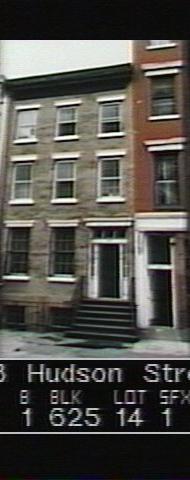
The city photographed every building for its tax records around 1940 and again in the 1980s. NYC Municipal Archives.
Written with AI from the source each entry cites, then fact-checked.
- 1842
Architect Edmund Hurry builds a brick Greek Revival house for himself at 613 Hudson Street
In 1842 Edmund Hurry designed and built a three-story brick house for his own use, set over a shallow brownstone English basement, with a doorway framed by plain pilasters and sidelights. During those years he also sat as a school commissioner for the Ninth Ward. He moved out in 1851, and the following year was named Consulting Architect for the New York Crystal Palace, the peak of his career.
Source: Daytonian in Manhattan
- 1875
A sheriff buys the house at his own foreclosure auction and runs it as a boarding house
Sheriff William C. Connor ran the foreclosure sale of the house on April 8, 1875, and then bought it himself. He operated it as a boarding house, and one tenant was Elia Jane Huling, who taught primary pupils at Grammar School No. 47 on East 12th Street. That July he deeded it to Jessie Clark, wife of Daniel, who passed it to Sarah Crygler three days later, starting a rapid string of sales.
Source: Daytonian in Manhattan
- 1877
William C. Carpenter buys 613 Hudson Street and runs it as a lodging house for over two decades
On August 20, 1877, William C. Carpenter bought the house for $5,000. He ran it as a lodging house, which the source distinguishes from a boarding house: no meals or common space, only an overnight bed at a much lower price. He and F. S. Carpenter, probably his son, kept it going until at least 1898.
Source: Daytonian in Manhattan
- 2002
A renovation turns the former rooming house back into a private home with a rebuilt stoop
After more than a century of renters, a renovation completed in 2002 returned the house to a private residence. The stoop, removed during the 20th century, was reproduced, and six-over-six window mullions were installed. The aim was to bring the brick house as close as possible to its 1842 appearance.
Source: Daytonian in Manhattan
Further reading
- The 1842 Edmund Hurry House -- No. 613 Hudson StreetDaytonian in Manhattan
- Then & Now photos: 613 Hudson StreetVillage Preservation: Greenwich Village Then & Now
Nearby
- Capt. John Joseph House64 Jane Street | 4 entries
- 797 Greenwich Street1 entry
- Trowmart Inn607 Hudson Street | 4 entries
- 299 West 12th Street4 entries
- 791 Greenwich Street1 entry
- The Cezanne61 Jane Street | 2 entries