62 Bank Street
West Village | built 1836
Open on the map5 entries

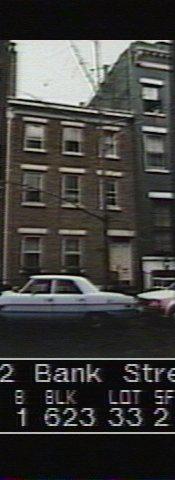
The city photographed every building for its tax records around 1940 and again in the 1980s. NYC Municipal Archives.
Written with AI from the source each entry cites, then fact-checked.
- 1836
Dry-goods merchant Leonard Kirby has a Flemish-bond brick house built at 62 Bank Street
Built in 1836 for Leonard Kirby, who kept a dry-goods business at 47 Cedar Street, this three-story house still used the Federal habit of Flemish-bond brickwork even though Greek Revival fashion was taking over. The landmarks commission called it vernacular in its simplicity, with an unusually low stoop and paneled lintels above the third-floor windows.
- 1841
Three Fisk sisters vanish on a walk, and the neighborhood fears the worst
After C. S. Fisk's three daughters, aged 11 to 14, left the house for their usual walk and did not return, excitement spread through the neighborhood and the acting mayor ordered police to find them. Officers traced a woman who had bought the girls shoes on Bleecker Street and found her in Jersey City within about ninety minutes. She was the girls' aunt, who said she had sent them to relatives in Boston to escape their stepmother, and she was released.
Source: Daytonian in Manhattan
- 1888
Gold rush grocer George W. Wiley dies in his Bank Street home
George W. Wiley, who moved into the house around 1883, had pooled money with five other men in 1849 to ship groceries and supplies to California by schooner. The cargo sold for large profits in San Francisco, and the partners opened a store in Sacramento. Wiley later ran a cooperage on Old Slip and was one of Greenwich Village's first volunteer firefighters. After a three-day illness he died at home on May 10, 1888.
Source: Daytonian in Manhattan
- 1889
A painter's fake diamond-theft ad exposes his wife, boarding upstairs
On February 26, 1889, portrait painter Samuel J. Cowley advertised a $6,000 reward for a stolen diamond necklace, which soon looked like a publicity stunt. Reporters then tracked down Minnie Cowley, who lodged on the top floor of Sarah Gorman's boarding house here and produced an 1879 marriage certificate. In early March she won warrants for his arrest for abandonment and bigamy, and over 100 people answered Gorman's room advertisement just to see her.
Source: Daytonian in Manhattan
- 1893
Landlady Sarah Gorman is killed when a folding bed snaps shut on her and a lamp
While cleaning a mattress with naphtha on August 9, 1893, boarding-house keeper Sarah Gorman was trapped when the folding bed in a street-front room snapped shut with her, a lighted lamp and the fluid inside, and she died in the ensuing fire. A boarder's small child spotted the blaze, and firefighters brought a tenant and her nine-month-old baby down a ladder from a rear room. The house was badly damaged.
Source: Daytonian in Manhattan
Further reading
- Scandal and Tragedy -- No. 62 Bank St.Daytonian in Manhattan
- Then & Now photos: 62 Bank StreetVillage Preservation: Greenwich Village Then & Now
Nearby
- 60 Bank Street1 entry
- 64 Bank Street1 entry
- 58 Bank Street1 entry
- 66 Bank Street4 entries
- 56 Bank Street2 entries
- 68 Bank Street5 entries