66 Bank Street
West Village | built 1841
Open on the map4 entries

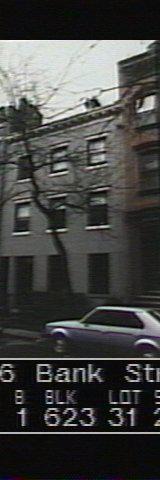
The city photographed every building for its tax records around 1940 and again in the 1980s. NYC Municipal Archives.
Written with AI from the source each entry cites, then fact-checked.
- 1841
Builder Andrew Lockwood erects 66 Bank Street beside a dissimilar neighbor
Andrew Lockwood built this three-story brick house in 1841 on his own account, as one of more than a dozen houses he put up on lots he bought in 1835. It is paired with a very different house next door. The landmarks commission noted its unusually low entrance, a narrow side alley, a plain wood cornice with modillions, and later Italianate ironwork around the door.
- 1851
Builder Jacob C. Bogert moves his family into the house
By 1851 Jacob C. Bogert, a builder who also worked on city commissions, had settled here with his wife Almira and five children. A boarder, boot and shoe dealer William H. Hall, lived with them throughout their stay. The family stayed until 1863, when Bogert completed a larger house next door, which later carried the number 68.
Source: Daytonian in Manhattan
- 1863
A son in the Union army writes home from Virginia asking for his commission papers
John A. Bogert, the builder's son, wrote his father on February 9, 1863 from Camp Bliss in Virginia. He asked that his commission and other papers, left at home, be mailed with care so he could collect pay for his service. He later rose to lieutenant colonel with the 103rd United States Colored Troops, whose officers were white. The family was preparing to move next door when the letter arrived.
Source: Daytonian in Manhattan
- 1864
Dr. James Ross, a tenant here, is named sanitary inspector under the city's new health council
After the Bogerts moved out, Dr. James Ross leased the house and stayed until 1870. In 1864 the new Council of Hygiene and Public Health appointed him sanitary inspector for the 15th District, covering crowded tenements from 14th Street to Rivington Street, between Avenue B and Clinton Street. He still kept office hours for his Greenwich Village patients.
Source: Daytonian in Manhattan
Further reading
- The Jacob C Bogert House - 66 Bank Street Daytonian in Manhattan
- Then & Now photos: 66 Bank StreetVillage Preservation: Greenwich Village Then & Now
Nearby
- 64 Bank Street1 entry
- 68 Bank Street5 entries
- 62 Bank Street5 entries
- 70 Bank Street5 entries
- 60 Bank Street1 entry
- 72 Bank Street2 entries