Red Hook Grain Terminal
685 Columbia Street | Red Hook | built 1921
Open on the map5 entries

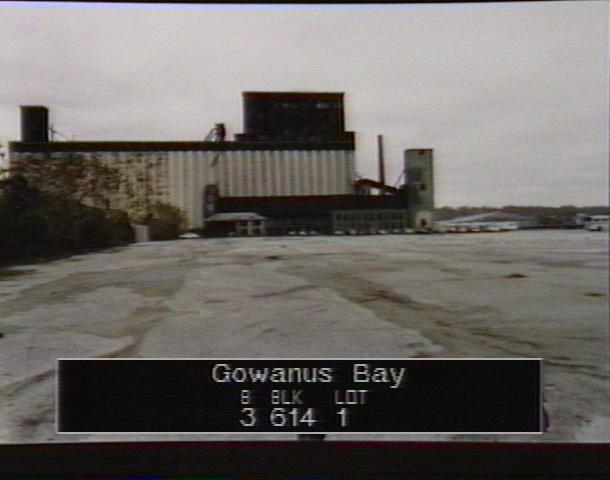
The city photographed every building for its tax records around 1940 and again in the 1980s. NYC Municipal Archives.
Written with AI from the source each entry cites, then fact-checked.
- 1922
New York State opens a grain terminal at the foot of Columbia Street to support its barge canal
Grain carried on the state's barge canal had fallen from 30 million bushels in 1880 to 1 million in 1918, partly because the city's two existing elevators belonged to railroads that denied barge operators storage. The Office of the State Engineer designed a reinforced concrete elevator that took 16 months to build and cost $2.5 million. Governor Nathan L. Miller spoke at the September 1, 1922 opening, saying the canal was worth having for emergencies even if never used in normal times.
“The Office of the State Engineer designed a 54-bin reinforced concrete grain elevator that took 16 months to build. ... The terminal cost $2.5 million.”
Source: Wikipedia
- 1944
The state hands the money-losing terminal to the Port Authority
The terminal failed to earn back its cost almost from the start. An industrial archaeologist who surveyed the waterfront for the Army Corps of Engineers in 1984 called the canal and terminal magnificent boondoggles. In 1944 the Port Authority of New York and New Jersey took control of the terminal from the state, and business improved for a time.
“The lack of success led control of the terminal to be transferred from the state to the Port Authority of New York and New Jersey in 1944.”
Source: Wikipedia
- 1965
The Port Authority shuts down the grain terminal after the St. Lawrence Seaway pulls cargo away
The terminal slipped into decline in the late 1950s, and the 1959 opening of the St. Lawrence Seaway cut shipments of Great Lakes grain to New York further. Labor costs were also high: in 1964 loading grain cost $0.78 a ton in New York against $0.21 in Philadelphia and $0.15 in New Orleans. The terminal was deactivated in 1965, and its loading pier and conveyor were demolished in 1987.
Source: Wikipedia
- 1997
Quadrozzi Concrete buys the abandoned terminal and 46 surrounding acres
After a 1990 recycling-center proposal for the site never went through, John Quadrozzi Sr. of Quadrozzi Concrete bought the terminal and about 46 acres around it in 1997, folding them into the Gowanus Industrial Park. He hoped to bring it back for concrete production and road salt storage. His son inherited the company after his death in 2004, and the building has stayed empty despite proposals that have included a movie studio, a concrete storage facility and a recycling plant.
Source: Wikipedia
- 2002
Zacho Dance Theater sends dancers up the terminal walls under projected video
In the summer of 2002 the Zacho Dance Theater staged an aerial performance in which dancers climbed the face of the empty terminal. Video images of Red Hook, 100 feet tall, were projected onto the walls at the same time. The building has also been used to film two music videos, one for Lorde's song Team and one for David Bowie's Valentine's Day.
“In the summer of 2002, Zacho Dance Theater presented an aerial performance where dancers scaled the building and 100-foot (30 m) video images of Red Hook were projected…”
Source: Wikipedia
Further reading
- Red Hook Grain TerminalWikipedia
Nearby
- Red Hook Play Center (Sol Goldman Pool)155 Bay Street | 8 entries
- Brooklyn Clay Retort and Fire Brick Works Storehouse76 Van Dyke Street | 6 entries
- Montauk Paint Manufacturing Company Building170 2nd Avenue | 6 entries
- Metropolitan Detention Center80 29th Street | 6 entries
- Defonte's Sandwich Shop379 Columbia Street | 2 entries
- Storehouse No. 2, U.S. Navy Fleet Supply Base850 3rd Avenue | 2 entries