Brooklyn Clay Retort and Fire Brick Works Storehouse
76 Van Dyke Street | also 224 Richards Street | Red Hook | built 1859
Open on the map6 entries

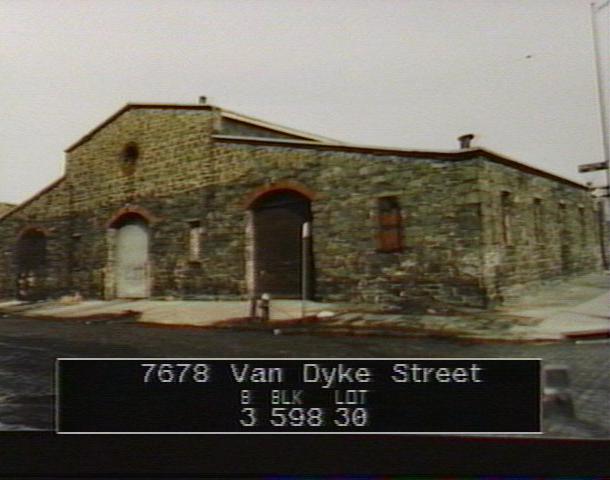
The city photographed every building for its tax records around 1940 and again in the 1980s. NYC Municipal Archives.
Written with AI from the source each entry cites, then fact-checked.
- 1854
Engineer Joseph K. Brick founds the fire-clay works whose storehouse stands here
Joseph K. Brick, a New Jersey native who trained in gas works engineering in Philadelphia, founded the Brooklyn Clay Retort and Fire Brick Company in 1854. He had come to the New York area around 1848 to build the Brooklyn Gas Light Company's works. His firm may have been the first in the country to make fire-clay retorts, using clay shipped from his New Jersey deposits.
“…founded in 1854 by Joseph Keaseby Brick, who was an authority on the construction and management of gas works…”
- 1859
A basilica-like schist storehouse goes up on Van Dyke Street, probably designed by Brick
The storehouse, dated c. 1859, has its main facades in roughly cut dark gray local schist, an unusual choice for New York industrial buildings. The Landmarks Commission thought Joseph Brick, an engineer, probably designed it and oversaw construction. Cast-iron columns support the raised central bay, and a clerestory, skylights and a bull's eye window light the interior.
- 1860
The works sells retorts to gas plants in Harlem, Syracuse, Hempstead, Genoa and Trieste
By 1860 the firm was supplying clay retorts to the gas works of Harlem, Syracuse and Hempstead. It had also entered the European market, selling retorts to gas works in Genoa and Trieste in Italy. The firm was soon making a full line of fire bricks as well.
“By 1860 it provided retorts for the nearby gas works of Harlem, Syracuse, and Hempstead…”
- 1867
Brick dies and his widow Julia and Edward D. White run the company
After Joseph Brick's death in 1867, his widow, Julia Brick, and Edward D. White, a Brooklyn businessman and a director of the Nassau Gas Light Company, ran the firm as a partnership. The work remained largely manual, with over seventy laborers processing 5,000 tons of clay a year. The firm was incorporated in 1893.
- 1995
Greg O'Connell restores the vacant storehouse, later home to Carvart Glass
After standing empty from 1985 to 1991, the building was bought by Red Hook developer Greg O'Connell, who restored it in 1995-96. As of 2013 it housed Carvart Glass, which makes architectural glass.
Source: brownstoner.com
- 2001
The Landmarks Commission designates the storehouse a city landmark
The Landmarks Preservation Commission designated the Brooklyn Clay Retort and Fire Brick Works Storehouse, 76-86 Van Dyke Street, on December 18, 2001. Five people testified in favor at the November hearing, and the Commission had also heard the building in 1990. It noted that these buildings are the only ones left in the area from the fire brick industry.
“Today the Brooklyn Clay Retort and Fire Brick Works are the only extant buildings in the area connected with this once-significant industry…”
Nearby
- Pioneer Works159 Pioneer Street | 6 entries
- Defonte's Sandwich Shop379 Columbia Street | 2 entries
- Red Hook Play Center (Sol Goldman Pool)155 Bay Street | 8 entries
- Red Hook Grain Terminal685 Columbia Street | 5 entries
- Frankies 457 Spuntino457 Court Street | 2 entries
- Building 315, officers' family housing315 Cartigan Road | 1 entry