Dr. Samuel MacKenzie Elliott House
69 Delafield Place | West New Brighton | built 1899
Open on the map3 entries

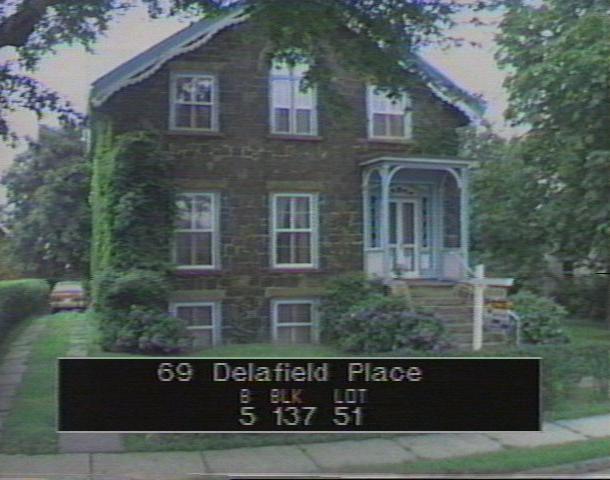
The city photographed every building for its tax records around 1940 and again in the 1980s. NYC Municipal Archives.
Written with AI from the source each entry cites, then fact-checked.
- 1840
Dr. Samuel MacKenzie Elliott builds a Gothic Revival stone cottage of his own design
Built around 1840 of local random stone, with walls 23 inches thick, the house is one of more than 22 that the doctor is said to have designed in the same style. It has eight large rooms, an attic and a huge cellar. The entrance in the gable end is framed by blue and orange diamond-paned sidelights under a fan-patterned transom, and scalloped wooden vergeboards trim the gables.
“Constructed of locally quarried random stone, the house was built about 1840 by Dr. Elliott, who was one of this country's early oculists.”
- 1840
Abolitionist eye surgeon Samuel Mackenzie Elliott reputedly makes the house an Underground Railroad refuge
Scottish-born Samuel Mackenzie Elliott, an oculist whose prominent patients included Horace Greeley, Peter Cooper, John Jacob Astor and Henry Wadsworth Longfellow, built this as one of 22 similar investment houses nearby. His influence on this part of the North Shore was such that the neighborhood was called Elliotville. An active abolitionist, he is said to have fitted out both this house and his own as hiding places for people fleeing slavery on the Underground Railroad.
Source: Wikipedia
- 1967
The Landmarks Preservation Commission designates the vine-covered Elliott House
At the September 13, 1966 hearing, three witnesses, the owner among them, spoke for designation and nobody opposed it. The Commission designated the house in April 1967, describing it as a stone monument to the doctor who designed it. At the time trumpet vine and Virginia creeper covered its walls.
“Three witnesses spoke in favor of designation including the owner of the property. There were no speakers in opposition to designation.”
Further reading
- Dr. Samuel MacKenzie Elliott HouseWikipedia
Nearby
- Kreuzer-Pelton House1262 Richmond Terrace | 4 entries
- New York Chinese Scholar's Garden1000 Snug Harbor Road | 3 entries
- Staten Island Museum (Sailors' Snug Harbor Building A)1000A Richmond Terrace | 6 entries
- Snug Harbor Building G1000G Richmond Terrace | 2 entries
- George William and Anna Curtis House234 Bard Avenue | 5 entries
- Snug Harbor Music Hall1000T Richmond Terrace | 6 entries