Bialystoker Synagogue
7 Bialystoker Place | Lower East Side | built 1826
Open on the map10 entries

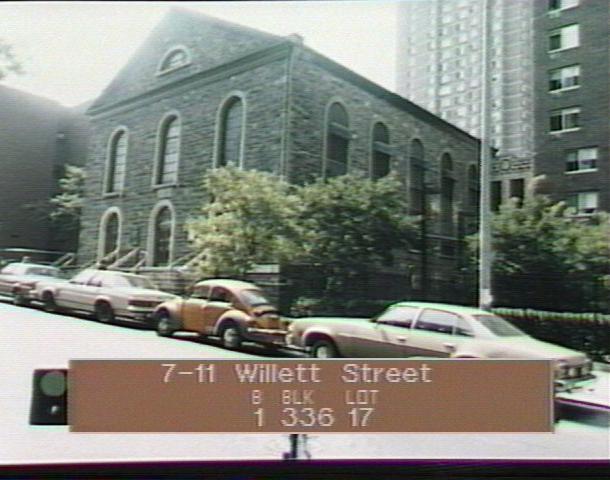
The city photographed every building for its tax records around 1940 and again in the 1980s. NYC Municipal Archives.
Written with AI from the source each entry cites, then fact-checked.
- 1826
The Willett Street Methodist Episcopal Church is built of local stone
This fieldstone church was built in 1826 for Methodists, with a simple pedimented roof and round-arched windows. Its walls are Manhattan schist from a quarry on nearby Pitt Street. It is one of only four early-19th-century fieldstone religious buildings surviving from the late Federal period in Lower Manhattan.
Source: Wikipedia
- 1854
The church moves its burying-ground dead to Cypress Hills, where the bones go into trenches
The Willett Street church had a graveyard beside it, but an 1851 city ordinance banned burials below 86th Street, so its trustees agreed to relocate the remains to Brooklyn's Cypress Hills Cemetery. The moves started in 1854 and continued for two years. A Brooklyn Daily Eagle reporter spoke with a watchman at the plot, who said the bones and coffins had gone into long trenches, with the headstones set up above them to look good.
Source: Daytonian in Manhattan
- 1865
The church sexton designs Lincoln's funeral catafalque
Peter Relyea, sexton and undertaker at the Willett Street Methodist Episcopal Church, designed the funeral catafalque used to carry Abraham Lincoln's coffin in April 1865. Relyea lived a few doors from the church at No. 3 Willett Street and later sold the property, decades before the congregation that built the church sold the building itself to Jewish immigrants from Bialystok.
Source: Daytonian in Manhattan
- 1877
The remodeled Willett Street church reopens for worship and appeals for money
Fifty years after it was built, the Willett Street Methodist Episcopal Church was remodeled and improved. The New York Times reported on November 5, 1877 that large congregations had attended services the day before, when the building was reopened for worship. Special appeals were made to the congregation to help pay for the improvements, and the Times said the response was generous.
Source: Daytonian in Manhattan
- 1883
Pastor John Searles returns and remembers the box pulpit and a vanished congregation
In December 1883 the Rev. John E. Searles came back to the Willett Street church as its pastor, forty years after he first took its pulpit in 1843. He observed that the building had been enlarged and that those who made up the congregation forty years earlier had passed away. He recalled a pulpit built like a box, so that no one could see him when he sat down, and blamed the shrinking membership on growing indifference to Christian duty.
Source: Daytonian in Manhattan
- 1902
The struggling church tries a jug-smashing fundraiser for its anniversary
By 1902 the Willett Street church was, in The New York Times' words, struggling to survive among the neighborhood's growing immigrant population. For its 83rd anniversary the pastor, J. L. Smith, invited former members who had moved away, and some came from the Bronx, Brooklyn and Philadelphia. They resolved that each member would keep a toy savings bank shaped like a jug and drop coins in it all year, then smash the jugs at a gathering and give the money to the pastor.
Source: Daytonian in Manhattan
- 1905
The Bialystoker congregation buys the church and makes it a synagogue
In 1905 the newly formed Bialystoker congregation bought the Willett Street Methodist Episcopal Church and moved in; the street was later renamed Bialystoker Place. The building was designated a New York City landmark in 1966, and the congregation restored its interior in 1988.
Source: Wikipedia
- 1905
The Bialystoker congregation dedicates its new synagogue
Nearly 3,000 people attended the dedication of the former Willett Street church as the Bialystoker Synagogue on August 20, 1905. When a piece of bunting caught fire from a gas burner during the ceremony, six-year-old Gertrude Rosenblum climbed onto a chair and pulled down the burning cloth, burning her hand but averting a panic. The congregation, formed by immigrants from Bialystok, had organized on the Lower East Side in 1865.
Source: Daytonian in Manhattan
- 1966
The Landmarks Preservation Commission designates the former church as the Bialystoker Synagogue landmark
On April 19, 1966, after a March 8 public hearing at which three speakers favored designation and none opposed, the Landmarks Preservation Commission designated the building at 7-13 Willett Street. The report calls it a plain late Federal building and one of the few of its type left in the city. It also notes the building as an example of a church no longer needed by its owners and bought by a group that preserved it.
- 1988
The congregation restores its sanctuary and the carved Ark
In 1988 the congregation restored the sanctuary, which is known for its colorful decoration. Gerald Wolfe's 2013 book on Lower East Side synagogues, quoted by Daytonian in Manhattan, lists among the restored treasures the nearly three-story-high hand-carved wooden Ark, flanked by tall stained glass windows. The Italian decorative painter Paolo Spano carried out the extensive restoration of the Ark.
Source: Daytonian in Manhattan
Further reading
- Bialystoker SynagogueWikipedia
- The 1826 Willletts Street Methodist Episcopal Church -- 7 Bialystoker PlaceDaytonian in Manhattan
Nearby
- Neighborhood Playhouse (Abrons Arts Center)466 Grand Street | 5 entries
- Toynbee House311 East Broadway | 3 entries
- St. Mary's Church440 Grand Street | 5 entries
- 511 Grand Street House511 Grand Street | 4 entries
- Isaac T. Ludlam House281 East Broadway | 5 entries
- 513 Grand Street House513 Grand Street | 4 entries