Cooper Union Foundation Building
7 East 7th Street | also 50 Astor Place | NoHo | built 1859
Open on the map17 entries

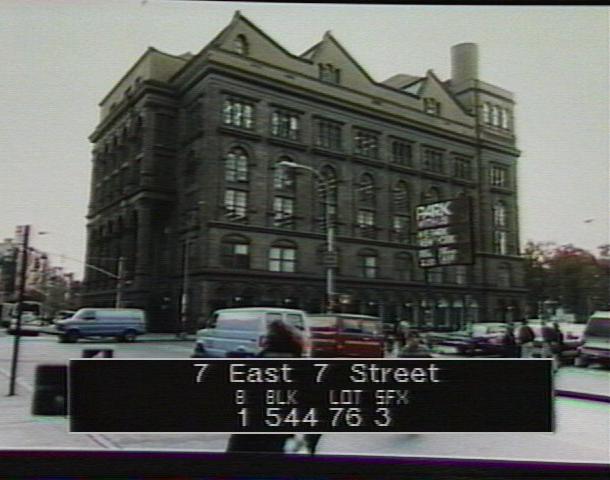
The city photographed every building for its tax records around 1940 and again in the 1980s. NYC Municipal Archives.
Written with AI from the source each entry cites, then fact-checked.
- 1853
Peter Cooper plans a round elevator shaft before elevators exist
Planning the Foundation Building in 1853, Peter Cooper was confident that an elevator would soon be invented, so he had the design include a shaft for one. He expected the car to be cylindrical, so he made the shaft circular. The building is described as the first in the world built with an elevator shaft.
“…first in the world to be built with an elevator shaft, because Cooper, in 1853, was confident an elevator would soon be invented…”
Source: Wikipedia
- 1858
The Great Hall opens in 1858, more than a year before the school itself
The Great Hall of the Foundation Building began hosting audiences in 1858, more than a year ahead of the institution's completion, and it quickly drew people who wanted to discuss and argue over the issues of the day. Cooper Union's own history says the hall hosted early workers' rights campaigns, and it names the hall the birthplace of the American Red Cross, the NAACP and the women's suffrage movement.
Source: cooper.edu
- 1859
Peter Cooper's Foundation Building rises on rolled-iron beams he made himself
Built in 1858–59 to designs by Frederick A. Peterson, a founder of the American Institute of Architects, the Foundation Building was the first structure in New York City framed with rolled-iron I-beams, which Peter Cooper's own ironworks produced. Cooper also included a round elevator shaft, anticipating a cylindrical elevator. The building became a National Historic Landmark in 1961 and a city landmark in 1965.
Source: Wikipedia
- 1859
Cooper Union opens as a free school for working people and women, with no color bar
When the Cooper Union opened in 1859, Peter Cooper made it free for the working classes and opened it to women as well as men, with no color bar. For people who could not study full time he also stocked a public reading room with the latest newspapers and periodicals. The school's history says the future Supreme Court Justice Felix Frankfurter was among the poor immigrant children who used it as a refuge from the bustle of the Lower East Side.
Source: cooper.edu
- 1860
Abraham Lincoln gives his Cooper Union address in the Great Hall
Invited by the Young Men's Central Republican Union, Abraham Lincoln spoke in the basement Great Hall on February 27, 1860, making a detailed historical case about the founders' views on slavery in the federal territories. Horace Greeley's New-York Tribune praised the speech, and newspaper and pamphlet reprints carried it across the North. Mathew Brady photographed Lincoln the same day. Three months later Lincoln won the Republican presidential nomination.
Source: Wikipedia
- 1868
An 1868 report counts 14,000 gas burners in the Foundation Building
Cooper Union's 1868 report, quoted by Daytonian in Manhattan, gives a glimpse of what it took to run the Foundation Building: 14,000 gas burners that burned a great deal of gas when all were lit, speaking-tubes installed throughout, framed engravings on every wall, and a fire hose on each floor even though the building was called fireproof. Rental of the Great Hall and other public spaces was meant to help pay such costs.
Source: Daytonian in Manhattan
- 1882
Cooper Union's free library, open to the public, holds more than 15,000 volumes
By 1882 the free library that Peter Cooper built into the Foundation Building held more than 15,000 volumes, and it was open to the general public as well as to students. Cooper had told his trustees he wanted the institution to help young people find useful knowledge and a place in the community. The collection reached 67,000 volumes by 1932, with another 17,000 in the separate art library.
Source: Daytonian in Manhattan
- 1909
Clara Lemlich calls for a general strike, launching the Uprising of the 20,000
At a mass meeting of garment workers in the Great Hall on November 22, 1909, 23-year-old Clara Lemlich grew tired of hours of speeches and moved for a general strike, drawing a standing ovation. About 15,000 shirtwaist makers walked out within two days, and the strike grew to 20,000 or more, most of them young Jewish and Italian immigrant women. It ended in February 1910 with gains in wages and hours.
Source: Wikipedia
- 1909
The first public meeting of the NAACP convenes in the Great Hall
Cooper Union's history credits the Great Hall as the place where the NAACP held its first public meeting, in 1909. The school's history adds that the hall also hosted labor organizing among Lower East Side workers. Seven serving or future U.S. presidents have spoken from its lectern.
Source: cooper.edu
- 1961
The Foundation Building becomes a National Historic Landmark
The federal government designates Peter Cooper's Foundation Building a National Historic Landmark, recognizing both its role in founding tuition-free higher education and its pioneering rolled-iron I-beams, which Cooper had manufactured himself. New York City follows with its own landmark designation in 1965.
Source: Wikipedia
- 1966
The city designates the Foundation Building a landmark
On March 15, 1966, the Landmarks Preservation Commission designated the Foundation Building a New York City landmark. Four witnesses spoke in favor at the hearing, none opposed, and Cooper Union's president, Richard F. Humphreys, wrote in support. The commission stressed the building's early rolled-iron beams, which it said made possible the later development of the skyscraper, and the school's free, women-welcoming mission.
- 1993
President Clinton makes the case for deficit reduction from the Great Hall lectern
On May 12, 1993, President Bill Clinton gave a major economic speech in the Great Hall about cutting the federal deficit. Cooper Union counts him among three sitting presidents to have spoken there, along with Woodrow Wilson and Barack Obama. Lincoln, Grant, Cleveland, Taft and Theodore Roosevelt all addressed the hall before they were elected.
Source: cooper.edu
- 2009
The Great Hall reopens after its first major renovation since 1978
After closing in late 2008, the Great Hall reopened in March 2009 following its first major renovation since 1978. The hall has continued as a metropolitan art space, hosting lectures and performances by figures such as Joseph Campbell, Steve Reich, Salman Rushdie and Ralph Nader, and it doubles as a lecture room for students and the stage for the school's annual Culture Show.
“…the first major renovation of the hall since 1978. It reopened in March 2009.”
Source: Wikipedia
- 2010
Barack Obama speaks in the Great Hall on financial reform
President Barack Obama addresses an audience in Cooper Union's Great Hall to press for Wall Street financial regulation, joining a long line of presidents who have spoken from the same stage, including Grant, Cleveland, Taft, Theodore Roosevelt, and Woodrow Wilson.
Source: Wikipedia
- 2012
Eleven students occupy a Foundation Building suite for a week to protest tuition
In December 2012, eleven students took over a suite inside the Foundation Building and stayed a week to protest the possibility that undergraduates would be charged tuition. The school had been in a financial crisis since late 2011, when forums with students, faculty and alumni were held, and in 2012 its trustees approved plans for a tuition-based graduate program. The college ended free tuition for undergraduates in 2014.
Source: Wikipedia
- 2014
Mahmoud Abbas gives his first formal English-language speech in the Great Hall
On September 22, 2014, the Palestinian Authority's president, Mahmoud Abbas, delivered his first formal speech in English from the Great Hall's lectern. The hall's roster of speakers runs from Frederick Douglass, Susan B. Anthony and Mark Twain to Venezuelan president Hugo Chavez, Bolivia's Evo Morales and Michael Bloomberg.
“President of the Palestinian National Authority Mahmoud Abbas delivered his first formal speech in English in the Great Hall.”
Source: Wikipedia
- 2014
Cooper Union ends its full-tuition scholarship after 155 years
Facing a financial crisis, the school's trustees vote to end the full-tuition scholarships that every admitted student had received since Peter Cooper founded the institution in 1859, shifting to half-tuition awards instead. A decade later, starting in the 2024 academic year, Cooper Union eliminates senior-year tuition for all students.
Source: Wikipedia
Further reading
- Cooper UnionWikipedia
Nearby
- Astor Place Tower445 Lafayette Street | 6 entries
- Metropolitan Savings Bank Building59 Cooper Square | 3 entries
- 51 Astor Place5 entries
- Hamilton-Holly House4 St Marks Place | 12 entries
- Carl Fischer Building56 Cooper Square | 4 entries
- Surma Book and Music Company11 East 7th Street | 4 entries