Trinity Church
75 Broadway | Financial District | built 1846
Open on the map19 entries

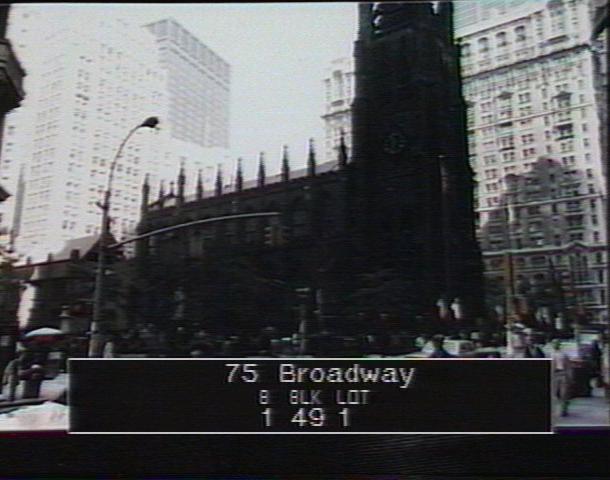
The city photographed every building for its tax records around 1940 and again in the 1980s. NYC Municipal Archives.
Written with AI from the source each entry cites, then fact-checked.
- 1673
Ground at Broadway and Wall Street is first recorded as a burial place
Writer Kevin Walsh traces the graveyard at Broadway and Wall Street back to 1673, the first time the space is mentioned as a place of burial. That is more than two decades before a small group of Anglicans petitioned Governor Benjamin Fletcher in 1696-97 for permission to buy land for a church, which they purchased from the Lutheran congregation. The dead came first. Fires later destroyed many of the old tombstones and left others unreadable.
Source: Forgotten New York
- 1697
King William III grants a charter to Trinity parish
Trinity parish was chartered by King William III on May 6, 1697, and built its first church on Wall Street the following year. That modest building burned in the Great Fire of 1776. A second church, consecrated in 1790, was weakened by heavy snows and taken down in 1838 and 1839 to make way for the present building.
Source: Wikipedia
- 1698
Captain William Kidd lends his ship's tackle to raise the first church's stones
The first Trinity Church went up in 1698 on Wall Street as a modest rectangle with a gambrel roof and a small porch, facing the Hudson. Its site had earlier been a formal garden and then a burial ground. According to the records, Captain William Kidd loaned a runner and tackle from his ship so the stones could be hoisted into place.
“Captain William Kidd lent the runner and tackle from his ship for hoisting the stones.”
Source: Wikipedia
- 1768
Comedian Adam Allyn is buried in the churchyard under a stone raised by his fellow actors
A headstone in Trinity's churchyard marks the grave of Adam Allyn, an actor who died in February 1768. The stone was erected by the American Company, the troupe David Douglass organized in 1758 and often called the first professional theater company in America. Allyn had come to the city with his wife in 1758, debuted in Philadelphia in 1759, and first played New York at the Beekman Street Theatre in November 1761. His epitaph labels him a comedian and gently admits he had a man's frailties.
Source: Forgotten New York
- 1776
Fire destroys the first Trinity Church during the Revolution
The Great Fire of 1776 destroys 400 to 500 buildings across the city, including the gambrel-roofed church built on the site in 1698, gutting Trinity's original building. The congregation worships without a permanent church for over a decade before building a replacement.
Source: Wikipedia
- 1790
The second Trinity Church opens and Washington's government worships there
Work on a second church began in 1788 on the same Broadway site, facing Wall Street. At 200 feet tall and larger than the first church, it was consecrated in 1790 and suited a fast-growing city; services had meanwhile been held at St. Paul's Chapel. President George Washington and members of his government often worshiped in the new building, and John Jay and Alexander Hamilton were among its parishioners.
“President Washington and members of his government often worshiped there. Additional notable parishioners included John Jay and Alexander Hamilton.”
Source: Wikipedia
- 1804
Alexander Hamilton is buried in Trinity's churchyard
Following his fatal duel with Aaron Burr in Weehawken, Alexander Hamilton is buried in the churchyard alongside other prominent early Americans, including Robert Fulton and Albert Gallatin, making the graveyard one of the city's most visited historic sites.
Source: Wikipedia
- 1839
The second Trinity Church is torn down for structural weakness
The Landmarks Preservation Commission's designation report traces the church's buildings: the first burned in the Great Fire of 1776, and the second came down in 1839 because it had become structurally weak. The present church, finished in 1846 to Richard Upjohn's design in brownstone, closes the vista at the end of Wall Street. The report calls the sculptured bronze doors among the finest of their kind in the country.
- 1846
Richard Upjohn's Gothic Revival church is consecrated on Ascension Day
The third Trinity Church, designed by Richard Upjohn and built from 1839 to 1846, was consecrated on Ascension Day, May 1, 1846. Its spire, topped by a gilded cross, made it the tallest building in the United States until 1869 and the tallest in New York City until 1890. Alexander Hamilton and Robert Fulton are among those buried in its churchyard.
Source: Wikipedia
- 1876
An altar and reredos honor William Backhouse Astor Sr. as the chancel is reworked
In 1876-77 Trinity installed a reredos and altar in memory of William Backhouse Astor Sr., designed by the architect Frederick Clarke Withers. The chancel was reworked at the same time, and the vestry voted to add a one-story extension at the rear with rooms for the clergy and choir and a mortuary chapel. The altarpiece was later restored during the church's 21st-century renovation.
“In 1876-1877, a reredos and altar were erected in memory of William Backhouse Astor, Sr., to the designs of architect Frederick Clarke Withers.”
Source: Wikipedia
- 1890
Trinity's spire loses its decades-long claim as the city's tallest
Richard Upjohn's 281-foot Gothic Revival spire, completed in 1846, had been the tallest structure in New York for more than forty years. The New York World Building overtakes it in 1890, ending Trinity's long reign over the skyline.
Source: Wikipedia
- 1893
William Waldorf Astor gives three sets of bronze doors in his father's memory
Trinity's three sets of bronze doors date from 1893 and were the gift of William Waldorf Astor, who gave them to honor his father, John Jacob Astor III. Richard Morris Hunt conceived them; Karl Bitter made the east door, J. Massey Rhind the south and Charles Henry Niehaus the north. The north and east doors each hold six panels from church history or the Bible, while the south door's panels tell the history of New York.
“…three sets of impressive bronze doors, donated by William Waldorf Astor, 1st Viscount Astor in memory of his father, John Jacob Astor III…”
Source: Wikipedia
- 1907
Albert Levering imagines Trinity Church swallowed by skyscrapers
In a 1907 illustration, Albert Levering drew Trinity hemmed in by towers of glass and steel, its graveyard cut away. The church had been the tallest structure on the city's skyline until 1890, and the drawing plays on the early 20th-century boom, when steel-frame office buildings of 20 stories and more were replacing low-rise ones. Ephemeral New York wonders whether any developers took the cartoon seriously.
Source: Ephemeral New York
- 1920
Trinity Church stands over Wall Street after a deadly bombing
A horse-drawn wagon packed with explosives detonates on Wall Street just outside Trinity's churchyard, killing dozens of people in an attack on the J.P. Morgan bank that is never conclusively solved.
Source: The Bowery Boys
- 1964
London's St. Mary-le-Bow sends Trinity a cherub head in thanks for rebuilding aid
A stone cherub head sits on the gate at the back of the churchyard on Trinity Place, renamed Cherub Gate. It came from St. Mary-le-Bow in London, a Wren church bombed during the Blitz. Trinity, a sister church of Bow since 1697, had pledged $50,000 to help rebuild it. The undamaged cherub was found in the rubble and given to Trinity in 1964 as a thank-you.
Source: Ephemeral New York
- 1966
The Landmarks Preservation Commission designates Trinity Church and its graveyard
After a public hearing on October 19, 1965, where four witnesses backed designation and two Trinity representatives spoke, the commission designated the church and graveyard, Tax Map Block 49, Lot 1, as a landmark. Its report points to the burying ground's historic occupants, among them Alexander Hamilton, Captain James Lawrence, Robert Fulton, Albert Gallatin and Francis Lewis, the only Declaration of Independence signer buried in Manhattan. It adds that designation need not freeze the church.
“Francis Lewis, the only signer of the Declaration of Independence to be buried in Manhattan.”
- 1976
Queen Elizabeth II visits and is paid 279 peppercorns in back rent
During the American Bicentennial, Queen Elizabeth II visited Trinity Church on July 10, 1976. The vestry presented her with 279 peppercorns as symbolic back rent, a nod to the parish's origins under a royal charter from the English crown in 1697. The number matched the years since the charter was granted.
Source: Wikipedia
- 2006
Twelve new change-ringing bells make Trinity the first U.S. church with a ring of 12
A plan to add twelve change-ringing bells, floated in 2001, was shelved after September 11 and carried out in 2006 with funding from the Dill Faulkes Educational Trust. A firm from Loughborough, England installed them in September, giving Trinity the first ring of 12 change-ringing bells in an American church. Practice ringing that autumn alarmed neighbors whose windows lie within 100 feet of the tower, so the church added a plywood deck and shutters to mute the sound.
Source: Wikipedia
- 2015
Trinity Root, a bronze sculpture based on a 9/11 sycamore's roots, leaves Wall Street
When wreckage fell on St. Paul's churchyard on September 11, it toppled a giant sycamore nearly a century old. Sculptor Steve Tobin built a bronze sculpture, Trinity Root, on the tree's roots, and it stood in front of Trinity Church at Wall Street and Broadway until December 2015. The church then moved it to its conference center in Connecticut. The move proved controversial: the piece was damaged, later repaired, and Tobin objected to the relocation.
“Sculptor Steve Tobin used its roots as the base for a bronze sculpture titled Trinity Root…”
Source: Wikipedia
Further reading
- Trinity Church (Manhattan)Wikipedia
- ADAM ALLYN, COMEDIAN, Trinity Church CemeteryForgotten New York
- Taking a trip back in time at this Wall Street subway stationEphemeral New York
- This Lower Broadway boot scraper may have been used by a US PresidentEphemeral New York
- A lovely view of Trinity Church from Wall StreetEphemeral New York
- A mystery studio building in Washington HeightsEphemeral New York
- What if this actually happened to Trinity Church?Ephemeral New York
- Peek into a travel diary of colonial New YorkEphemeral New York
Nearby
- Empire Building71 Broadway | 12 entries
- Trinity Commons68 Trinity Place | 3 entries
- United States Express Company Building101 Greenwich Street | 6 entries
- Trinity Building111 Broadway | 5 entries
- American Stock Exchange Building86 Trinity Place | 12 entries
- American Express Building65 Broadway | 9 entries