American Stock Exchange Building
86 Trinity Place | also 113 Greenwich Street | Financial District | built 1921
Open on the map12 entries

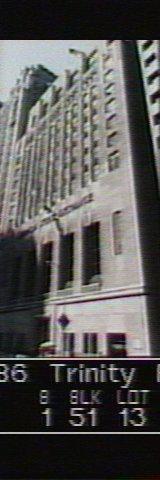
The city photographed every building for its tax records around 1940 and again in the 1980s. NYC Municipal Archives.
Written with AI from the source each entry cites, then fact-checked.
- 1921
The Curb Market moves off the sidewalk and into a new trading hall
After decades of outdoor trading on nearby Broad Street, the New York Curb Market opened its first indoor home, a Starrett & Van Vleck building with a 65-foot trading floor lined in marble. Leaders Edward McCormick, Alfred Sturges and Franklin Leonard guided the move, and new members paid a $1,500 seat fee plus $500 initiation.
Source: Daytonian in Manhattan
- 1922
A few curb brokers keep trading in the street after the exchange moves indoors
Moving into the Greenwich Street building did not end outdoor trading at once. A curb broker told the New York Tribune that open-air trading would go on because he and his fellow brokers had a city permit to trade in the street. In 1922 S. S. Huebner wrote in The Stock Market that, according to press accounts, a limited group once connected with the Curb market was still operating on the street as before.
Source: Daytonian in Manhattan
- 1929
The Curb trades a record seven million shares on the day Wall Street crashes
The New York Curb Market had just been renamed the Curb Exchange in June 1929, and the second half of the year proved extremely volatile. On the day Wall Street crashed, over seven million shares changed hands on the Curb, a record for the exchange. It still listed more foreign issues than all other American securities markets combined and pressed ahead with plans for an addition estimated at $1.25 million.
“…the day Wall Street crashed more than seven million shares – a record for the Curb – changed hands.”
- 1931
An Art Deco expansion doubles the trading floor
Starrett & Van Vleck returned to expand their own building in Art Deco style, enlarging the board room from 13,500 to over 20,000 square feet and increasing the number of trading posts from 16 to 28.
Source: Wikipedia
- 1941
Upper floors are leased for defense work as Depression-era trading shrinks
Volume on the Curb fell sharply during the Depression, dropping from 476 million shares in 1929 to just 43 million by 1940. From 1941 four upper floors went to groups doing defense work, and so did a single floor of the neighboring Hamilton Building, which the Curb had purchased in 1930 with an eye to later expansion.
“Volume on the Curb diminished sharply during the Depression years, dropping from 476 million shares in 1929 to just 43 million by 1940.”
- 1953
The Curb Exchange takes the name American Stock Exchange
The exchange formally renamed itself the American Stock Exchange, or AMEX, retiring the "Curb" name that had described its origins as outdoor street trading.
Source: Wikipedia
- 1978
The exchange building is placed on the National Register of Historic Places
In June 1978, after the AMEX board voted to stay on Trinity Place rather than move to New Jersey or Battery Park City, the building was placed on the National Register of Historic Places. The report called it sleek and business-like and the best surviving symbol of outdoor securities trading in the nation's financial capital over three centuries.
- 1982
A new trading mezzanine raises the floor's capacity by up to 40 percent
The AMEX trading floor was extensively remodeled in 1967 to serve a growing membership. In 1982 the exchange built a new mezzanine in the trading room, adding 35 to 40 percent more capacity. These interior changes had limited effect on the building's exterior.
“A new trading mezzanine was built in 1982. ... increased the capacity of the trading floor by 35 to 40 per cent.”
- 2009
The American Stock Exchange stops trading and its building falls empty
The American Stock Exchange became part of a group headed by the New York Stock Exchange in 2008, which the Landmarks Preservation Commission described as ending a centuries-old rivalry between two Manhattan financial institutions. The commission says the AMEX ceased trading in February 2009 and that the building on Trinity Place and Greenwich Street stood vacant from then until its 2012 designation report.
- 2011
Michael Steinhardt and Allan Fried buy the exchange and plan a hotel
In 2011 investors Michael Steinhardt and Allan Fried bought the exchange building together with the neighboring Western Electric building at 22 Thames Street for $65 million, about a quarter of it for the exchange. They announced plans to convert the Greenwich Street section into shops and a hotel and to demolish 22 Thames Street, which raised concerns among preservationists and neighborhood residents.
Source: Wikipedia
- 2012
The city designates the exchange building a landmark
Decades after the exchange itself moved on following NYSE's 2008 acquisition of AMEX, New York City designated the Trinity Place building an official city landmark.
Source: Wikipedia
- 2017
A Louis Vuitton exhibit in the old exchange building revives the hotel plan
In November 2017 the former exchange building hosted an exhibit on the history of the fashion house Louis Vuitton. Its success, along with the Financial District's growth into a live-work-play neighborhood, prompted Allan Fried to move forward with his plan for a hotel. The next year, GHC Development and Clarion Partners announced a hotel and retail renovation, with a Live Nation concert venue planned on the Greenwich Street side.
“The old Stock Exchange building was used in November 2017 for an exhibit about the history of fashion house Louis Vuitton.”
Source: Wikipedia
Further reading
- American Stock Exchange BuildingWikipedia
- The New York Curb Market Building -- 113-123 Greenwich StreetDaytonian in Manhattan
Nearby
- Trinity Commons68 Trinity Place | 3 entries
- Leadership & Public Service High School90 Trinity Place | 3 entries
- 125 Greenwich Street22 Thames Street | 10 entries
- United States Express Company Building101 Greenwich Street | 6 entries
- High School of Economics and Finance100 Trinity Place | 5 entries
- Trinity Church75 Broadway | 19 entries