John L. Hasbrouck Building
75 Hudson Street | Tribeca | built 1868
Open on the map5 entries

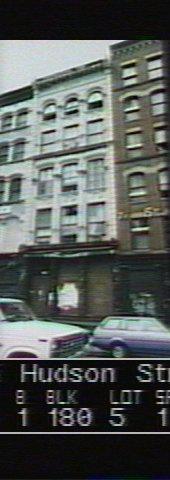
The city photographed every building for its tax records around 1940 and again in the 1980s. NYC Municipal Archives.
Written with AI from the source each entry cites, then fact-checked.
- 1868
George Youngs gives 75 Hudson Street a marble facade over a cast-iron base
The Landmarks Commission describes the 1868 building as one of the earliest surviving store and loft buildings on its block. Architect George Youngs set a marble Italianate facade above a cast-iron base, with two two-story arcades divided by a band course and rusticated end piers. It was meant as a store and warehouse for John L. Hasbrouck.
- 1868
Wine importer John L. Hasbrouck builds a new headquarters near the Hudson River Railroad depot
Born in Utica in 1810 to a Huguenot family, Hasbrouck came to New York in 1860 and founded John L. Hasbrouck & Co. five years later. The firm began as a wine importer and grew to include a distillery in Brooklyn. He hired George Youngs to build here, close to the freight depot Cornelius Vanderbilt had put on the old St. John's Park site in 1866. Hasbrouck died in 1895, aged 85.
Source: Daytonian in Manhattan
- 1898
Dyestuff maker John Campbell & Co. buys the building for $80,000
The sale to John Campbell & Co. was announced in November 1898 after Hasbrouck's sons moved their business to Brooklyn. Campbell, born in Liverpool, had founded his dye company in 1878; its factory was in Newark, New Jersey, and the Hudson Street building served as offices and shipping. The firm stayed until 1947, with companion firms Amalgamated Dyestuff and Republic Color also based here.
Source: Daytonian in Manhattan
- 1918
John Campbell & Co. urges American dye makers to drop German color names
With the United States at war, Campbell's president George H. Whaley circulated a pamphlet to other dye manufacturers insisting that American colors were as good as, and often better than, the German standards. He asked mill men to stop using German trade words and give American colors American names, calling it a matter of loyalty.
Source: Daytonian in Manhattan
- 1919
Executive George Whaley's romance with his stenographer ends in a $100,000 lawsuit
Whaley, Campbell's president, had put the title of a West 88th Street house in the name of his private stenographer May M. Croke, and in 1919 he gave her a $2,200 diamond ring after divorcing his wife. Detectives he hired reported she had been seeing other men from the office, including Monte F. Jacobs. Effie Elizabeth Jacobs then sued Croke for $100,000 for alienation of affection and attached the house. Whaley kept his job.
Source: Daytonian in Manhattan
Further reading
- The John L. Hasbrouck Bldg - No. 75 Hudson StreetDaytonian in Manhattan
Nearby
- Brooklyn Flint Glass Works Building73 Hudson Street | 4 entries
- Welsh and Tweddle Building77 Hudson Street | 6 entries
- 5 Harrison Street3 entries
- 71 Hudson Street5 entries
- Henry M. Day Building81 Hudson Street | 5 entries
- New York Hospital House of Relief67 Hudson Street | 5 entries