Henry M. Day Building
81 Hudson Street | also 1 Harrison Street | Tribeca | built 1919
Open on the map5 entries

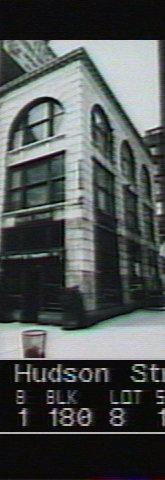
The city photographed every building for its tax records around 1940 and again in the 1980s. NYC Municipal Archives.
Written with AI from the source each entry cites, then fact-checked.
- 1919
Demolition begins on the Federal-style house at Hudson and Harrison streets
An earlier building on the site, a Federal-style house, was the last holdout of a once-refined residential neighborhood. Its brick and lintels were painted white and a storefront had replaced the ground floor, and Austin, Nichols & Co., wholesale grocers, had been a recent occupant. Henry M. Day bought it in February 1919 and demolition began in April, as photographed by Wurts Brothers.
Source: Daytonian in Manhattan
- 1919
Schwartz & Gross build a three-story terra-cotta office for Henry M. Day, Inc.
Designed by Schwartz & Gross for Henry M. Day, Inc. and built by Edgar A. Levy, the neo-Renaissance building replaced a three-story store and residence. Terra-cotta blocks cover its facades, with tall tripartite windows and round arches at the top story. Each spandrel has three recessed panels, and the cornice is plain.
- 1919
Captain Henry M. Day Jr., a Legion of Honour veteran, builds his import firm a headquarters
Day returned from France with the Legion of Honour and took over Henry M. Day & Co., the fruit and nut importing business his father founded. The 33-year-old built the $25,000 headquarters, with the company name in bronze letters below the cornice. The New-York Tribune noted it was the first building in the district erected for its own occupant.
Source: Daytonian in Manhattan
- 1921
Henry M. Day sells his new building and heads into oil with Harry Sinclair
The New-York Tribune reported on August 18, 1921 that Day's company had sold the building. He had moved on to oil, working for Harry Sinclair, attending conferences in Genoa and Lausanne and doing business in Persia and Russia. When Sinclair stood trial in the Teapot Dome scandal, Day too was convicted of jury shadowing and spent three and a half months in jail.
Source: Daytonian in Manhattan
- 2009
The building becomes a tavern with a single-family home above
After Day's sale, floors were leased to produce firms, such as importer-exporter Eligio Cerruti in April 1922. In 2009, as Tribeca's warehouses became shops and apartments, the ground floor became a restaurant-tavern and the upper floors a single-family home. Outwardly the white terra-cotta building has changed little.
Source: Daytonian in Manhattan
Further reading
- The 1919 Henry M. Day Building - No. 81 Hudson StreetDaytonian in Manhattan
Nearby
- Welsh and Tweddle Building77 Hudson Street | 6 entries
- 5 Harrison Street3 entries
- John L. Hasbrouck Building75 Hudson Street | 5 entries
- Brooklyn Flint Glass Works Building73 Hudson Street | 4 entries
- New York Mercantile Exchange Building6 Harrison Street | 5 entries
- 71 Hudson Street5 entries