Casa Belvedere (Louis A. and Laura Stirn House)
77 Howard Avenue | also 79 Howard Avenue | Silver Lake | built 1901
Open on the map8 entries

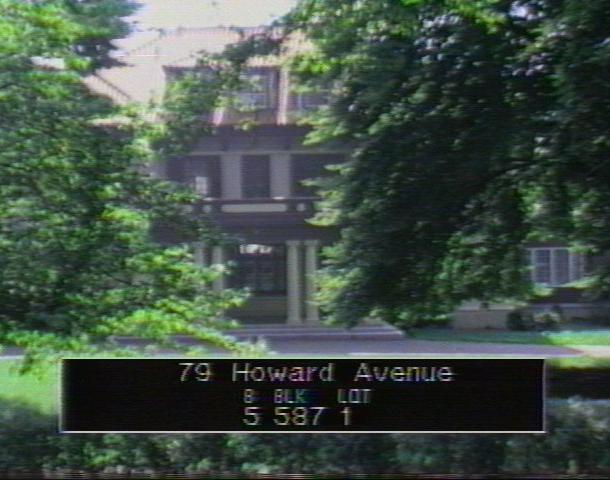
The city photographed every building for its tax records around 1940 and again in the 1980s. NYC Municipal Archives.
Written with AI from the source each entry cites, then fact-checked.
- 1907
Eleanor Phelps Sedley sells the Howard Avenue hillside land to Louis and Laura Stirn
In June 1907 Eleanor Phelps Sedley sold Louis A. and Laura Stirn the ground where their house would rise. The tract had passed from the heirs of Thomas Eakin to the actor and journalist Henry Sedley in 1879. As bought, it fronted about 275 feet on Howard Avenue and ran roughly 600 feet down the slope to Sunset Terrace; today the lot measures 274 by 200 feet.
“In June 1907 she sold the land acquired from the Eakins family to Louis A. and Laura Stirn.”
- 1908
Kafka & Lindenmeyr complete the Stirn mansion for $32,000
The architects Kafka & Lindenmeyr submitted plans to the borough's building department in March 1908, and construction began almost at once. The house was finished that December for $32,000, not counting the $14,000 the Stirns had paid for the land. It housed the couple, their five children, Laura's widowed sister Emily Wicchers, her boy Manolo, a cook and two maids.
- 1908
The Stirn house borrows the form of an Italian Renaissance villa with Arts and Crafts details
The stucco-clad house has a block-like, symmetrical main section, a low hipped roof of terra-cotta tiles over deep bracketed eaves, columned porticos and arched first-floor windows, all drawn from Italian villas. Arts and Crafts touches include stylized Ionic capitals, wrought-iron balustrades and a polychrome terra-cotta frieze, a recent material the Landmarks Preservation Commission found very unusual on suburban houses then. Its Portland cement stucco facing was considered permanent in color and texture, and so free of upkeep.
“The polychrome terra-cotta used for the frieze was also a recent innovation and was very unusual for a suburban house of the period.”
- 1908
Silk merchant Louis A. Stirn builds a mansion on Grymes Hill, a favorite of wealthy German businessmen
Louis A. Stirn, son of a Lutheran clergyman, was born in 1853 in Eschersheim outside Frankfurt and came to New York to work in the silk trade. He started his own firm in 1894, which became L. & E. Stirn when his brother Edmund joined; the brothers also controlled the Concordia Silk Mills, with several thousand workers in Philadelphia, Watertown and Johnstown. Stirn had moved to Staten Island in 1882 and married Laura Natalie Methfessel six years later, and in 1908 they built this house on Grymes Hill.
“Stirn established his own firm in 1894. Three years later, his brother Edmund became a partner in the firm, which was known as L. & E. Stirn.”
- 1908
Laura Stirn, granddaughter of Brooklyn Bridge planner John A. Roebling, makes her home here
Laura Stirn was the daughter of the educator Anton Gottlieb Methfessel, founder of the school that became Staten Island Academy, and a granddaughter of John A. Roebling, who planned the Brooklyn Bridge. She helped found the St. Cecilia Society, a women's singing group, and was a member of the island's Bird Club and its Garden Club, whose members knew her for the rare plants she collected. She also sat on the board of trustees of the Staten Island Hospital.
- 1962
Attorney Reuben Gross buys the house after Louis Stirn's death
Louis and Laura Stirn lived in the house until their deaths, Laura in 1943 and Louis in 1962; in the 1920s Louis had also built homes on Howard Avenue for his son Albert and his son-in-law Arthur Benbow Elliman. After Louis died, Reuben Gross, a prominent lawyer and Jewish community leader, bought it with his wife, Blanche. When the landmark report was written, the estate of Blanche Gross still owned it.
“Following Louis Stirn's death the house was sold to Reuben Gross, a prominent attorney and leader in the Jewish community, and his wife Blanche Gross.”
- 2001
The Landmarks Preservation Commission designates the Stirn house a city landmark
At a hearing on May 16, 2000, five witnesses backed designation, including speakers for the Historic Districts Council and the Serpentine Art & Nature Commons, while the owner took no position. The commission also received nine supporting letters, one from Assemblyman Eric N. Vitaliano, and an online petition with ten signatures. It designated the house on January 30, 2001, as a rare surviving Staten Island country house of its scale.
“The owner did not take a position on the designation at the time of the hearing. The Commission has received nine letters in support…”
- 2010
The Biancardi-Rammairone family opens Casa Belvedere, an Italian cultural center, in the house
Gina Biancardi and Luciano Rammairone bought the mansion in 2008. In 2010 their family founded Casa Belvedere there, a center for Italian studies, and gave the house to the newly formed Italian Cultural Foundation. A $5 million renovation over the next 15 years, funded by private donors, the Save America's Treasures program and the city's cultural affairs department, brought accessibility upgrades and structural reinforcement. Hurricane Sandy also caused structural damage to the building.
“In 2010, the Biancardi-Rammairone family established Casa Belvedere in the Stirn House and donated it to the newly formed Italian Cultural Foundation.”
Source: Wikipedia
Further reading
- Casa BelvedereWikipedia
Nearby
- Our Lady of Good Counsel Church10 Austin Place | 1 entry
- 390 Van Duzer Street House390 Van Duzer Street | 3 entries
- 364 Van Duzer Street House364 Van Duzer Street | 3 entries
- Caleb T. Ward Mansion141 Nixon Avenue | 6 entries
- St. Paul's Memorial Church219 St Pauls Avenue | 3 entries
- Mary and David Burgher House63 William Street | 4 entries