Hallenbeck-Hungerford Building (Lafayette Hall)
80 Lafayette Street | also 76 Lafayette Street | Civic Center | built 1920
Open on the map4 entries

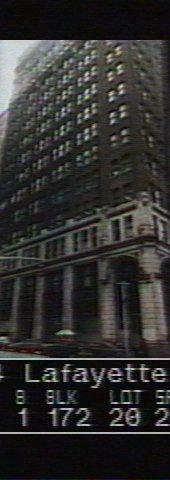
The city photographed every building for its tax records around 1940 and again in the 1980s. NYC Municipal Archives.
Written with AI from the source each entry cites, then fact-checked.
- 1914
Hungerford and Hallenbeck build a large printing loft after the city stalls on a courthouse site
U. T. Hungerford's brass and copper company had a ten-story building at Park and Pearl Streets, beside land condemned for the new courthouse, and the city had been slow to decide whether to take it. Hungerford and his real estate partner Harry C. Hallenbeck instead bought land at the southwest corner of Lafayette and White Streets. Plans by William E. Austin for a heavy-duty printing building carried an estimated cost that rose from $1.2 million to $2 million, and Hungerford's company was to take the ground, basement and second floors.
Source: Daytonian in Manhattan
- 1915
Two sisters who worked for Lupton Press die of typhoid traced to the building's artesian well
The owners sank an artesian well in May 1915 and piped its water to washrooms and drinking faucets. That August, Julia and May Healy and other women at Lupton Press noticed the water tasted and looked wrong, and the sisters died on September 13, within 14 hours of each other. A Board of Health inspector detected colon bacilli in the water, and at least a dozen other women fell ill. In February 1918 a jury awarded their father $5,000 over Julia's death.
Source: Daytonian in Manhattan
- 1918
U.S. Marines take over the Ford Instrument Company plant during a strike
Ford Instrument Company, a tenant here, was making wartime equipment described as highly confidential when 250 workers walked out after a foreman fired a coworker. Company officials called the police, and the matter went to the Justice and Navy Departments. A company of Marines then marched in and took charge of the plant, the first such takeover in the city since the war began. According to The Sun, the strikers settled once the troops arrived.
Source: Daytonian in Manhattan
- 1999
New York University converts the loft into Lafayette Hall, housing about 1,100 students
The building's tenants shifted from printers and publishers to government offices around 1970, including the Department of Consumer Affairs, a dental center and the Child Welfare Administration, which stayed until 1998. In 1999 New York University converted it into Lafayette Hall, a residence for nearly 1,100 upperclass students.
Source: Daytonian in Manhattan
Further reading
- The Hallenbeck-Hungerford Bldg - 80 Lafayette StDaytonian in Manhattan
Nearby
- Ahrens Building40 Franklin Street | 4 entries
- 83 White Street2 entries
- 79 White Street5 entries
- 54 Franklin Street4 entries
- Mudd Club building77 White Street | 5 entries
- 88 White Street4 entries