88 White Street
Civic Center | built 1915
Open on the map4 entries

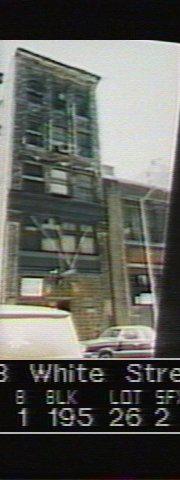
The city photographed every building for its tax records around 1940 and again in the 1980s. NYC Municipal Archives.
Written with AI from the source each entry cites, then fact-checked.
- 1889
Robert W. Gibson files plans for a five-story Romanesque Revival factory and store
B. F. Wheelright, a banker and politician, bought the old 23-foot-wide building here in 1880, and in 1889 his estate hired architect Robert W. Gibson to replace it. On June 14 Gibson submitted plans for a brick store of five stories costing $30,000. He used Roman brick, curved bull-nosed edges and brownstone capitals, a scaled-back version of the style he had used for the United States Trust Company on Wall Street.
Source: Daytonian in Manhattan
- 1900
Potter & Pearson, oilcloth makers, add linoleum to their line while based here
The first tenant seems to have been Potter & Pearson, makers of oilcloth, a waterproof fabric used for floor mats, trunk linings and carriage upholstery. Edward Silas Pearson, born in 1856, had married the daughter of his employer and taken over the firm. Around the turn of the century it began selling linoleum, and it stayed until about 1910, when it moved to East 16th Street.
Source: Daytonian in Manhattan
- 1915
Jenkins Bros. valve makers lease space here as an annex to their White Street headquarters
By 1915 Jenkins Bros., the pressure valve manufacturer founded by Nathaniel Jenkins in 1864, expanded into this building as an annex to its headquarters at 80 White Street. A year earlier B. E. Mfg. Co. had made it home, producing motorcar accessories such as collapsible fire buckets, tire and radiator covers and starting-crank holders. Hardware dealer Burger & Baumgard was also here by 1916.
Source: Daytonian in Manhattan
- 2003
Owners file to legalize the artists' loft apartments that had grown up in the building
Like many Tribeca lofts at the end of the 20th century, this one had been taken over by artists for studio and living space, whether legal or not. The owners filed in 2003 to legalize an interim multiple dwelling. Five years later each of the top three floors held a single apartment, and an exterior renovation finished in 2014 replaced the parapet and restored the brownstone.
Source: Daytonian in Manhattan
Further reading
- Robert W. Gibson's 1889 No. 88 White Street Daytonian in Manhattan
Nearby
- Sullivan, Randolph & Budd Building80 White Street | 5 entries
- 94-100 Lafayette Street Building (Avildsen Building)91 Walker Street | 5 entries
- 85 Walker Street5 entries
- 81 Walker Street2 entries
- 87 Walker Street5 entries
- 83 Walker Street1 entry