Sullivan, Randolph & Budd Building
80 White Street | also 11 Cortlandt Alley | Civic Center | built 1868
Open on the map5 entries

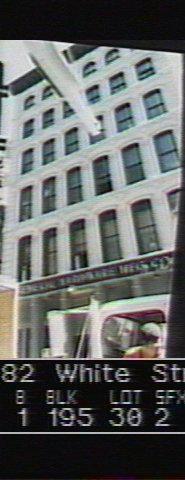
The city photographed every building for its tax records around 1940 and again in the 1980s. NYC Municipal Archives.
Written with AI from the source each entry cites, then fact-checked.
- 1868
Henry Engelbert designs a marble loft for carpet dealer Elias S. Higgins
Elias S. Higgins & Co., carpet dealers, built the six-story store and loft at 80-82 White Street in 1867-68, to a design by Henry Engelbert. The marble facade has stylized neo-Grec details on its pilasters, and the Landmarks Commission believes Badger's Architectural Iron Works made the cast-iron storefront, since the company's foundry mark is on the side. The site previously held two masonry dwellings.
- 1868
Sullivan, Randolph & Budd, textile importers, move in
By March 1868 the new building was home to Sullivan, Randolph & Budd, importers of woolens for menswear, which claimed to be the oldest textile house in the country. It had started around 1834 as Wilson G. Hunt & Co. The firm was known for durable uniform cloth sold to West Point, other military schools and police departments. A steam hoist moved goods between the basement and the roof.
Source: Daytonian in Manhattan
- 1875
The Indian Department holds its annual bid-opening reception at 82 White Street
The Bureau of Indian Affairs kept an office here by 1875 to buy supplies for missions and reservations in the West. On April 27 Commissioner Edward P. Smith held the department's annual reception and read aloud the bids. About 300 bidders attended, mostly from the West, offering to supply goods from shoes and blankets to beef, according to the New York Herald.
Source: Daytonian in Manhattan
- 1913
Jenkins Bros., valve makers, lease the whole building
In 1913 Jenkins Bros., makers of plumbing valves with their main plant in Bridgeport, Connecticut, leased the entire building. During World War II the firm made valves for U.S. Navy ships, and on April 13, 1944 the Secretary of the Navy was authorized to take over its plants after a walkout. In 1949 Jenkins moved to 100 Park Avenue and the heirs of Eugene Higgins sold the White Street building.
Source: Daytonian in Manhattan
- 2017
Artists Space announces its move into the restored building
General Hardware Manufacturing Company, later General Tools, owned the building and had long used it. A restoration beginning in 2016 by FSI Architecture aimed to create retail space, offices and an apartment. In May 2017 Artists Space, a nonprofit gallery, announced that it would move in.
Source: Daytonian in Manhattan
Further reading
- The Sullivan, Randolph & Budd Bldg - 80-82 White StreetDaytonian in Manhattan
Nearby
- 88 White Street4 entries
- 79 Walker Street5 entries
- 81 Walker Street2 entries
- 384 Broadway2 entries
- 388 Broadway2 entries
- 83 Walker Street1 entry