Knickerbocker Club
805 5th Avenue | also 2 East 62nd Street | Upper East Side | built 1915
Open on the map13 entries

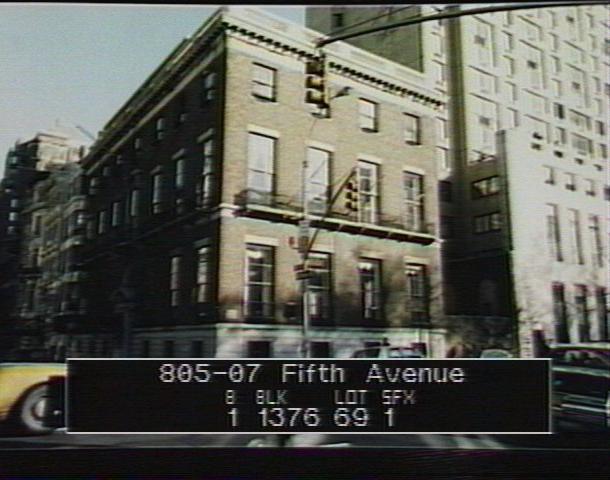
The city photographed every building for its tax records around 1940 and again in the 1980s. NYC Municipal Archives.
Written with AI from the source each entry cites, then fact-checked.
- 1871
Eighteen founders organize the Knickerbocker Club in reaction to the Union Club
The Knickerbocker Club was organized on October 31, 1871 by men who felt the Union Club had loosened its admission standards after the Civil War. The eighteen founders included Alexander Hamilton Jr., August Belmont, John L. Cadwalader and John Jacob Astor. Early meetings took place at Delmonico's, where they settled on the name Knickerbocker over options such as Crescent, Half Moon and Federal. The first clubhouse was at Fifth Avenue and 28th Street.
“Organized on October 31, 1871 the Knickerbocker Club was founded as a reaction against the relaxation of admissions standards…”
- 1898
Brewer's widow Josephine Schmid builds a turreted chateau at 807 Fifth Avenue
Josephine Schmid inherited about $1 million in 1889 when her husband August, a partner in the Lion Brewery, died. In September 1897 she paid $92,599 for the southeast corner of Fifth Avenue and 62nd Street, and her new home began rising a year later. It was a Loire Valley style chateau with a conical corner tower, tall narrow chimneys and Gothic tracery. The mansion stood on the ground where the Knickerbocker Club's present building now stands.
Source: Daytonian in Manhattan
- 1909
Josephine Schmid marries Giovanni del Drago and the New York Times questions his title
In 1909 the fifty-year-old brewery heiress married Giovanni del Drago of Rome. The New York Times first gave his age as 27, then corrected it, reporting that he was 47, divorced, had a 20-year-old son and was not a prince. Two days after the wedding the Times ran a story headed Brewer's Widow Not a Princess, noting that nearly a dozen lives stood between her new husband and the family title. She insisted on being called Princess Del Drago anyway, and the couple closed up the chateau, which stood where the Knickerbocker Club's building stands today, that year.
Source: Daytonian in Manhattan
- 1912
The Princess del Drago sells the empty Schmid chateau to the City Investing Company's president
In 1912 the Princess del Drago, the former brewer's widow Josephine Schmid, sold her Fifth Avenue chateau, on the corner where the Knickerbocker Club now stands, to Robert E. Dowling, president of the City Investing Company. The limestone house, with its corner tower and Gothic ornament, belonged to the Lion Brewery fortune: after August Schmid's death in 1889 Josephine ran the business and multiplied its profits fivefold. After her 1909 marriage the house stood nearly empty.
“The Princess del Drago sold the property to…”
- 1913
The Knickerbocker Club buys the Fifth Avenue corner and a neighboring house for a new clubhouse
On June 13, 1913 the club bought the corner chateau from Robert E. Dowling, president of the City Investing Company, and then acquired the William Lanman Bull house just south of it. Together the lots measured 75 feet along Fifth Avenue and 125 feet along 62nd Street. Some members had thought the site too far uptown, but the club's search below 59th Street found nothing. In February 1914 work began on tearing down both houses, with Delano & Aldrich as architects.
- 1914
Work begins to tear down the Schmid chateau and the Bull house, and Delano & Aldrich are chosen architects
In February 1914 it was reported that crews had started tearing down the Schmid chateau and the house of William Lanman Bull, the two Fifth Avenue houses on the site of today's clubhouse, and that Delano & Aldrich would design the new clubhouse. Together the two parcels had a Fifth Avenue frontage of 75 feet, ran 125 feet along 62nd Street, and carried an assessed value of $780,000.
- 1914
William L. Bull, a former Stock Exchange president who lived at 805 Fifth Avenue, dies
William Lanman Bull, who was president of the New York Stock Exchange from 1888 to 1890, lived with his wife Sara at 805 Fifth Avenue, the address the Knickerbocker Club building now carries; his house was one of two the club tore down for its clubhouse. A partner in the banking house Edward Sweet & Co. for more than 45 years, he retired in 1908 and died on January 2, 1914.
Source: Wikipedia
- 1914
Club member William Adams Delano and builder John I. Downey shape the new clubhouse
The club's new house was credited to two men with similar backgrounds: the architect William Adams Delano, himself a Knickerbocker member, and the builder John I. Downey. Both studied at Yale and belonged to the Century Association. Delano returned from Paris in 1903 to partner with Chester Aldrich and was later a White House renovation consultant in 1949, while Downey left construction in 1927 for Bankers Trust. They worked together again on the Union Club in 1935.
“William Adams Delano (1874-1960) and John Irving Downey (1877-1961), the builder.”
- 1915
Delano & Aldrich complete a neo-Federal clubhouse inspired by a Salem mansion
The Commission credits the building's design to William Adams Delano, with John Irving Downey as builder, and calls it one of the finest neo-Federal buildings in the city. Its flat rectangular massing, three main stories, roof balustrade and restrained ornament recall Samuel McIntire's Pingree House of 1805 in Salem, Massachusetts. Delano and Aldrich added French touches, including a broken-pediment doorway and a curved iron balcony above it.
- 1936
Franklin D. Roosevelt, a member since 1903, resigns from the Knickerbocker Club
Franklin D. Roosevelt joined the Knickerbocker Club in 1903, soon after graduating from Harvard, when the club still met in its Fifth Avenue and 32nd Street house. He resigned in 1936, while he was president, by which time the club was in the Delano & Aldrich building at 2 East 62nd Street. Theodore Roosevelt Sr., the father of President Theodore Roosevelt, had been among the club's founding members in 1871.
“…joined in 1903 upon his graduation from Harvard University. Resigned from the club in 1936.”
Source: Wikipedia
- 1954
Nelson Rockefeller's generosity lets the Knickerbocker Club stay in its clubhouse rent-free
American Heritage reported in December 1954 that, through Nelson Rockefeller's generosity, the club could keep its Fifth Avenue and 62nd Street clubhouse rent-free for ten years, and ten more if Rockefeller was still living. The magazine judged it perhaps the most socially eminent club in the city, yet one that had difficulty attracting new members.
Source: americanheritage.com
- 1959
The club weighs merging back into the Union Club, but the plan dies
By the 1950s membership in New York's urban social clubs was shrinking, largely because wealthy families had moved to the suburbs. In 1959 the Knickerbocker Club weighed merging its 550 members into the Union Club, which had 900 and which the club's founders had left in 1871. The plan never came to fruition.
“In 1959, the Knickerbocker Club considered rejoining the Union Club…”
Source: Wikipedia
- 1979
The Landmarks Commission designates the clubhouse over its owner's written objection
After hearings in January and March 1979, the Landmarks Preservation Commission designated the Knickerbocker Club Building on September 11, 1979. Three witnesses spoke for designation, while the owner sent a letter against it. The Commission called the building one of the finest examples of neo-Federal design in New York and noted that it was the club's third home.
Further reading
- Knickerbocker ClubWikipedia
Nearby
- 810 Fifth Avenue810 5th Avenue | 4 entries
- Fifth Avenue Synagogue5 East 62nd Street | 6 entries
- William Ziegler Jr. House2 East 63rd Street | 5 entries
- The Pierre797 5th Avenue | 11 entries
- Metropolitan Club790 5th Avenue | 8 entries
- 820 Fifth Avenue820 5th Avenue | 11 entries