820 Fifth Avenue
820 5th Avenue | also 1 East 63rd Street | Upper East Side | built 1916
Open on the map11 entries

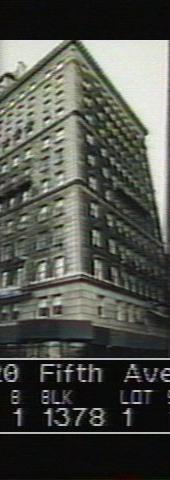
The city photographed every building for its tax records around 1940 and again in the 1980s. NYC Municipal Archives.
Written with AI from the source each entry cites, then fact-checked.
- 1901
The Progress Club leaves its Fifth Avenue clubhouse, which millionaire James Haggin buys for a mansion that never rises
Before the apartment house, the corner of Fifth Avenue and 63rd Street held the Progress Club's clubhouse. When the club moved west of Central Park in 1901, millionaire James Haggin bought the building as the site for his own mansion. He never built it, and the clubhouse stood empty until his death in 1914, after which his estate sold the land to a syndicate.
Source: Daytonian in Manhattan
- 1916
Robert Goelet leases an eighteen-room apartment before the building is finished
Prospective tenants were signing leases while the building was still under construction. The New York Times reported on May 13, 1916 that Robert Goelet, a recently divorced real estate tycoon, had taken an apartment of eighteen rooms and six baths. He was leaving his marble-fronted mansion at 647 Fifth Avenue.
Source: Daytonian in Manhattan
- 1916
A syndicate builds "horizontal mansions" at 820 Fifth Avenue
A syndicate bought the site from the estate of millionaire James Haggin in 1915 and hired Starrett & Van Vleck to design a 12-story building inspired by Italian Renaissance palazzi. Most floors held a single apartment, marketed as a "horizontal mansion" and expected to rent for $18,000 to $25,000 a year. Each apartment had its own passenger, service and party elevators.
Source: Daytonian in Manhattan
- 1918
Tobacco executive George Arents dies in his apartment at 83
George Arents, treasurer of the American Tobacco Company and one of its co-organizers, had been among the building's first residents with his wife, Annie Amelia Walter. Pneumonia took his life at their apartment on February 22, 1918, when he was 83, and he left an estate of $10,040,643.
Source: Daytonian in Manhattan
- 1919
Automaker John North Willys leases Alfred Nathan's apartment and later moves within the building
In January 1919, Alfred Nathan leased his huge apartment to John North Willys, president of Willys-Overland, then the second-largest automobile maker in the country, for a long term of years. After seven years Willys's family moved within the building in April 1926 to a duplex of twenty-three rooms and eight baths, where a New York Times writer described its Italian paintings.
Source: Daytonian in Manhattan
- 1924
Robert Goelet throws a supper dance for 150 guests after his wife files for divorce
Fernanda Goelet had begun divorce proceedings in Paris against Robert Goelet, The New York Times reported on February 10, 1924. He kept to his social calendar anyway: on March 26 he gave a supper dance at his apartment for roughly 150 guests, among them princes and princesses, the Otto Kahns and members of the Drexel, Gerard and Pell families.
Source: Daytonian in Manhattan
- 1934
Former governor Alfred E. Smith moves into 820 Fifth Avenue
Alfred E. Smith, the former New York governor, took the seventh-floor apartment and lived there with his wife and several grown children. He died there on October 4, 1944, five months to the day after his wife Catherine.
Source: Daytonian in Manhattan
- 1944
Alfred E. Smith retires to 820 Fifth Avenue after his wife's death and dies five months later
Catherine Dunn Smith died of pneumonia at St. Vincent's Hospital on May 4, 1944, aged 65. The New York Times reported that her husband, former governor Alfred E. Smith, withdrew to their home at 820 Fifth Avenue. He died on October 4, 1944, aged 70, and his funeral at St. Patrick's Cathedral was broadcast on radio nationwide.
Source: Daytonian in Manhattan
- 1949
820 Fifth Avenue converts to a cooperative
The building became a cooperative in 1949. By 1968 typical apartments were selling for about $750,000. Today the co-op board requires buyers to pay entirely in cash.
Source: Daytonian in Manhattan
- 1968
The Wrightsmans pay about $350,000 for a floor to use as extra gallery space
New York Magazine described 820 Fifth Avenue on May 20, 1968, saying its tenants included the William Paleys. It reported that Charles and Jayne Wrightsman had just paid about $350,000 for a floor to serve as supplementary gallery space. Typical apartments in the cooperative then sold for about $750,000.
Source: Daytonian in Manhattan
- 2019
Jayne Wrightsman's art-filled third-floor apartment goes on the market for $50 million
Jayne Wrightsman, widow of the Oklahoma oil tycoon Charles Wrightsman, moved into 820 Fifth Avenue in the 1950s and lived there after his 1986 death. After she died in April 2019 at 99, her third-floor apartment, described by The New York Times as filled with priceless paintings and rare books, was listed that November for $50 million.
Source: Daytonian in Manhattan
Further reading
- 820 Fifth AvenueWikipedia
- "Horizonal Mansions" - the 1916 820 Fifth AvenueDaytonian in Manhattan
Nearby
- Edward J. Berwind House828 5th Avenue | 11 entries
- Edmond J. Safra Synagogue11 East 63rd Street | 8 entries
- William Ziegler Jr. House2 East 63rd Street | 5 entries
- New India House3 East 64th Street | 4 entries
- 834 Fifth Avenue834 5th Avenue | 10 entries
- 810 Fifth Avenue810 5th Avenue | 4 entries