81 Barrow Street
West Village | built 1853
Open on the map3 entries

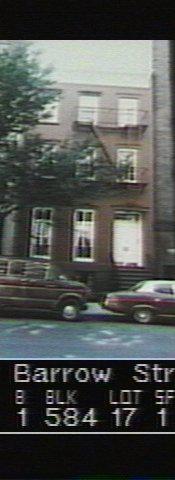
The city photographed every building for its tax records around 1940 and again in the 1980s. NYC Municipal Archives.
Written with AI from the source each entry cites, then fact-checked.
- 1853
Builder James Vandenbergh puts up an Italianate house at No. 81 on Trinity Church land
Read more
In 1852-53 James Vandenbergh, a longtime Village builder who had served as master mason on the building of Trinity Church, built this brick house, three stories above a rusticated basement. It was one of a row of three on land owned by Trinity, and his own residence stood on the site of what is now No. 79. By 1969 the Landmarks Preservation Commission described No. 81 as the lone survivor of that row and the only reminder of the block's earlier age.
“…erected in 1852-53 by James Vandenbergh, a well-established builder ... master mason in charge of construction at Trinity Church. This house is the lone survivor of a row of three…”
- 1907
A resident of No. 81 is hurt when two Sixth Avenue elevated trains collide near 34th Street
John Mappis, who lived at 81 Barrow Street in 1907, got on a Sixth Avenue elevated train that November morning. Near 34th Street, across from Macy's, his train and another struck each other at low speed. Mappis was cut about the head and face and taken to Bellevue Hospital, and the New-York Tribune reported that the slow speed had probably prevented a long list of deaths.
Source: Daytonian in Manhattan
- 1946
Novelist Isabel Bolton, unable to see well enough to write, dictates her books at No. 81
By the middle of the twentieth century Mary Britton Miller, who published fiction as Isabel Bolton, was living at 81 Barrow Street. Past her sixtieth birthday, her eyesight no longer allowed her to write, so she dictated her books and poems in the house. Her 1946 novel Do I Wake or Sleep won praise from the critic Edmund Wilson, and The Christmas Tree and Many Mansions followed. She died in April 1975.
Source: Daytonian in Manhattan
Further reading
- Then & Now photos: 81 Barrow StreetVillage Preservation: Greenwich Village Then & Now
Nearby
- 79 Barrow Street1 entry
- 77 Barrow Street1 entry
- 50 Commerce Street (Commerce Inn)75 Barrow Street | 3 entries
- 48 Commerce Street5 entries
- 46 Commerce Street5 entries
- Cornelius Oakley House59 Morton Street | 5 entries