Edward J. Berwind House
828 5th Avenue | also 827 5th Avenue, 2 East 64th Street | Upper East Side | built 1896
Open on the map11 entries

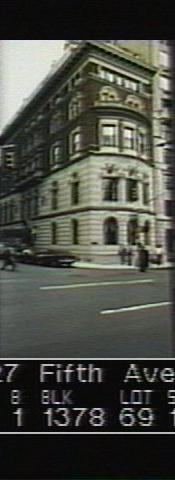
The city photographed every building for its tax records around 1940 and again in the 1980s. NYC Municipal Archives.
Written with AI from the source each entry cites, then fact-checked.
- 1896
Nathan Clark Mellen designs Edward Berwind's Fifth Avenue mansion
Coal magnate Edward J. Berwind, sole coal supplier to the U.S. Navy, commissions the little-known architect Nathan Clark Mellen to design a red brick and limestone house at Fifth Avenue and 64th Street. The house, finished in 1896, has a bowed Fifth Avenue front, a two-story rusticated base and an arched entry on 64th Street. A shallow moat behind a limestone wall with scrolled bronze grills screens it from passersby. The French firm Jules Allard & Son decorates the interiors, which include a second-floor ballroom.
Source: Daytonian in Manhattan
- 1907
The Times calls Edward Berwind an outsider among Upper Fifth Avenue's New York-born millionaires
On May 26, 1907 the New York Times ran a long article assuring readers that native New Yorkers still owned upper Fifth Avenue. It had to admit one exception at 64th Street: Edward J. Berwind, a Philadelphia native who represented Pennsylvania's coal interests. Daytonian in Manhattan notes that his mansion, designed by the little-known Nathan Clark Mellen, was as much an outlier as its owner.
Source: Daytonian in Manhattan
- 1922
Sarah Berwind leaves her estate to charity and her brother, not her husband
When Edward Berwind's wife Sarah dies, her estate of nearly half a million dollars goes to charity and to her brother. She leaves Edward her jewelry, appraised at $376,944, but no money, stating in her will that he does not need it. His unmarried sister Julia then moves into the house to act as his hostess here and at The Elms in Newport.
Source: Daytonian in Manhattan
- 1936
Coal baron Edward Berwind dies in the mansion at 88
Edward J. Berwind died in his Fifth Avenue house on August 18, 1936, at age 88. After a funeral at St. Thomas Church on Fifth Avenue he was buried at West Laurel Hill Cemetery in Pennsylvania, in a mausoleum Horace Trumbauer designed on the model of Athens's Tower of the Winds. His sister Julia and his nephew Charles E. Dunlap were the main heirs.
Source: Wikipedia
- 1945
Julia Berwind sells the mansion and its grand central staircase is removed
After Edward Berwind dies in 1942, his sister Julia stays on in the house until 1945, when she sells it to the Institute of Aeronautical Sciences for about $300,000. The Institute keeps most of the interiors but takes out the grand central staircase. The building later becomes headquarters of the American Heart Association, which stays until 1978.
Source: Daytonian in Manhattan
- 1963
The Institute of the Aeronautical Sciences sells the mansion to developer Harry Waxman
The Institute of the Aeronautical Sciences, which bought the house in 1945, sold it in 1963 to developer Harry Waxman and relocated to a building on Sixth Avenue. Despite the Institute's modern work, which included interviewing engineering candidates for helicopter and guided-missile programs, the Gilded Age interiors survived its tenure intact.
Source: observer.com
- 1967
After his brother dies at a party in the house, Harry Waxman sells it to the New York Heart Association
Harry Waxman's brother and business partner Sydney died of a heart attack during a party at the mansion, and the property quickly went back on the market. A group wanting a nursing home bid $1.5 million, but Waxman disliked that fate for the house and sold it in 1967 to the New York Heart Association, taking half the bid. The association kept the painted ceilings and carvings and used the rooms as offices and meeting space.
Source: observer.com
- 1978
The mansion is converted back to apartments and gains a glass penthouse
In 1978, as the American Heart Association era ends, the mansion returns to residential use and a modern glass penthouse is added to the roof. The main rooms become two full-floor apartments, two smaller duplexes and four apartments in the former servants' quarters. Scientist Joel Birnbaum lives in the parlor-floor apartment from 1984 to 1999, and singer Donna Summer and designer Adolfo are among other residents.
Source: Daytonian in Manhattan
- 1983
Toni Morrison reads from the unpublished 'Beloved' at an Ethical Culture meeting in the mansion
In 1983, when the building was already divided into co-op apartments, the New York Society for Ethical Culture held a meeting in the mansion. Toni Morrison read there from her then-unpublished novel Beloved. The Observer notes that she did so in much the same space that Edward Berwind built a century earlier.
Source: observer.com
- 1999
Scientist Joel Birnbaum sells the parlor-floor apartment for $9.5 million after fifteen years
Scientist Joel Birnbaum lived from 1984 to 1999 in the parlor-floor apartment, about 3,500 square feet with 18-foot ceilings and a vaulted foyer. The mansion's formal rooms had been turned into apartments when the building went back to residential use in 1978. In 1999 Birnbaum sold his for $9.5 million to the real estate developer Howard Ronson.
Source: Daytonian in Manhattan
- 2013
Roman Abramovich reportedly goes under contract for the Ronson family's share of the mansion
Developer Howard Ronson bought up pieces of the old mansion, and after his death in 2007 his family acquired the penthouse too. They put their 15,080 square feet, including the ballroom, on the market in 2012 for $72 million. In 2013 Roman Abramovich was reported to be in contract, but the deal fell apart, and the triplex was later offered for rent at $80,000 a month.
Source: observer.com
Further reading
- Edward J. Berwind HouseWikipedia
- The Edward Berwind House - 828 Fifth AvenueDaytonian in Manhattan
Nearby
- 820 Fifth Avenue820 5th Avenue | 11 entries
- 834 Fifth Avenue834 5th Avenue | 10 entries
- New India House3 East 64th Street | 4 entries
- Edmond J. Safra Synagogue11 East 63rd Street | 8 entries
- The Arsenal830 5th Avenue | 12 entries
- Wildenstein & Co. Building19 East 64th Street | 4 entries