Strand Bookstore
826 Broadway | also 828 Broadway | Greenwich Village | built 1902
Open on the map14 entries

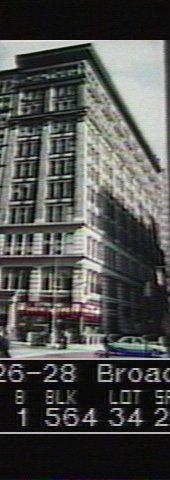
The city photographed every building for its tax records around 1940 and again in the 1980s. NYC Municipal Archives.
Written with AI from the source each entry cites, then fact-checked.
- 1902
Row houses, a cast-iron loft and warehouses make way for a new corner building at Broadway and 12th Street
The Strand's building replaced several structures from the 1830s to the 1850s: 828 Broadway, a six-story cast-iron-fronted loft, 826 Broadway, a former five-story row house used commercially, and two warehouses at 61 and 63 East 12th Street. In 1895 Albert Joske bought the L-shaped property that included 828 Broadway, while Jacob Hirsh bought the corner sites. In January 1902 John H. Parker bought both parcels and merged them into one site.
- 1902
William H. Birkmire designs the eleven-story National Building for garment makers
John H. Parker, president of the National Realty Company, hired William H. Birkmire, a specialist in steel-frame construction, to design an eleven-story Renaissance Revival building. Because of Parker's company it was known in its early years as The National Building. Construction took place through 1902 and the building was ready for occupancy in 1903. It was built on speculation for garment makers who wanted large, bright floors near Union Square, with open floor plans of about 10,000 square feet.
- 1903
Shirtwaist, suit and children's clothing makers fill the building's loft floors
The landmark report lists Hirsch Brothers, an all-purpose women's clothing factory, and Philip Rosenwasser, a shirtwaist specialist, among the early tenants. Piddian & Wormser made children's clothing, while S.J. Nathan and the Merrimac Manufacturing Company made men's suits. The A.B. Kirschbaum men's clothing store occupied the ground floor.
“Philip Rosenwasser, a shirtwaist specialist; Piddian & Wormser, maker of children’s clothing…”
- 1908
A Pittsburgh industrialist buys the National Building for $1 million
In 1908, six years after the building opened, Herbert Du Puy, a Pittsburgh industrialist, paid $1 million to the Belfrank Realty Company for the National Building at Broadway and 12th Street. The press cited the sale as one example of wealthy buyers from outside Manhattan snapping up premier buildings in the city.
- 1917
A Pittsburgh owner trades the National Building and four Pittsburgh properties for the Saks store
In 1908 the Pittsburgh industrialist Herbert Du Puy bought the building for $1,000,000, a sale the press cited as part of a trend of wealthy out-of-towners buying Manhattan buildings. In 1917, in a $7,000,000 deal, Du Puy sold it with four Pittsburgh properties to Henry Morgenthau Sr.'s Herald Square Realty Company. In exchange he received the Saks department store building at West 34th Street and Sixth Avenue.
- 1923
Garment makers drift uptown, and the building sells for far less than before
As clothing manufacturers moved to a new Garment District around Seventh Avenue in the West 30s, 826 Broadway lost value. When the Herald Square Realty Company sold it to the Deroldine Realty Corporation in 1923, it was worth around $680,000. By 1942 it was assessed at only $290,000, even though it was fully occupied and earning about $50,000 a year in rent.
“When Morganthau's company sold 826 Broadway to the Deroldine Realty Corporation in 1923, the building's value had declined to around $680,000.”
- 1950
Book publishers take space near Book Row
By 1950 book publishers were renting space at 826 Broadway, drawn by its closeness to Fourth Avenue's Book Row, the strip of secondhand shops between Astor Place and Union Square. At its busiest, around the middle of the century, roughly 30 to 40 shops lined Book Row. From the 1920s to the 1950s some garment production also continued in the building, alongside a stationery company, a perfume maker and a maker of medical devices.
“By 1950, book publishers also moved into 826 Broadway, taking advantage of the building's proximity to Fourth Avenue's traditional sales district known as "book row.”
- 1956
The Strand leaves Fourth Avenue's Book Row and moves into the ground floor of 826 Broadway
Benjamin Bass had founded the Strand in the late 1920s and the store had spent 18 years at 81 Fourth Avenue. In 1956, the year his son Fred became manager, that building was demolished for a large apartment house, and the Strand moved into the ground-floor store at 826 Broadway. Under Fred Bass it later grew to three floors of retail space and two of offices.
- 1996
The Strand buys the building it has occupied since 1956
In 1996 the Strand bought 826 Broadway. By then it was the largest used-book store in the world, known for rare and out-of-print titles as well as current ones. Under Fred Bass it had grown to three floors of retail and two of offices, with more than 2.5 million books, and had begun hosting author readings and community events.
- 2005
A major renovation brings the Strand an elevator and air conditioning
In 2005 the Strand's main store was renovated and expanded. The work added an elevator and air conditioning and rearranged the floors to make browsing easier. The store also started selling discounted new books and other goods besides books; its shirts and tote bags bring in more than 15 percent of its revenue today.
“…the main store underwent a major renovation and expansion, with the addition of an elevator, air conditioning, and a re-organization of the floors…”
Source: Wikipedia
- 2012
Strand workers reject a union contract, then ratify one two months later
The Strand has had a unionized workforce for more than 35 years. On April 5, 2012, union workers at the store rejected a proposed new contract, and on June 15 they ratified a new one.
Source: Wikipedia
- 2019
The Landmarks Commission designates the Strand building over the owner's opposition
After two public hearings, the second on February 19, 2019, the city's Landmarks Preservation Commission designated 826 Broadway an individual landmark on June 11, 2019. Fourteen people testified against at the second hearing, including the building's owner, while seven spoke in favor. The designation report cites the intact Renaissance Revival facade, the steel frame and the Strand's presence since 1956.
- 2020
The Strand's plea that it may close brings 25,000 online orders in a single weekend
On October 23, 2020, owner Nancy Bass Wyden posted a statement saying the Strand was in danger of closing during the pandemic. The appeal, issued on a Friday, drew enormous sales, with 25,000 online orders placed over the weekend. It also drew criticism from people who had followed ongoing labor disputes at the store, which had laid off most of its employees that March.
Source: Wikipedia
- 2020
The Strand lays off most of its staff as the pandemic hits
The Strand let go of most of its employees in March 2020 because of the COVID-19 pandemic. In April it received a Paycheck Protection Program loan of between $1 million and $2 million meant to support 212 jobs, of which 188 had already been cut. Fewer than two dozen union jobs were later restored, and in July the store laid off 12 workers it had recently rehired.
“…in April it received a Paycheck Protection Program loan between $1 and $2 million intended to help maintain 212 jobs of which 188 had already been eliminated…”
Source: Wikipedia
Further reading
- Strand BookstoreWikipedia
Nearby
- 830 Broadway Building830 Broadway | 7 entries
- 832-834 Broadway Building832 Broadway | 7 entries
- 836 Broadway Building836 Broadway | 8 entries
- 840 Broadway Building840 Broadway | 8 entries
- 817 Broadway Building817 Broadway | 6 entries
- 827-831 Broadway Buildings827 Broadway | 9 entries