840 Broadway Building
840 Broadway | Greenwich Village | built 1901
Open on the map8 entries

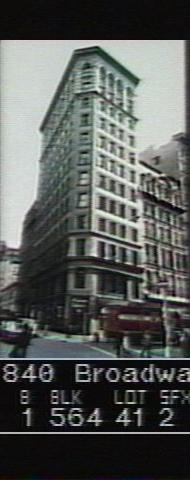
The city photographed every building for its tax records around 1940 and again in the 1980s. NYC Municipal Archives.
Written with AI from the source each entry cites, then fact-checked.
- 1899
Henry Corn buys a Federal-style house and an Italianate neighbor to put up a large mercantile building
Two older buildings stood here before the present one: a 2.5-story house in the Federal style, leased to the tailors Gardner & Company in the 1890s, and a four-story Italianate building. The real estate operator Henry Corn bought the site in June 1899, saying he would build a large mercantile building. This entry describes the earlier buildings on the site.
- 1901
The clothier Thompson & Company opens an uptown branch in the new building
Thompson & Company signed a ten-year lease on the ground floor in 1899, and a 1901 advertisement called the new corner building the Thompson Building. The shop sold hats, haberdashery, and men's and youths' clothing. It closed at the end of 1907, and other menswear firms followed in the space.
- 1901
Robert Maynicke gives the corner a clipped entrance and five plate-glass show windows
Maynicke's design sits on a trapezoidal lot with a 50-foot Broadway front and a 95-foot front on East 13th Street. He cut a ten-foot clipped corner to draw attention to the store entrance from Union Square. The ground-floor store has five show windows made of large sheets of plate glass: a single one facing Broadway and four along East 13th. Permits were filed in December 1899, and construction ran from 1900 to 1901.
“To heighten the building's visibility from Union Square, Maynicke employed a clipped corner. About ten feet wide, the slender corner facade draws attention to the store entrance…”
- 1915
Henry Corn's holding company goes bankrupt and he turns to the movie business
Henry Corn, who developed 840 Broadway, was remembered at his death in 1934 as one of the city's largest real estate operators. In 1906 he formed the Improved Property Holding Company, which owned the Alwyn Court apartment house at 58th Street and Seventh Avenue. It went bankrupt in 1915, and Corn then worked in the movie business.
“In 1906, Corn formed the Improved Property Holding Company which owned, among other buildings, the Alwyn Court. The company went bankrupt in 1915; afterwards Corn worked in the movie business.”
- 1953
The Goodyear Waterproof Company's raincoat store leaves the corner space
After Lester & Lester, another men's clothier, the ground floor went to the Goodyear Waterproof Company, which sold raincoats and other rainproof clothing. Goodyear stayed until 1953. During its tenancy the store entrance was moved to the Broadway side, and the show window was blocked or altered. The space later became the World Antiques Center and then a bookstore.
- 1970
The loft building becomes Burnham House, a cooperative apartment building
As clothing makers left over the decades, floors went to architects, attorneys, printers and publishers. In 1970 the building was converted into a co-op called Burnham House. By the mid-1980s the corner entrance on the facade had been reopened.
- 1985
Director Tom O'Horgan hangs his loft with world instruments and hosts Mister Rogers
Tom O'Horgan, the director of the Broadway musicals Hair and Jesus Christ Superstar, kept a 3,000-square-foot loft here. It was known for parties attended by artists such as Norman Mailer and Beverly Sills, and the walls held instruments from around the world, including an alcove of gongs. Fred Rogers visited the loft for a 1985 episode of Mister Rogers' Neighborhood.
“O'Horgan lived in a 3,000-square-foot loft in Manhattan at 840 Broadway (at 13th Street) that was famous for parties and events attended by artistic figures like Norman Mailer and Beverly Sills.”
Source: Wikipedia
- 2007
Tom O'Horgan's loft and instrument collection are sold as Alzheimer's disease overtakes him
O'Horgan's Alzheimer's disease first showed itself in 2002. By 2007 he owed large debts and could no longer look after himself, so friends Marc and Julia Cohen took over his care and his loft and instrument collection were sold. He relocated to Venice, Florida, and died there on January 11, 2009.
“…by 2007 he was deeply in debt and unable to care for himself. He came under the care of friends Marc and Julia Cohen, his loft and collections of instruments were sold…”
Source: Wikipedia
Nearby
- 836 Broadway Building836 Broadway | 8 entries
- 832-834 Broadway Building832 Broadway | 7 entries
- 830 Broadway Building830 Broadway | 7 entries
- 827-831 Broadway Buildings827 Broadway | 9 entries
- 827-831 Broadway Buildings831 Broadway | 8 entries
- Strand Bookstore826 Broadway | 14 entries