The Roosevelt Building
841 Broadway | also 849 Broadway | Greenwich Village | built 1900
Open on the map11 entries

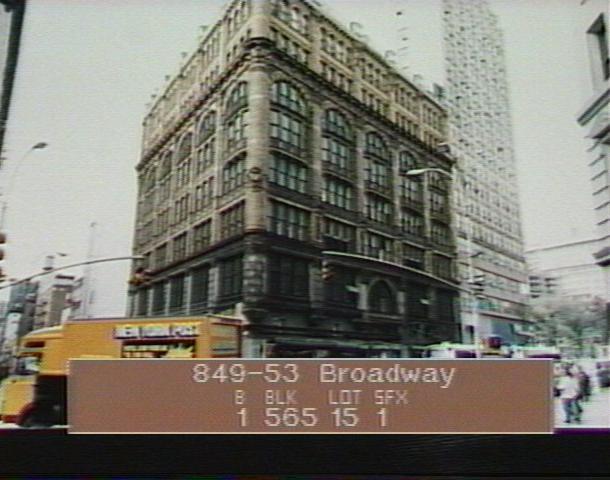
The city photographed every building for its tax records around 1940 and again in the 1980s. NYC Municipal Archives.
Written with AI from the source each entry cites, then fact-checked.
- 1865
The Roosevelt family's Broadway mansion stands in the Lincoln funeral photograph
The ground under today's building was once the garden behind Cornelius V.S. Roosevelt's mansion at Broadway and 14th Street, bought around 1842. A well-known photo of Lincoln's funeral procession in 1865 shows the mansion in the background, and legend places young Theodore Roosevelt and his brother Elliott in a window. The house was razed after Cornelius died in 1871, and by 1891 a row of three buildings stood where the garden had been; this entry concerns that earlier property.
- 1893
The Roosevelt family announces a $500,000 fireproof office building at Broadway and 13th Street
The New York Times reported that members of the Roosevelt family had formed a corporation to build an eight-story fireproof office building at the corner. James A. and Robert Barnwell Roosevelt were the main owners, with relatives investing alongside. Plans filed in February named Stephen Decatur Hatch as architect and included three elevators and electric lighting.
“Members of the Roosevelt family have formed a corporation for the purpose of erecting an eight-story office building on the northwest corner of Broadway and Thirteenth Street.”
- 1893
Builder Otto Eidlitz floats the Roosevelt Building on an artificial bottom
The soil here was clay and sand, with rock only toward the center of the lot, 35 to 40 feet in from the sidewalk. Otto Eidlitz of Marc Eidlitz & Son solved the problem by creating an artificial bottom 17 to 19 feet down where rock was found, so the building effectively floated. Work began in spring 1893 and ended a year later.
“Eidlitz's solution was to "float" the building by creating an artificial 'bottom'...from seventeen to nineteen feet below the surface" in those areas where rock was found.”
- 1894
A trade journal mocks the new Roosevelt Building for standing empty
Within months of completion, the Real Estate Record and Builder's Guide scolded the owners for the unrented building, which it said was costly to build and managed unwisely without professional leasing agents. The journal joked that the "For Rent" sign had nearly become part of the structure. By March 1895 several tenants had moved in.
- 1894
Hatch covers two corner facades in terra-cotta mermaids and sea creatures
Stephen Hatch's eight-story design for the Roosevelts has two nearly identical facades, on Broadway and East 13th Street, built of honey-colored Roman brick over a rusticated stone base. Terra-cotta ornament crowds the cornices and column capitals, including mermaid figures sprouting from leafy cups and animals with fish-like tails. The building blends Romanesque Revival arches with more delicate Renaissance Revival details.
“…two nearly identical and fully articulated, tripartite facades on the east and south facades ... mermaid torsos emerging from inverted foliage cups and beasts with sea creature tails.”
- 1895
The American Ball Nozzle Company turns the ground floor into a miniature village to demo its fire-hose nozzle
The American Ball Nozzle Company, which made a bell-shaped hose nozzle with a loose rubber ball inside, rented the whole ground floor in 1895 for a lavish exhibit. Half the space became a miniature village with lawns. The other half held a fountain that used the nozzle to throw a spray said to be able to put out fires or simply water a lawn.
“…the company rented the entire ground floor of the Roosevelt Building in 1895 and held an elaborate exhibit. Half of the space was transformed into a "miniature village…”
- 1896
The American Mutoscope Company builds a rotating film studio on the roof
In February 1896 alterations were listed to install brick piers on the roof to carry a track for a platform that could move, costing $2,000. The track, designed by architect Chauncy F. Mack, let the platform rotate to follow the sun, in imitation of Edison's Black Maria studio in New Jersey. From here the company, later called Biograph, turned out more than 4,000 film titles between 1897 and 1907.
“The track, which was designed by the architect Chauncy F. Mack and constructed by the builder Hitchings & Co, rotated to follow the sun…”
- 1903
A fire in the "fireproof" Roosevelt Building kills Captain John T. Andariese
The blaze began in the Altman Neckwear offices on the sixth floor and ravaged the top three stories. Collapsing ceilings crashed through the floors, seven firefighters were badly hurt, and Captain Andariese of Engine Company 1 fell through a hole on the sixth floor and died. A trade journal remarked that nothing burns so readily as a fireproof building.
Source: Daytonian in Manhattan
- 1903
Hackett, Carhart & Co. anchors the building so firmly that it is sometimes called the Hackett, Carhart Building
By 1903-04 most tenants made clothing. Crown Suspender had the third floor, Nanotuck Silk the fourth, Brainard & Armstrong Silk the fifth and Altman Neckwear the sixth. The main tenant was the men's clothier Hackett, Carhart & Co., which kept salesrooms on the first two floors and stored stock on the seventh and eighth. Founder Corcellus Hubbard Hackett had come to New York in 1885.
“The building's primary tenant at this time was Hackett, Carhart & Co., a men's clothier that had their salesrooms on the first and second stories…”
- 1906
Biograph abandons its rooftop stage here for a studio on East 14th Street
Around 1906 the American Mutoscope and Biograph Company left the roof for a new studio at 11 East 14th Street. Film historian Paul Spehr noted that the rooftop was unusable in winter, since cold, stormy or overcast weather ruined the strong, even light filming needed. At the new studio the company became the first to use only artificial light, and D.W. Griffith made about 450 films there between 1908 and 1913.
- 2007
A restoration brings back the missing copper cornice and cleans the terra cotta
By the mid-20th century the Roosevelt Building sat dirty with a bare scar where its copper cornice had been. In 2007 Israel Berger Architects began a major restoration that replaced the cornice, cleaned the masonry and replicated damaged terra-cotta ornament. At the time of the landmark report its tenants included a bank branch, a restaurant, a yoga center and a chocolate bar.
Nearby
- Abrahams Magazine Service Building56 East 13th Street | 5 entries
- 827-831 Broadway Buildings831 Broadway | 8 entries
- 827-831 Broadway Buildings827 Broadway | 9 entries
- 840 Broadway Building840 Broadway | 8 entries
- 37 East 12th Street5 entries
- 832-834 Broadway Building832 Broadway | 7 entries