Reformed Church of Newtown
85-15 Broadway | Elmhurst | built 1834
Open on the map7 entries

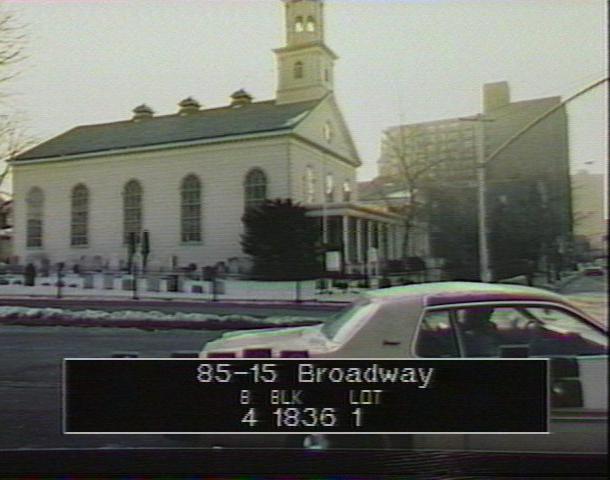
The city photographed every building for its tax records around 1940 and again in the 1980s. NYC Municipal Archives.
Written with AI from the source each entry cites, then fact-checked.
- 1735
The Dutch congregation finishes its first church, later a British armory, an earlier building on the site
Dutch immigrants organized the congregation in 1731 in Newtown, which the Dutch had founded in 1652 as Middenburgh. Their first church was finished in 1735. It came through the colonial years and the Revolutionary War, when the British took it over to store arms, and stood until the present sanctuary replaced it; its cornerstone survives in the newer church's foundation.
Source: Wikipedia
- 1831
The congregation builds the present wooden Greek Revival church on the old cornerstone
The 1831 church replaced an octagonal wooden church that volunteers had finished in 1735. It reused the first church's cornerstone in its foundation and is framed entirely in wood, with a porch on seven wooden columns, round-headed windows and an octagonal bell tower with a copper roof. Its churchyard toward Corona Avenue keeps many of its old headstones.
- 1956
President Dwight D. Eisenhower visits the church for its 225th anniversary
Eisenhower came to Newtown church in 1956 to mark the congregation's 225th year. For the occasion the Reverend A. Nelson Doak wrote a short history of the parish in which he praised the ethnic variety of Elmhurst.
“In 1956, for its 225th anniversary, President Dwight D. Eisenhower visited the church.”
Source: Wikipedia
- 1966
The city designates the church and its Fellowship Hall as landmarks
At the February 1966 hearing, three speakers backed designation, among them the minister, the Rev. A. Nelson Doak, and nobody objected. The commission called the 1831 church and its 1860 hall one of the few all-wood church groups left in New York and the leading architectural monument of the neighborhood. A year earlier, aluminum shingles had been laid over the original wood shingles to protect them.
- 1980
The Rev. David Boyce starts a Taiwanese service, and membership doubles within two years
As Elmhurst changed, Boyce added a worship service for Taiwanese immigrants and later one for Tamil-speaking Indians, so the once-Dutch church held services in English, Taiwanese and Tamil. Led by the Rev. Bill H.C. Lee, the Taiwanese ministry soon outnumbered the white members as membership more than doubled from 1981 to 1982. Boyce made Lee his equal co-pastor, though the denomination formally allows only one senior pastor.
“…the Taiwanese ministry, led by the Rev. Bill H.C. Lee, soon outnumbered Newtown's white congregants, as the membership more than doubled from 1981 to 1982.”
Source: Wikipedia
- 1989
A renovation replaces the church's storm-damaged cupolas
A 1989 renovation put in new cupolas after a storm had damaged the old ones. The Landmarks Preservation Commission has called the sanctuary and adjoining hall a rare surviving pair of all-wood church buildings in New York, and the complex has been on the National Register of Historic Places since 1980.
Source: Wikipedia
- 1995
The Rev. David K.T. Su adds a Mandarin service, giving the church three Sunday congregations
Su's Mandarin service joined the Taiwanese service and an English service attended by Asian, Latino and white worshippers each Sunday. He served the church for nearly thirty years before retiring in December 2017, after which the Rev. Dr. Tien-Heng Chiu became the church's senior pastor.
Source: Wikipedia
Further reading
- Reformed Church of NewtownWikipedia
Nearby
- Old St. James Church86-02 Broadway | 7 entries
- St. James Episcopal Church84-07 Broadway | 1 entry
- Indo Java Groceries (Warung Selasa)85-14 Queens Boulevard | 2 entries
- Newtown High School48-01 90th Street | 9 entries
- Elks Lodge 87882-10 Queens Boulevard | 8 entries
- Queens Place Mall88-01 Queens Boulevard | 3 entries