85 Walker Street
Civic Center | built 1869
Open on the map5 entries

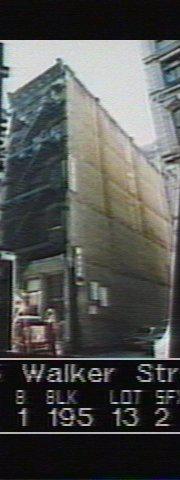
The city photographed every building for its tax records around 1940 and again in the 1980s. NYC Municipal Archives.
Written with AI from the source each entry cites, then fact-checked.
- 1869
Henry Fernbach designs a sandstone loft for Charles Zinn & Co. at 85 Walker Street
The five-story store and loft building went up in 1868-69 for Charles Zinn & Co. to designs by Henry Fernbach, who drew several other buildings on the block. It is about 24 feet wide and 90 feet deep, with a sandstone front that mixes Italianate and Second Empire features and an original cast-iron storefront. The iron vault covers in the sidewalk bear the mark of the Jackson Burnet Co. of 201 Centre Street. The Landmarks Preservation Commission notes that one earlier masonry building stood on the lot.
- 1869
Hall, Black & Co. advertise parasols from the building's first season
The building was finished in 1869 and first rented to Hall, Black & Co. On April 14 of that year the firm ran a newspaper advertisement headed "Parasols!" three times over, promising goods priced to meet the trade at all times, and later that spring called its stock the finest and cheapest parasols in the country. The firm was gone within three years. Umbrella and parasol makers would keep returning to the address for decades.
Source: Daytonian in Manhattan
- 1878
Umbrella maker Asher T. Meyer, a tenant, helps arrange summer outings for poor children
The American Manufacturing Co., an umbrella and parasol maker run by Asher T. Meyer as president, took space in the building. Meyer was a director of Mount Sinai Hospital, and in 1878 The Jewish Messenger named him among the businessmen organizing river excursions for poor children, including those of the Hebrew Orphan Asylum and Free Schools. He patented an improved umbrella and parasol rib in 1884, and around 1900 the company reportedly made about a thousand dozen frames a day.
Source: Daytonian in Manhattan
- 1901
A cape factory on the upper floors employs about twenty on 60-hour weeks
Around 1899 Schulman & Goldstein, makers of capes, moved into the building. In 1901 its factory employed eleven men, one teenage boy and nine women, all working 60 hours a week. Other firms in the building that year included a window shade maker, a maker of capes and suits, and a jobber of cloths, which shows how completely the loft had turned to the garment trades.
Source: Daytonian in Manhattan
- 1968
A renovation turns the loft into apartments reserved for working artists
Peterson Bros. Corp., a machinery and hardware firm incorporated here in 1926, stayed in the building until 1968. That year a renovation created a first-floor studio apartment, one apartment each on the second and third floors, and a duplex on the top two. The Department of Buildings recorded that the apartments were to be occupied by bona fide artists and their families only, a sign of the Tribeca loft conversions then beginning.
Source: Daytonian in Manhattan
Further reading
- Henry Fernbach's 1869 No. 85 Walker StreetDaytonian in Manhattan
Nearby
- 87 Walker Street5 entries
- 83 Walker Street1 entry
- 81 Walker Street2 entries
- 94-100 Lafayette Street Building (Avildsen Building)91 Walker Street | 5 entries
- 79 Walker Street5 entries
- 88 White Street4 entries